
Home › Semantic SEO › Entity SEO
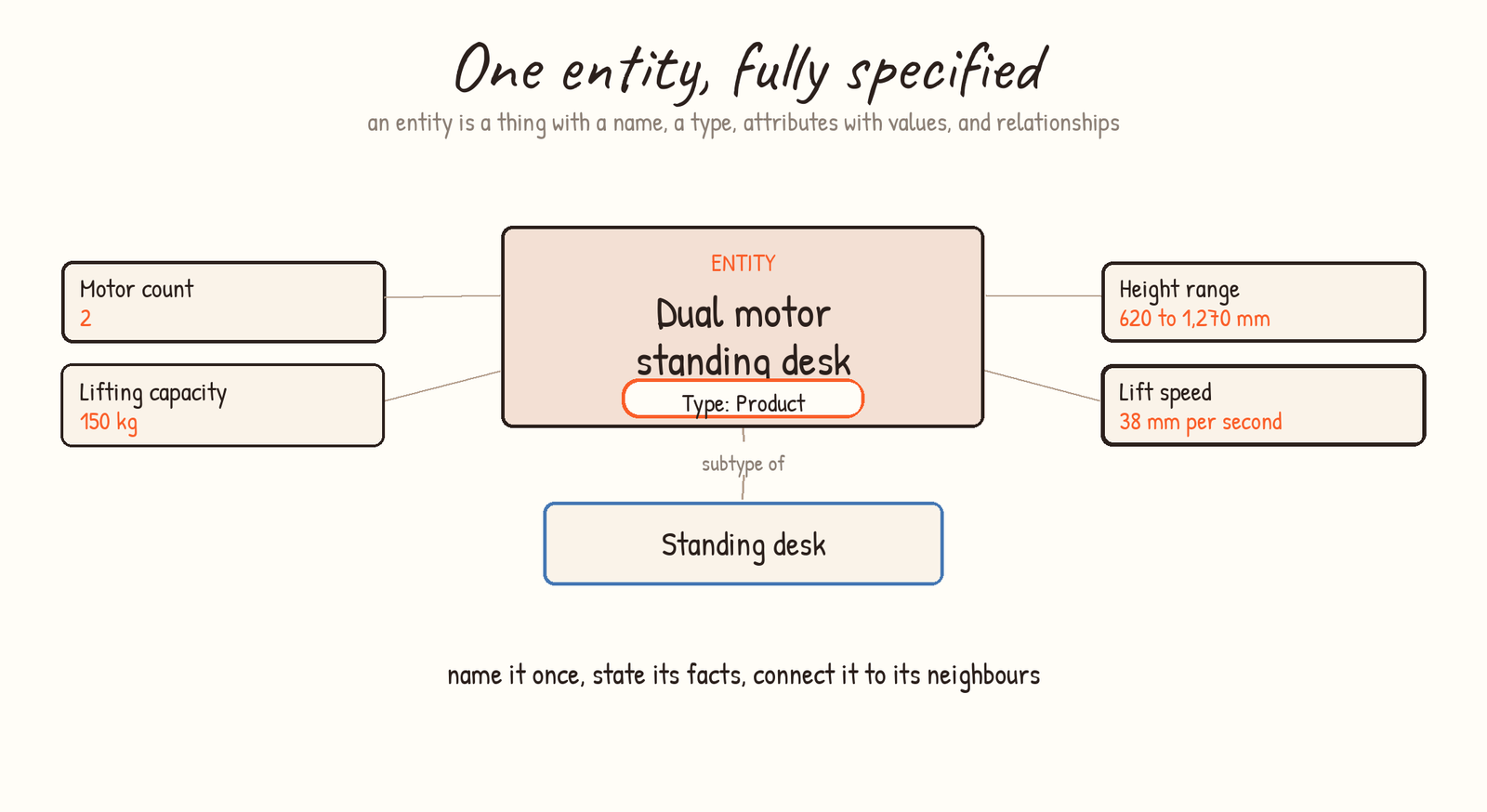
Entity SEO is the practice of making search engines understand the things your pages are about, the people, organizations, products, places and concepts, as distinct, identifiable entities with attributes and relationships, instead of as strings of words to match. Google announced the shift in May 2012 when it launched the Knowledge Graph under the line “things, not strings”, and every system built since, including the AI answer engines, retrieves and reasons over entities.
This guide explains what an entity is, how search engines extract entities from a page and score them, the Entity-Attribute-Value model that structures the facts, and the concrete work of optimizing pages and brands at entity level. Entity SEO is the entity layer of semantic SEO. It is where the wider system touches the page.
What is entity SEO?
Entity SEO is optimization aimed at how search engines identify, classify and connect entities. A keyword-based page tells a search engine which string it wants to rank for. An entity-based page tells the search engine which thing it is about, what that thing’s attributes are, what values those attributes hold, and which other things it relates to. The engine can then match the page to any query about that thing, in any wording, instead of only to queries containing the page’s target string.
The difference shows in durability. Keyword rankings describe a relationship between a page and a string, and they reset whenever the algorithm reweighs strings. Entity relationships describe what things are, and they persist inside the engine’s knowledge infrastructure across updates, languages and spellings. A page whose central entity is extracted correctly keeps its meaning when it is translated, summarized or quoted by an AI system. A page built on a string keeps nothing but the string.
What is an entity in search?
An entity in search is, in Google’s own definition, “a thing or concept that is singular, unique, well-defined, and distinguishable.” A company, a person, a city, a product, a book, a medical condition and an abstract concept such as topical authority can all be entities, provided each can be told apart from everything else.
Every entity carries 4 properties.
- A name, which may have variants and translations.
- A type, Organization, Person, Place, Product, Event and narrower types beneath them.
- A set of attributes, The properties that describe it, such as a company’s founding date, headquarters and founder.
- Relationships to other entities, The company employs the person. The product is made by the company. The city contains the place.
Inside the Knowledge Graph, a recognized entity also holds a machine identifier that persists across languages and spellings, which is what makes the entity one thing rather than a pile of mentions that happen to share a name.
That identifier is the dividing line in entity SEO. The word “apple” is a string shared by a fruit, a technology company and a record label. Each is a separate entity with its own identifier, its own attributes and its own relationships. Search engines spend much of their processing deciding which entity a page means. Entity SEO is the work of leaving them nothing to guess.
How do search engines identify entities on a page?
Search engines identify entities on a page in 4 steps, using natural language processing.
- Extraction: Named entity recognition scans the text and marks the spans that name things.
- Classification: Each extracted entity is assigned a type, with a confidence level.
- Salience scoring: Each entity is scored for how central it is to the document.
- Disambiguation: The engine matches the extracted entity against its knowledge base entries and attaches the identifier of the entry it believes the page means.
Salience is the step SEOs most often misunderstand. In Google’s Natural Language API, which exposes this machinery publicly, salience is a score between 0 and 1 expressing how central an entity is to the whole text. A score near 1 means the document revolves around that entity. A score near 0 means the entity appears in passing. Salience is not keyword frequency. Repeating a name 50 times in a page about something else does not make it central, and modern extraction reads the name’s role in the facts stated around it. A well-built page has one entity with clearly dominant salience, its central entity, supported by the related entities its attributes bring in. A page whose salience is spread evenly across 6 competing entities reads as a page about nothing in particular, and it ranks and gets cited accordingly. How engines process meaning beyond extraction is covered in our semantic search guide.
Disambiguation is where pages fail silently. If your brand shares a name with a better-known entity, or your product name is also a common noun, the engine may attach the wrong identifier to your mentions, or decline to attach one at all. Every practice in the rest of this guide exists to raise extraction confidence. State the entity’s type plainly. State its attributes with values. Keep its facts identical everywhere they appear.
What is the Entity-Attribute-Value model?
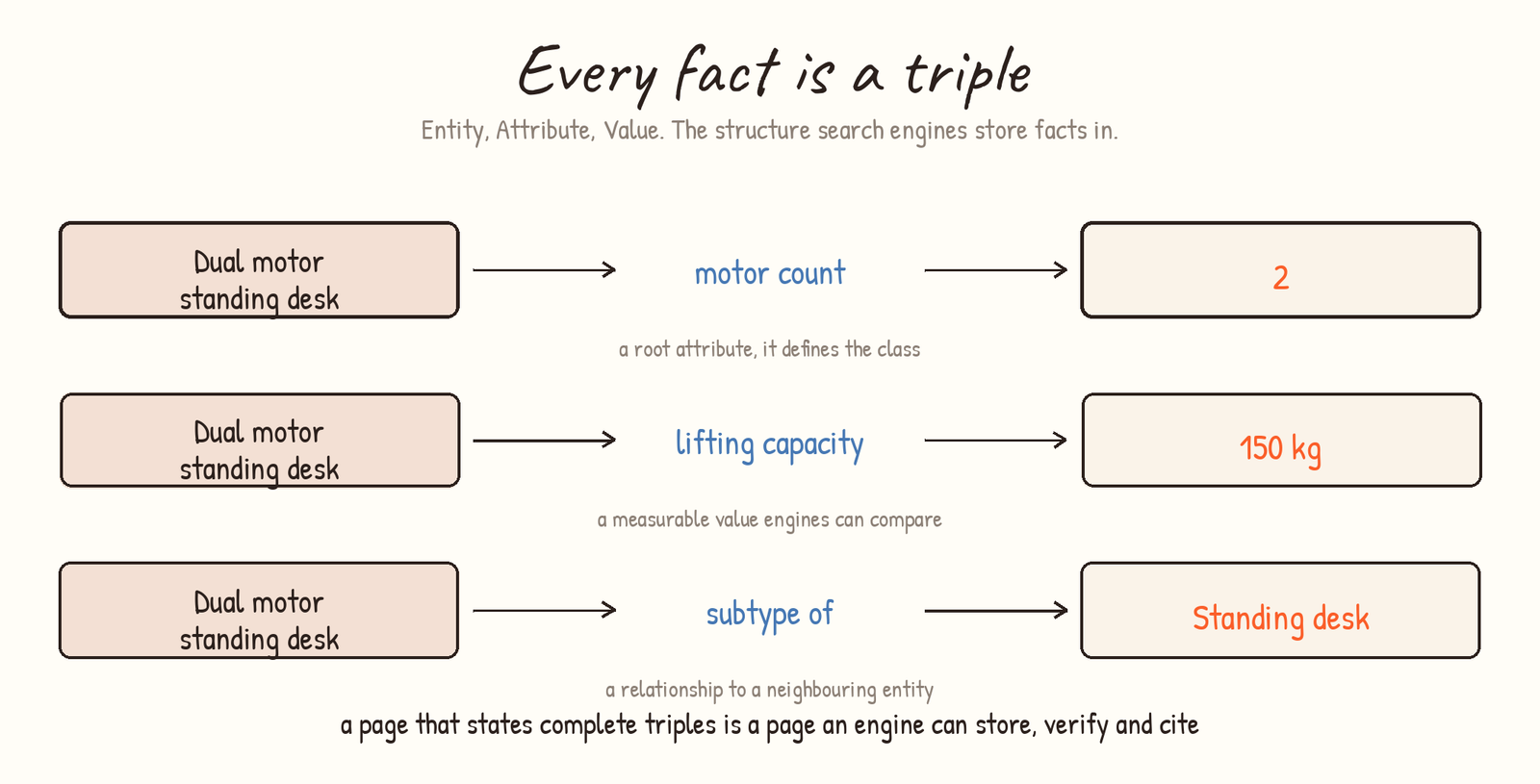
The Entity-Attribute-Value model, shortened to EAV, is the data structure search engines use to store facts. Every fact is a triple of 1 entity, 1 attribute and 1 value. “Apple Inc., founded, 1976” is a triple. So is “standing desk, motor count, 2” and “Hanzala Khan, founder of, Just Semantic SEO”. The Knowledge Graph is, at bottom, an enormous set of such triples sharing entities. Subject-predicate-object triples in language and EAV triples in data are the same structure seen from 2 sides.
For content work, the model matters because it tells you exactly what a page must state. An entity mentioned without attributes gives the engine a node with nothing attached. An attribute named without a value gives it a property it cannot verify. A complete triple gives it a fact it can store, compare against other sources, and quote. Pages that state facts as complete triples are easier to extract, easier to verify, and easier to cite than pages that circle their facts in descriptive prose.
Koray Tuğberk Gübür’s framework divides attributes into 3 classes, and the classes are a coverage strategy. Root attributes define what the entity is. They are the properties every source states, without which the entity is misclassified. Unique attributes belong to this entity alone. They are the properties no competitor can state about their own entity, and the raw material of information gain. Rare attributes are real properties of the entity that few sources bother to cover. They are the cheapest coverage gaps in most markets, because the facts exist and simply go unstated. A page or a site that covers root attributes completely, states its unique attributes explicitly, and collects the rare attributes its competitors skipped presents an entity record the engine can build with confidence.
Entity SEO examples, with one entity fully specified
Abstract models are easier to judge against a worked example. Take one entity from the topical map example published on this site, a dual motor standing desk, and state it the way an extraction system wants to read it.
| Entity | Attribute | Value |
|---|---|---|
| Dual motor standing desk | Motor count | 2 |
| Dual motor standing desk | Lifting capacity | 150 kg |
| Dual motor standing desk | Height range | 620 to 1,270 mm |
| Dual motor standing desk | Lift speed | 38 mm per second |
| Dual motor standing desk | Frame stages | 3 |
| Dual motor standing desk | Controller | Handset with 4 memory presets |
6 triples give the engine the entity’s type, its class-defining root attributes (motor count, the attribute that separates it from the single motor entity), measurable values it can compare against rival pages, and hooks for relationships. This entity is a subtype of standing desk, contrasts with single motor standing desk, and suits the heavy monitor setup entity. The same page written as marketing prose (“powerful, smooth, built for serious work”) gives the engine the name and nothing else. That difference, repeated across every entity a site covers, is most of what entity SEO is.
What is the Knowledge Graph, and why does it matter for entity SEO?
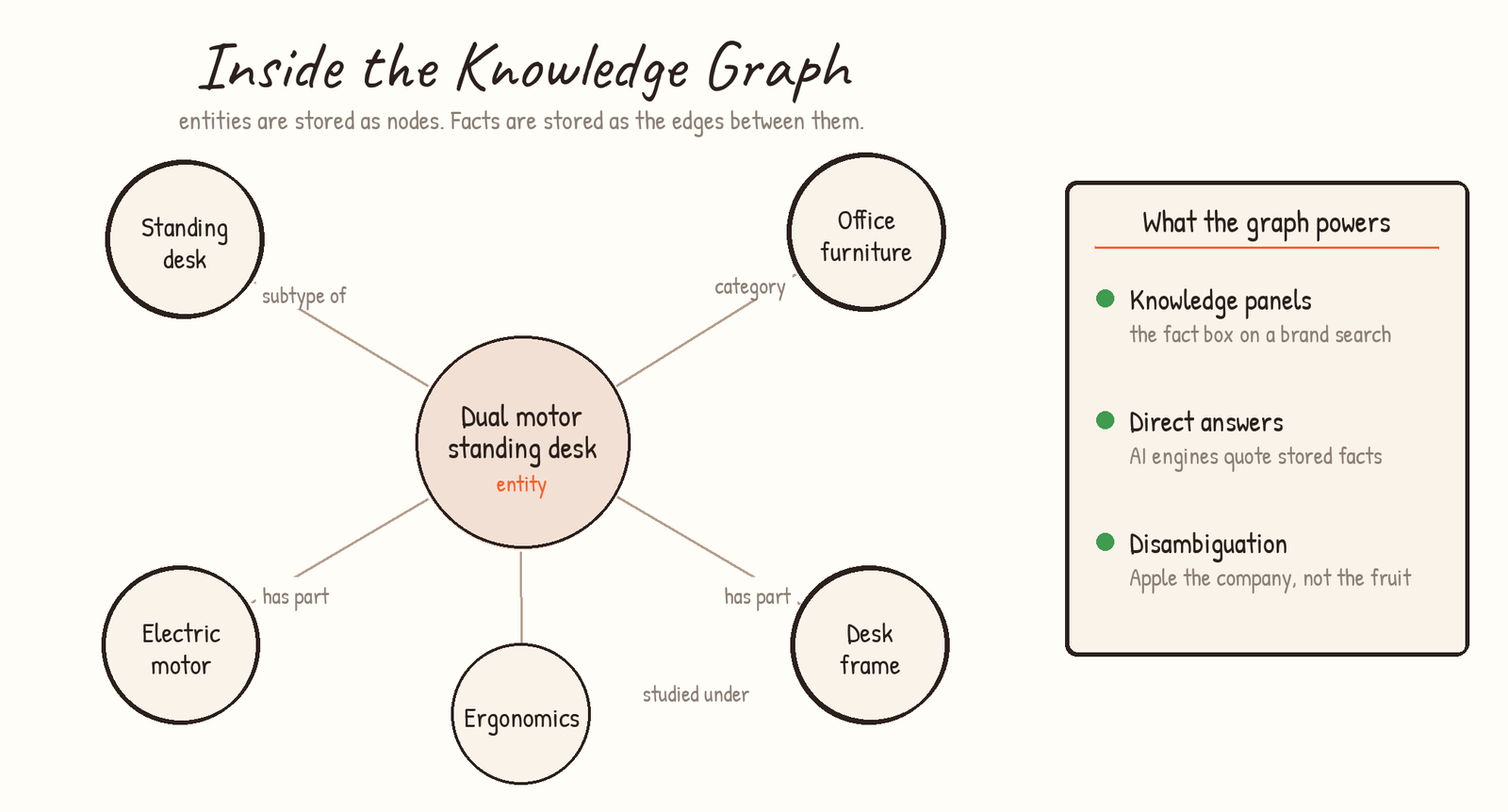
The Knowledge Graph is Google’s database of entities and the relationships between them, launched in 2012 and still the reference structure behind knowledge panels, entity-based query interpretation and much of AI answer assembly. Each recognized entity holds a record. Its identifier, its type, its attributes gathered as triples, and its edges to other entities. Google assembles those records from structured data on websites, from public knowledge bases such as Wikidata, from licensed data, and from the way the entity is described consistently across the web.
Two facts about the Knowledge Graph set the limits of entity SEO. First, you cannot edit it directly. There is no submission form that creates or corrects a record on demand; records change when the sources Google trusts change, and stay changed when those sources agree. Second, agreement is the mechanism. An attribute stated on your site, repeated in your profiles, and corroborated by independent sources becomes part of the record. An attribute stated once, contradicted elsewhere, or tangled up with a same-named entity does not. Entity SEO is therefore partly an on-page discipline and partly a consistency discipline. The same facts, stated the same way, in every place the entity is described.
The visible outputs tell you the work is landing. A knowledge panel on your brand’s query means the entity has a record solid enough to present. A correct answer from the Knowledge Graph Search API, Google’s public lookup into the graph, shows the identifier and type attached to your name. An AI assistant answering factual questions about your brand correctly shows the record is being read by the systems downstream of it.
How do you optimize a page for entities?
You optimize a page for entities by deciding, before writing, which entity the page is about and which facts it will state about that entity, then writing so extraction cannot miss them. The practices are specific.
- One central entity per page. The page’s subject is a single entity, and it holds dominant salience. Supporting entities enter through its attributes and relationships, never as rival subjects.
- State the type early. The opening lines say what the thing is, its type and its class. Extraction confidence starts there.
- State attributes with values. Every important attribute gets a value, a number, a date, a name, a place. Adjectives are not values. This is fixed at the brief stage in our workflow, and our content brief guide shows the attribute table a brief carries for exactly this reason.
- Use one name form. The entity is named the same way throughout the page and across the site. Variant spellings and playful synonyms force the engine to spend confidence on identity instead of facts.
- Connect the entity to its neighbours. Relationships are stated in sentences and in links. The page links to the pages of the entities it relates to, with anchors that name the relationship’s target, so the site’s internal graph mirrors the knowledge graph’s shape.
- Add identity markup. Structured data with an @id gives your own entities a persistent identifier inside your markup, and sameAs properties point from your entity to its corroborated profiles and knowledge base entries. Markup signals identity, it does not manufacture recognition, and it works when the facts in the text and the facts across the web already agree.
Not sure which entity your key pages are actually about?
The free site audit reads your pages the way an extraction system does. It shows where the central entity is ambiguous, split across pages, or missing entirely.
How do you establish your brand as an entity?
You establish your brand as an entity by making its facts impossible to misunderstand and identical everywhere. The brand record an engine builds is only as clean as the messiest source it reads, so the work is an audit of everywhere the brand is described. Its own site, its profiles, its listings, its press mentions. The name is written one way. The founding facts, the location, the founder, the services and the contact facts match character for character. The Organization markup on the site carries an @id and sameAs links to the profiles, and the profiles link back, so the corroboration forms a closed loop the engine can follow.
Independent sources do the part you cannot do yourself. A brand described only by its own site is a claim. The same facts repeated by sources with no reason to copy you, a directory, a podcast page, a partner’s site, a knowledge base entry where the brand qualifies for one, become corroboration, and corroboration is what turns a claim into a record. This is also where entity SEO meets topical authority. A brand whose site completely covers its topic gives the engine both the identity record and the evidence that the identity matters in that topic.
Check the result with the 3 public tests.
- Query the Knowledge Graph Search API for the brand name and read the identifier and type it returns.
- Search the brand name and look for a knowledge panel or a consistent entity treatment.
- Ask the major AI assistants factual questions about the brand, its founder, its services and its location, and note where the answers are wrong, vague or about a different entity with the same name.
Each wrong answer points at a source the engines are reading that you have not corrected yet.
What tools help with entity SEO?
3 public tools cover most entity SEO checks, and none of them is a ranking tool.
- The Knowledge Graph Search API is the ground truth lookup. It returns the entities Google holds under a name, with identifiers, types and descriptions, so you can see whether your brand exists in the graph and what it is confused with.
- Google’s Natural Language API and its public demo run the extraction pipeline on any text you paste. The entities found, their types and their salience scores make it the fastest way to check whether a draft page gives its central entity dominant salience before you publish.
- Wikidata is the public knowledge base underneath much of the graph. Searching it shows the identifier, attributes and relationships recorded for the entities in your market, including the competitors and concepts your pages relate to.
Most SEO platforms now include some form of entity analysis, checking which entities a page mentions against the entities ranking pages cover. Used as a gap list at the brief stage, that is legitimate. Used as a score to chase, it repeats the keyword era’s mistake with better vocabulary. The goal is a complete and correct entity record, not a higher number in a tool.
How is entity SEO different from keyword SEO?
Entity SEO and keyword SEO differ in the unit they optimize, the thing they ask the engine to do, and what survives an algorithm update.
| Dimension | Keyword SEO | Entity SEO |
|---|---|---|
| Unit of optimization | A string and a target page | An entity and its record |
| What the page states | The string, at a workable density | Attributes with values, as complete triples |
| How the engine responds | Matches the string to queries containing it | Matches the entity to any query about the thing |
| Ambiguity handling | The string is the strategy | Disambiguation is the strategy. One entity, unmistakable |
| What an update can break | String weights and ranking factors | Very little. Facts about things stay facts |
| Success measure | Positions for chosen strings | Extraction confidence, graph presence, citations by name |
Keyword SEO and entity SEO are not enemies. Searchers still type strings, and pages still need to be findable by them. Entity SEO is the layer underneath. It decides what the page means, and meaning is what the engine now matches first and the string second.
Why does entity SEO matter for AI search?
Entity SEO matters for AI search because answer engines assemble their answers from entity records. When an engine fans a question out into sub-queries and retrieves passages, it resolves the entities in the question first, then looks for sources with facts about those entities. A brand the engine cannot resolve, or resolves to a different entity with the same name, is not rejected; it is simply never considered. The citation goes to the source whose entity record is clean and whose pages state the needed attribute with its value.
This raises the value of the unglamorous work in this guide. Consistent naming, corroborated facts, complete triples and closed sameAs loops are what let an engine say your brand’s name in an answer with confidence. Our answer engine optimization playbook covers the page-level craft of being cited; entity SEO is the identity layer that decides whether your brand is eligible to be cited at all.
Frequently asked questions
Is entity SEO the same as semantic SEO?
No, Entity SEO is one layer of semantic SEO, the layer concerned with entities, their attributes and their identity. Semantic SEO is the full system. It also includes the topical map that decides which entities and pages exist, the semantic content network that connects them, and the historical data the network accumulates. A site can do entity SEO on isolated pages and still lack the coverage that makes those entities matter.
What is entity salience?
Entity salience is a score between 0 and 1 that expresses how central an entity is to a document, exposed publicly by Google’s Natural Language API. An entity near 1 is what the document is about. An entity near 0 is mentioned in passing. Salience is computed from the entity’s role in the text, not from how often its name repeats, which is why one clear central entity per page is an entity SEO rule rather than a style preference.
Does schema markup create an entity?
No, Schema markup signals identity. It tells engines which entity a page is about and, through @id and sameAs, which records and profiles that entity corresponds to. Recognition itself comes from corroborated facts across sources the engine trusts. Markup on a page whose facts are vague, inconsistent with the brand’s other sources, or about an ambiguous name does not produce a Knowledge Graph record.
Can a small business be an entity in the Knowledge Graph?
Yes, Entity records are not reserved for famous brands. Local organizations, individual professionals and small products hold records when their facts are consistent and corroborated. The recognition bar is lower than the knowledge panel bar. A small business may hold a clean entity record, powering correct answers in assistants and accurate local results, long before any panel appears on its brand query.
How do I check whether my brand is in the Knowledge Graph?
Use the 3 public checks. Query your brand name in the Knowledge Graph Search API and see whether a result returns with your type and description. Search your brand name in Google and look for a knowledge panel or entity treatment of the results. Ask the major AI assistants factual questions about the brand and compare their answers against your real facts. A miss on all 3 means the corroboration work, consistent facts in independent sources, has not been done yet.
What is an entity ID?
An entity ID is the persistent identifier a system assigns to one entity so that every mention of it resolves to the same record. Google’s Knowledge Graph uses machine identifiers, Wikidata uses Q-numbers, and your own structured data uses the @id you declare for your entities. The 3 are different namespaces for the same idea, an identity that survives spelling changes, translations and redesigns, because it points at the thing rather than at any of its names.
Entities are how search engines store the world, and your pages either feed that storage clean facts or leave it guessing. If you want your brand’s entity record audited, which entities your market runs on, which of your pages state complete triples and which leave their central entity ambiguous, that audit is the first deliverable in our semantic SEO work, and it starts from your site’s current coverage. Our entity SEO service runs that audit as a standalone engagement, from the record resolution to the monitoring cycle.

Written by Hanzala Khan
Hanzala Khan has over 5 years of specialized experience in entity-based search optimization, Knowledge Graph engineering, and topical authority architectures. He specializes in designing custom semantic topical maps, advanced Schema.org data layers, and algorithmic authorship frameworks that help enterprise brands achieve durable search dominance and AI citation authority across Google, Perplexity, and ChatGPT.
One Response