Semantic SEO: Modern Approach For LLMs and SEOs
Semantic SEO is the process of optimizing web content and domain architecture around real-world entities, contextual attributes, and topical relationships rather than isolated keyword strings. By structuring information into unambiguous Subject-Predicate-Object knowledge triples, engineering exhaustive topical maps, and deploying nested Schema.org markup, semantic SEO allows search engines (Google Hummingbird, RankBrain, BERT, MUM) and AI Large Language Models (ChatGPT Search, Perplexity, Google Gemini) to understand the true conceptual meaning of a website, satisfying user search intent and earning definitive topical authority.
What is Semantic SEO?
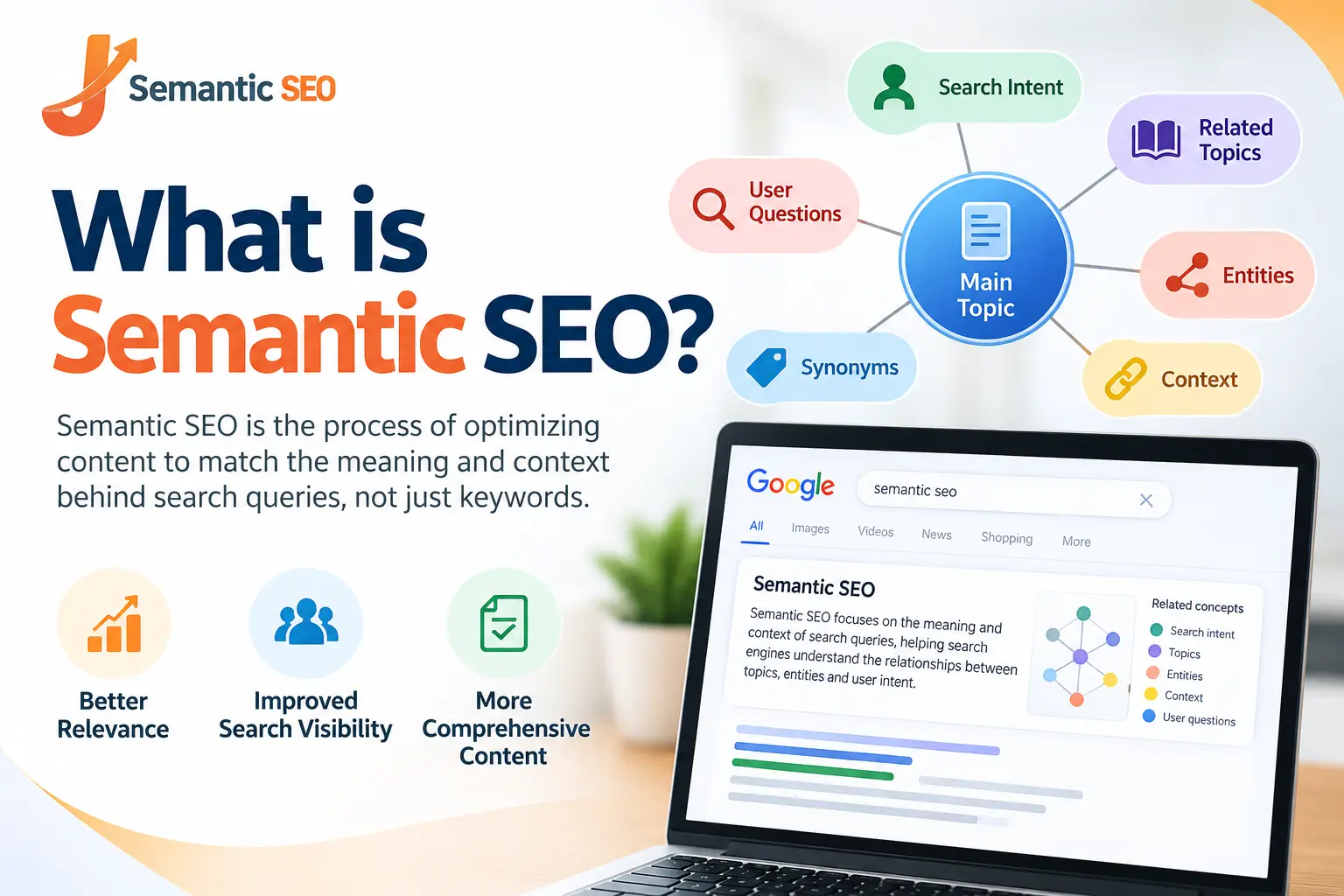
Semantic SEO is an advanced search engine optimization methodology that organizes website content around conceptual entities, factual relationships, and comprehensive topical coverage rather than repetitive keyword strings. The term semantic originates from the ancient Greek word sēmantikos (meaning “significant” or “pertaining to meaning”) and linguistic theory, which examines the fundamental relationship between linguistic signs and what they denote in reality.
The computational foundation of semantic SEO stems from Sir Tim Berners-Lee’s 2001 vision of the Semantic Web—a universal medium wherein data is given well-defined meaning, enabling machines and human agents to work in cooperation. In the context of search engines, semantics represents the definitive transition from “strings to things”: search algorithms no longer evaluate text merely as sequences of characters, but as nodes within vast ontological knowledge graphs.
The essential attributes that define semantic SEO include:
- Entity Disambiguation: Distinguishing between polysemous words (e.g., separating Apple the multinational corporation from Apple the pomaceous fruit) via surrounding contextual signals.
- Predicate Relationships: Connecting entities using explicit directional predicates (e.g.,
[JustSemanticSEO] — (provides) —> [Topical Mapping]). - Vector Proximity: Ensuring high semantic similarity in high-dimensional embedding spaces (Word2Vec, GloVe, Transformer embeddings).
- Information Gain: Delivering original, verifiable factual data points that go beyond generic search consensus.
How search engines evaluate co-occurring entity attributes to determine explicit user intent:
| Target Entity | Surrounding Co-Occurring Attributes | Extracted Knowledge Triple | Algorithmic Resolution |
|---|---|---|---|
| Mercury (Planet) | Orbit, perihelion, solar system, terrestrial, crater | [Mercury] — (isA) —> [Terrestrial Planet] |
Classified under Astronomy & Planetary Physics ontology |
| Mercury (Element) | Atomic number 80, Hg, liquid metal, toxic, thermometer | [Mercury] — (hasSymbol) —> [Hg] |
Classified under Chemistry & Periodic Table ontology |
| Mercury (Mythology) | Roman god, messenger, Hermes, caduceus, winged sandals | [Mercury] — (equivalentTo) —> [Hermes] |
Classified under Classical Roman Mythology ontology |
How is Semantic SEO different from traditional SEO?
Semantic SEO differs from traditional SEO by optimizing for topical authority, contextual meaning, and entity networks, whereas traditional SEO relies on keyword search volume, exact-match keyword density, and isolated URL targeting. In the pre-semantic era, webmasters created separate, near-identical thin pages for minor syntactic variations (such as “best running shoes,” “top running sneakers,” and “shoes for running”).
In today’s modern search ecosystem—dominated by large language models and neural ranking systems—search engines consolidate all lexical variations into a unified semantic intent class. A single comprehensive asset that systematically covers entity attributes (e.g., shoe drop, midsole cushioning, pronation control, and outsole rubber compounds) naturally captures hundreds of related queries simultaneously.
| Optimization Dimension | Traditional Keyword SEO | Modern Semantic SEO (AI & LLM Era) |
|---|---|---|
| Core Target Unit | Character strings, keywords, search volume | Real-world entities, attributes, and knowledge triples |
| Content Architecture | Isolated blog posts targeting specific single keywords | Interconnected semantic topical maps covering whole domains |
| Search Engine Engines | Inverted index string matching (PageRank, BM25) | Knowledge Graph, RankBrain, BERT, MUM, Vector Retrieval |
| Optimization Metric | Keyword density, exact match in H1/Title | Attribute coverage, semantic closeness, factual clarity |
| Internal Linking | Exact-match anchor text focused solely on link juice | Contextual entity relationships and query path navigation |
| AI & LLM Citations | Low (lacks structured facts and disambiguation) | High (provides machine-verifiable answer passages for RAG) |
| Algorithm Resistance | Fragile (vulnerable to Core & Helpful Content updates) | Durable (algorithm updates reward systemic topical authority) |
The shift toward semantic indexing was propelled by milestone updates to Google’s algorithmic core:
- Google Knowledge Graph (2012): Introduced the paradigm “Things, not strings,” connecting billions of real-world entities into an interconnected knowledge base.
- Google Hummingbird (2013): Completely rebuilt Google’s core parsing engine to process conversational intent and semantic syntax rather than disparate words.
- RankBrain (2015): Google’s first deep-learning AI system, translating queries into multi-dimensional vectors to understand ambiguous and never-before-seen searches.
- BERT (2019): Bidirectional transformers deciphering subtle nuances of prepositions (e.g., “to”, “for”, “from”) in conversational human language.
- MUM (2021): Multitask Unified Model, 1,000 times more powerful than BERT, executing multimodal and cross-lingual concept synthesis.
What Are the Best Practices for Semantic SEO?
The best practices for semantic SEO require establishing comprehensive topical authority, anchoring every page to verified Knowledge Graph entities, structuring content in direct answer formats, and deploying nested structured data. Executing these practices ensures your content communicates with mathematical precision to both lexical crawlers and vector-based AI retrieval models.
- Engineer Complete Topical Maps Prior to Authoring: Never publish disconnected articles. Map out every parent entity, child entity, and peripheral concept required to exhaust your topical domain.
- Apply the “First Answer, Then Expand” Principle: Answer the core question directly in the very first sentence beneath any heading using concise, factual subject-predicate-object phrasing.
-
Implement Multi-Layered Schema Markup: Connect your on-page content directly to global entity databases (Wikidata, Wikipedia) using
aboutandmentionsschema properties. - Build Non-Reciprocal Semantic Link Paths: Guide search engines through logical query progression by linking from broad high-level concepts to granular attributes.
- Optimize for Generative Engine Retrieval (GEO): Structure facts, comparative parameters, and data tables to maximize citation probabilities in Google AI Overviews, Perplexity, and ChatGPT Search.
What is a Semantic SEO Entity Map?
A Semantic SEO Entity Map is an explicit knowledge graph diagram that visualizes all recognized entities, their class hierarchies, and their directional relationships within a specific niche. Unlike traditional keyword lists that categorize terms by search volume or cost-per-click, an entity map catalogs the conceptual universe that search engines associate with your primary subject.
In an entity map, nodes represent distinct entities (e.g., Search Engine, Topical Authority, Vector Embeddings), while directed edges represent semantic predicates (e.g., measures, computes, establishes). Building an entity map enables content architects to eliminate topical gaps, resolve ambiguities, and ensure that every page on a website contributes to a unified domain ontology.
Exhaustive coverage of source context, central entity, and search intent nodes.
JSON-LD triples embedding explicit about & mentions Wikidata URIs.
Transformer models computing cosine similarity across semantic dimensions.
RAG pipelines citing verified factual triples in Perplexity & ChatGPT Search.
What is a Semantic Topical Map?
A Semantic Topical Map is a comprehensive architectural taxonomy that outlines every entity, core topic, subtopic, and contextual query required to demonstrate total topical authority on a defined subject. Pioneered in advanced holistic SEO by Koray Tuğberk GÜBÜR, the Semantic Topical Map framework operates as a structured semantic blueprint that guides entire website content production.
According to Koray Tuğberk GÜBÜR’s Holistic SEO framework, a topical map is built upon three foundational pillars:
- Source Context: The fundamental operational perspective and business identity of the website. The source context dictates how information is framed (e.g., an enterprise software vendor explains CRM from an architectural perspective, whereas a sales trainer explains CRM from a workflow perspective).
- Central Entity: The single primary concept or subject around which the entire website builds its expertise (e.g., Semantic SEO).
- Central Search Intent: The primary commercial or informational objective that aligns the central entity with the specific needs of the target audience.
By publishing content that methodically satisfies every node in the topical map, a website reduces the algorithmic “Cost of Retrieval” for search engines. Search engines recognize that the site provides exhaustive, factual answers without forcing users to bounce back to the search results, thereby awarding the site high topical authority scores across the entire query cluster.
How Koray Tuğberk GÜBÜR’s Holistic SEO model organizes topical mastery:
Pillar articles covering the macro entity with full ontology definition and direct schema anchor.
Supporting cluster articles addressing explicit specifications, variations, workflows, and algorithmic methods.
Edge-case queries, comparison articles, integration guides, and semantic boundary limiters.
What is a core and outer section of the topical map?
The core section of a topical map comprises the essential, non-negotiable concepts that define the central entity, while the outer section covers peripheral, comparative, and contextual boundary topics that support and validate that core.
- The Core Section: Directly addresses the central search intent. For a site focused on Semantic SEO, the core section includes foundational pillars such as Topical Mapping, Schema Markup Layering, Entity-Attribute-Value Modeling, and Vector Search Engines. Search engines require complete mastery of these topics before trusting a site’s authority.
- The Outer Section: Encompasses adjacent topics that demonstrate broader industry integration. This includes comparisons (e.g., Semantic SEO vs Programmatic SEO), complementary tools (e.g., Diffbot, Wikidata API), and adjacent marketing disciplines (e.g., Digital PR for Entity Recognition). The outer section prevents topical narrowness and confirms deep topical competence.
What is Taxonomy and Ontology in a Semantic SEO?
In Semantic SEO, an ontology defines the conceptual nature, types, and properties of entities and how they relate across an entire domain, whereas a taxonomy is the hierarchical classification and category tree used to organize those entities into structured parent-child directories.
| Characteristic | Taxonomy (Classification) | Ontology (Knowledge Modeling) |
|---|---|---|
| Primary Function | Hierarchical categorization (Parent > Child) | Complex relational network (Entity > Predicate > Entity) |
| Structural Model | Tree-like structure (Categories, Subcategories, URLs) | Multi-dimensional Knowledge Graph |
| Relationship Types | Strictly “is-a” or “part-of” relationships | Diverse semantic predicates (causes, manufactures, operatesWith) |
| SEO Implementation | URL paths, breadcrumb navigation, category hubs | Schema.org JSON-LD graphs, Wikidata ID linking, topical maps |
What is Semantic content Brief?
A Semantic Content Brief is an algorithmic architectural specification that instructs a content writer exactly which entities, contextual vectors, heading hierarchies, factual triples, and internal link anchors must be included to satisfy a specific search intent. Unlike outdated editorial briefs that merely suggest target word counts and lists of keywords to repeat, a semantic brief engineers the document’s information geometry.
In accordance with Koray Tuğberk GÜBÜR’s algorithmic authorship standards, a semantic brief includes:
- Contextual Headings & Vector Alignment: Formulating headings that directly answer specific sub-queries with zero lexical ambiguity.
- Entity Requirements: Listing mandatory primary entities, attribute values, and associated co-occurring concepts.
- Hierarchy & Methodology: Dictating the exact logical flow from high-level definitions to granular technical mechanics.
- Contextual Connections: Prescribing precise internal link paths and anchor texts to sustain the website’s non-reciprocal link graph.
- Macro and Micro Sections: Structuring the page into thematic overarching layers (macro) and paragraph-level knowledge triples (micro).
Need professional assistance building production-ready briefs? Learn more about our semantic content brief creation services.
How holistic domain strategy systematically cascades into sentence-level entity triples:
- Intent Classification: Defines explicit search intent (Informational vs. Commercial) and user journey phase.
- Topical Map Positioning: Assigns pillar hub vs. supporting attribute node status within the topic cluster.
- Central Entity ID: Anchors primary Wikidata URI and canonical disambiguation vectors.
- Global Schema Specification: Dictates root JSON-LD graph (TechArticle, HowTo, Service, FAQPage).
- Internal Linking Graph: Specifies incoming and outgoing non-reciprocal link pathways.
- Heading Formulation: Shapes H2/H3 tags directly into focused search queries and sub-vectors.
- First-Sentence Direct Answer: Mandates bold, factual, entity-first answers to immediately satisfy NLP retrieval.
- Entity-Attribute Triples: Enforces required subject-predicate-object combinations per section.
- Anchor Text Directives: Prescribes exact descriptive anchor texts for internal topical navigation.
- Information Gain Elements: Dictates custom data tables, formulas, and visual comparative callouts.
What is Macro and Micro section in Semantic content brief?
In a semantic content brief, the macro section defines document-wide thematic attributes (intent class, canonical focus, global schema), while the micro section dictates paragraph-level engineering (heading vectors, direct answer phrasing, and specific knowledge triples).
- Macro Section Scope: Governs how the page functions within the broader topical map. It specifies whether the page acts as a pillar hub or an attribute leaf node, assigns the page to a specific user journey stage, and defines the primary entity ID (e.g., Wikidata reference).
- Micro Section Scope: Drills down to the specific HTML blocks. For every H2 and H3, it specifies the exact subject-predicate-object statement required in the first paragraph, the supporting attributes that must be contextualized, and the exact anchor text pointing to child or parent resources.
How to make a content brief?
To create a semantic content brief, follow a 5-step engineering process: determine the central intent, extract recognized entities from the Knowledge Graph, structure the heading vector hierarchy, draft direct answer formulas, and assign non-reciprocal internal links.
- Define the Target Entity & Core Search Intent: Identify the primary entity using Wikidata or Google’s Knowledge Graph Search API, establishing unambiguous disambiguation.
- Extract Co-Occurring Entity Attributes: Analyze top semantic competitors and academic knowledge graphs to extract the mandatory attributes and predicates expected by NLP parsers.
- Formulate Vector-Driven Headings: Convert user query paths into descriptive H2s and H3s that reflect genuine linguistic inquiries rather than fragmented keyword insertions.
- Draft First-Sentence Answer Formulas: Write out the exact, concise definition required immediately below each heading to guarantee snippet eligibility.
- Embed Internal Link Anchors & Schema Requirements: Map out exactly which contextual links will flow in and out of the document, along with JSON-LD
aboutandmentionsparameters.
What is the difference between traditional Briefs and Semantic Briefs?
Traditional briefs emphasize superficial metrics such as word count and keyword frequency targets, whereas semantic briefs prioritize entity completeness, factual information gain, and algorithmic readability.
| Brief Parameter | Traditional SEO Brief | Semantic Content Brief |
|---|---|---|
| Primary Guideline | “Write 2,500 words and repeat keyword X 8-12 times” | “Cover entities A, B, and C with predicates X and Y” |
| Heading Instructions | Include primary keyword in H2 where possible | Formulate heading vectors that resolve specific intent classes |
| Answer Delivery | Long introductory fluff before getting to the point | Strict Algorithmic Authorship: First answer, then expand |
| Data Formatting | Unstructured text blocks and paragraphs | Structured HTML tables, definition lists, and factual triples |
| Internal Links | Generic suggestion: “Include 3 internal links” | Prescribed contextual anchors connecting specific entity nodes |
What is Semantic Search?
Semantic search is a data searching technique where a search engine interprets the underlying meaning, contextual intent, and conceptual relationships of a user query rather than relying exclusively on literal keyword matching. By utilizing natural language processing (NLP), vector embeddings, and multi-dimensional knowledge bases, semantic search delivers results that satisfy the user’s true informational objective—even when the query contains spelling errors, vague phrasing, or zero keywords found in the source document.
Is Google a semantic search?
Yes, Google is fundamentally a semantic search engine that utilizes deep-learning models, Knowledge Graph entity repositories, and vector retrieval systems to understand the meaning of queries and documents. Google officially transitioned to a semantic search engine in 2013 with the release of the Hummingbird algorithm, which replaced its legacy lexical engine with a semantic processing core. Today, Google evaluates searches through multi-layered AI architectures including RankBrain, BERT, MUM, and Gemini.
What is semantic search vs lexical search?
Lexical search searches for literal character-for-character matches between query tokens and an inverted document index (such as BM25), whereas semantic search evaluates the mathematical distance between conceptual vector embeddings to identify topical meaning.
For example, if a user queries “inexpensive lodging near Eiffel Tower,” a lexical search engine searches documents for the exact words “inexpensive,” “lodging,” and “Eiffel Tower.” If a hotel website uses the words “affordable boutique hotel in central Paris with views of the Champ de Mars,” lexical search fails to match it. In contrast, semantic search recognizes that “inexpensive” is semantically close to “affordable,” “lodging” is equivalent to “boutique hotel,” and the “Champ de Mars” is the exact geographic location of the Eiffel Tower entity.
Can NLP be used to perform semantic search?
Yes, Natural Language Processing (NLP) is the primary computational mechanism used to perform semantic search by tokenizing text, identifying named entities, resolving grammatical dependencies, and converting unstructured sentences into dense mathematical vector embeddings.
NLP algorithms break down complex sentences into semantic components through techniques such as:
- Part-of-Speech (POS) Tagging: Identifying nouns, verbs, and adjectives to map sentence grammar.
- Lemmatization: Reducing words to their base conceptual dictionary forms (e.g., “running,” “ran,” and “runs” resolve to run).
- Transformer Attention: Assessing how words in a sentence modify each other’s meaning bidirectionally (as executed in BERT).
- Dense Passage Retrieval: Mapping documents and queries into shared vector spaces where similarity is calculated via cosine distance.
What is Entity, attribute and Value in semantic SEO?
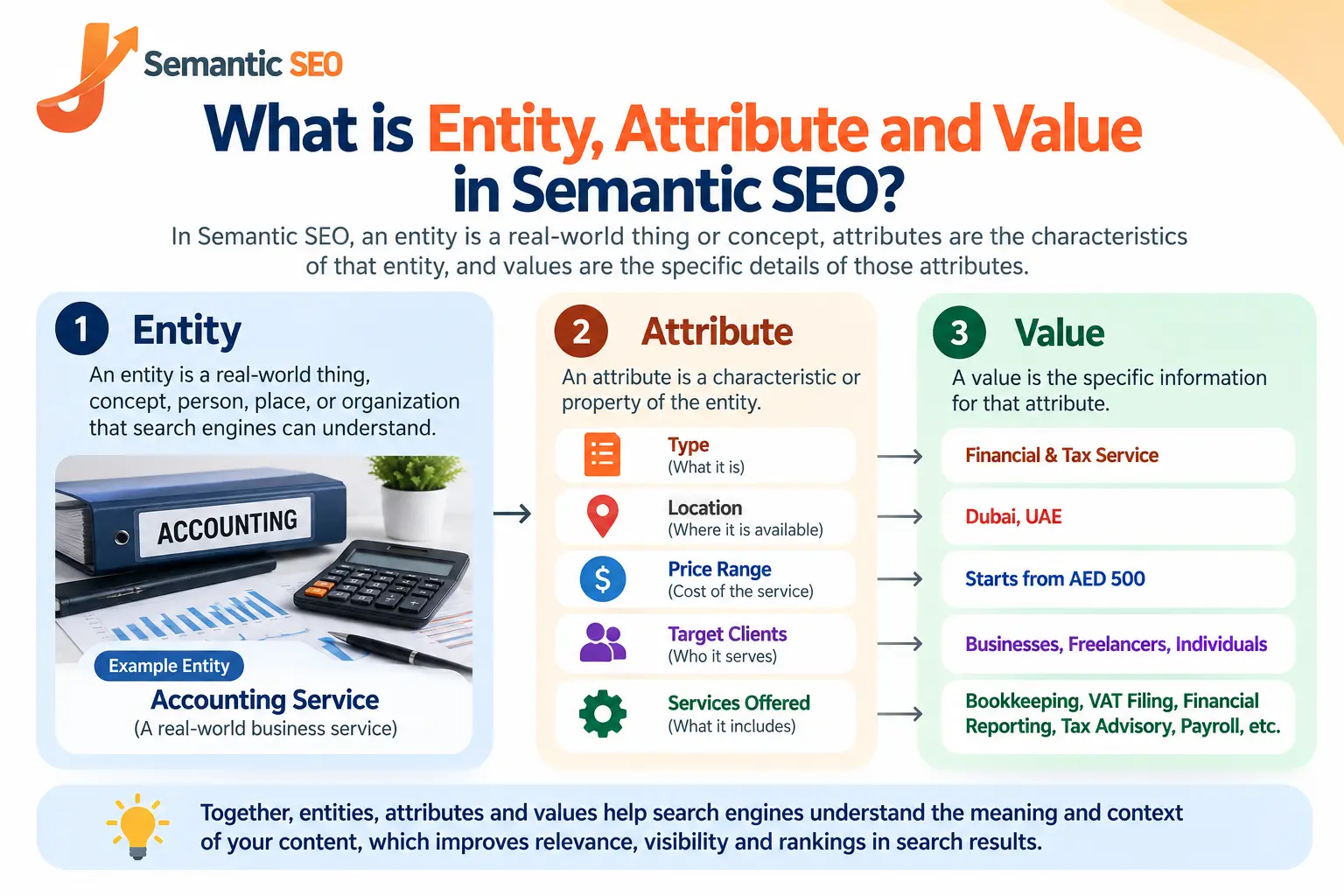
In semantic SEO, the Entity-Attribute-Value (EAV) model is a data representation framework where an Entity is a recognized person, place, or concept; an Attribute is a characteristic of that entity; and a Value is the specific qualitative or quantitative data assigned to that attribute. The EAV model forms the foundational syntax for all search engine knowledge graphs and AI fact repositories.
How unstructured language resolves into structured machine data:
| Entity (Subject) | Attribute (Predicate) | Value (Object) | Formal Knowledge Triple |
|---|---|---|---|
| Tesla Model 3 | Battery Capacity | 82 kWh | [Tesla Model 3] — (hasBatteryCapacity) —> [82 kWh] |
| Albert Einstein | Award Received | Nobel Prize in Physics | [Albert Einstein] — (receivedAward) —> [Nobel Prize] |
| Semantic SEO | Core Paradigm | Things, Not Strings | [Semantic SEO] — (embracesParadigm) —> [Things, Not Strings] |
Structuring web content around explicit EAV data points delivers three massive advantages:
- For Search Engines: Enables instant fact extraction without algorithmic uncertainty, making content prime candidates for Google Direct Answer boxes and Knowledge Panels.
- For LLMs (AI Answer Engines): Provides unambiguous factual nodes that generative models can safely extract for Retrieval-Augmented Generation (RAG) without hallucination.
- For Human Users: Delivers immediately scannable, factual answers that satisfy informational intent without requiring users to sift through filler content.
What is the importance of Semantic SEO in the AI Era?
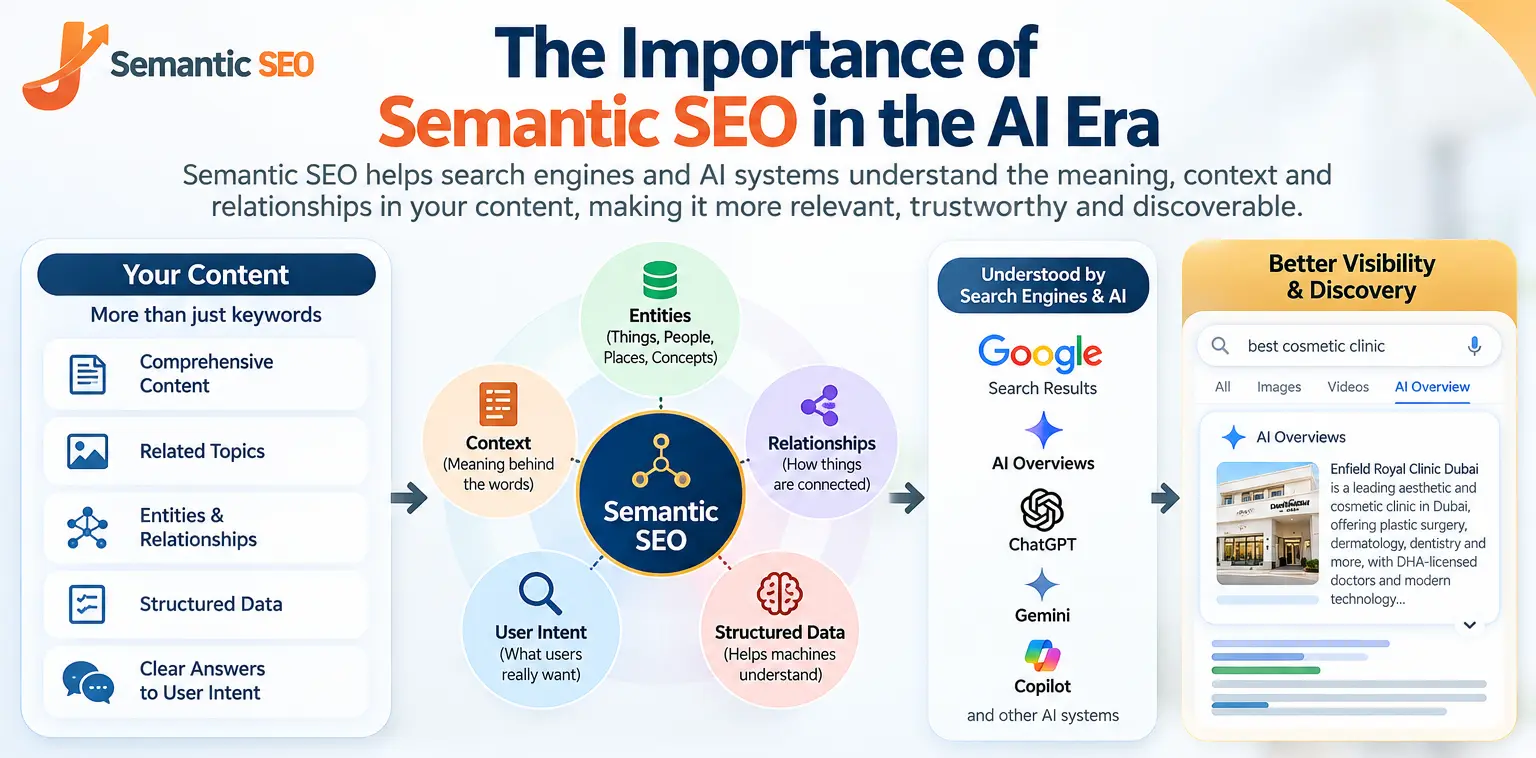
In the AI era, Semantic SEO is essential because AI answer engines (Google AI Overviews, Perplexity, ChatGPT Search) retrieve and cite web pages based on entity recognition, semantic consensus, and factual clarity rather than traditional keyword density or raw backlink counts. As search evolves toward Generative Engine Optimization (GEO), websites lacking structured semantic architectures become completely invisible to conversational answer engines.
Large Language Models (LLMs) utilize Retrieval-Augmented Generation (RAG) to synthesize real-time web information. When an LLM executes a web query, it breaks down the prompt into sub-entities, retrieves vector-relevant document passages, evaluates source consensus across trusted entity graphs, and cites the sources providing the clearest, most authoritative knowledge triples.
Discover how our dedicated AI SEO services optimize your website for multi-engine AI citations and generative search visibility.
Does semantic topical map really help businesses to get cited in LLMs?
Yes, a semantic topical map directly helps businesses get cited in LLMs by establishing verified entity consensus, eliminating topical voids, and providing clear factual passages that RAG systems can extract with high confidence scores.
LLMs do not synthesize answers from thin air; they retrieve text chunks with high vector proximity and source credibility. When a business publishes an exhaustive topical map that covers every related attribute, comparative question, and procedural vector of a niche, LLM retrieval agents recognize the domain as an authoritative reference node, repeatedly citing it in generated summaries.
Does semantic topical map really help businesses to get cited in CHATGPT?
Yes, semantic topical maps substantially increase citation frequency in ChatGPT and SearchGPT by delivering unambiguous entity-attribute answers that match the synthetic prompts generated during conversational search browsing.
When ChatGPT performs web searches, it decomposes complex multi-layered prompts into targeted sub-queries. Websites engineered with semantic topical maps provide clean, direct answers to these exact sub-queries, allowing ChatGPT’s citation parser to reference the URL as the primary source of truth for the generated response.
What is Semantic Content writing?
Semantic content writing is the practice of authoring text using explicit entity-attribute-value structures, high lexical density, and direct answer framing to satisfy both human cognitive needs and algorithmic NLP parsing systems. Rather than writing for a predetermined word count or repeatedly stuffing keywords, semantic content writing operates within the Algorithmic Authorship framework established by Koray Tuğberk GÜBÜR.
Key principles of Entity-Based Semantic Content Writing include:
- Direct Answer Syntax: Answering the core heading query in sentence one using Subject-Predicate-Object structure.
- Contextual Lexical Variety: Integrating naturally co-occurring domain terms and synonyms that NLP parsers expect to see alongside the primary entity.
- Information Gain: Ensuring every sentence contributes unique, verifiable data rather than rewording generic industry truisms.
- Elimination of Contextless Fluff: Removing empty transitional padding such as “In today’s fast-paced digital world…” which increases the computational cost of retrieval without adding semantic value.
Explore our specialized semantic content writing services to scale entity-based content creation.
What is the Semantic Content Layer?
The Semantic Content Layer is a tripartite architecture comprising the Entity Layer, the Structure Layer, and the Retrieval Layer that together ensure content is understandable to search engines and AI agents.
- The Entity Layer: Identifies and situates the conceptual nouns, technical attributes, and relationship predicates within the body copy.
-
The Structure Layer: Formats the text through semantic HTML5 tags (
<article>,<section>,<header>,<table>,<ol>) and nested JSON-LD schema definitions that eliminate ambiguity. - The Retrieval Layer: Optimizes passage lengths, direct definitions, and vector embeddings to facilitate instantaneous extraction by search engine passage ranking algorithms and generative AI scrapers.
How Google and AI Systems Process Semantic Content
Google and AI systems process semantic content through a 4-stage pipeline: text tokenization, dependency parsing, entity reconciliation with knowledge graphs, and vector embedding generation for semantic similarity scoring.
- Tokenization & Normalization: Raw text is broken down into sub-word tokens and normalized by stripping formatting anomalies.
- Syntactic & Dependency Parsing: NLP models analyze grammatical relationships, determining which nouns act as subjects and which verbs link them to predicates.
- Entity Linking & Reconciliation: Recognized entities are matched against existing Knowledge Graph IDs (e.g., Wikidata or Google’s MREID database).
- Vector Projection: Transformer models (BERT/Gemini) project the document’s concepts into dense vector space to evaluate its relevance and authority against the search query.
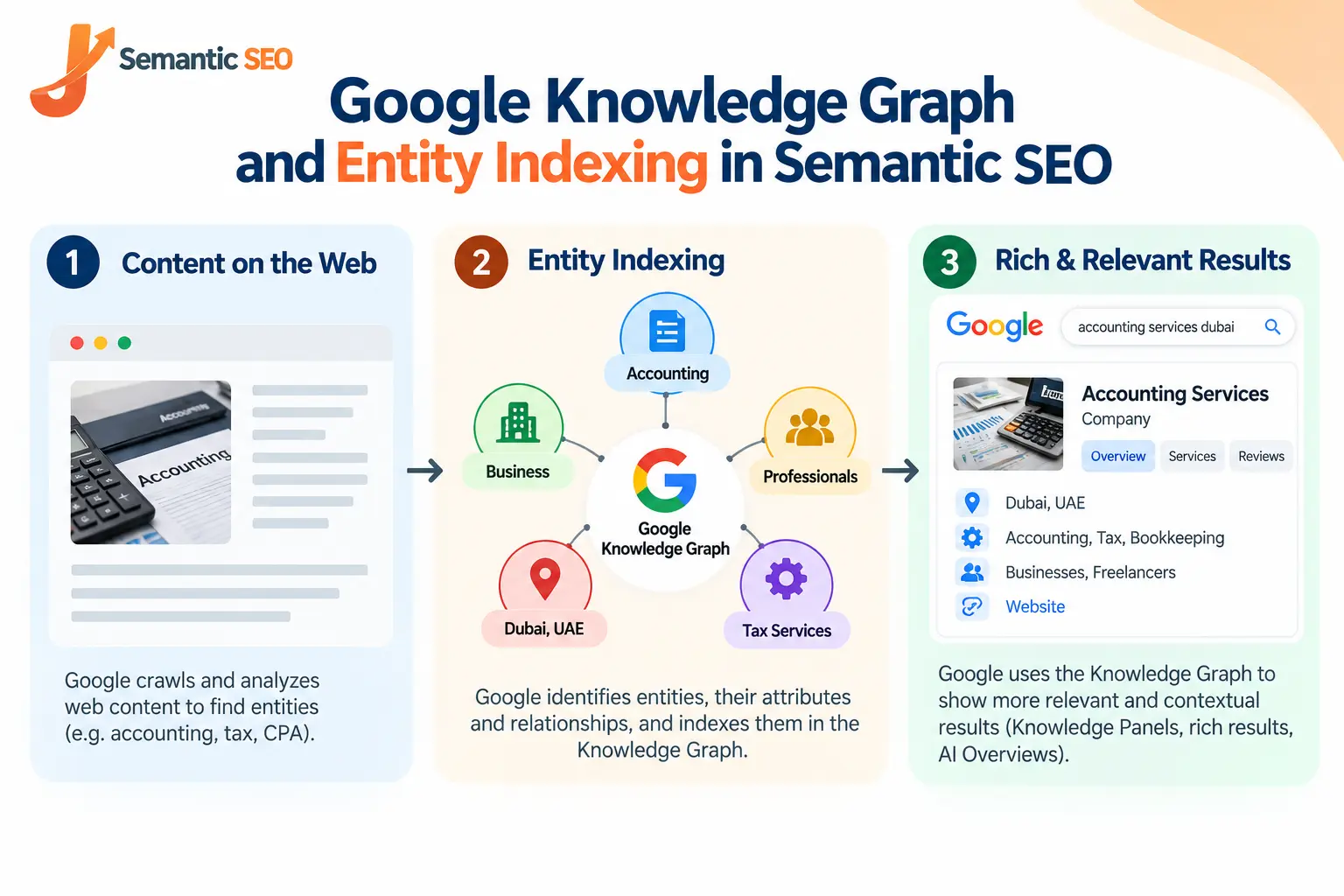
What is Google Knowledge Graph and entity indexing in Semantic SEO?
The Google Knowledge Graph is a multi-billion-entity knowledge base that stores real-world entities and their interconnected relationships, allowing Google to index the web by concepts (“things”) rather than mere keyword strings. Entity indexing is the mechanism by which Google associates a specific URL with recognized Knowledge Graph entity IDs rather than maintaining an index based solely on word counts.
What is the role of Natural Language Processing (NLP) in semantic SEO?
The role of Natural Language Processing (NLP) in semantic SEO is to enable search engines to read unstructured human text, extract entities and factual relationships, determine user search sentiment, and interpret complex search intents.
What is the importance of RankBrain in Semantic SEO?
Introduced in 2015, RankBrain is Google’s first deep-learning AI system that maps never-before-seen and ambiguous search queries into multi-dimensional concept vectors, matching them with relevant documents even when those documents do not contain the query words. RankBrain forced SEOs to abandon literal keyword matching, rewarding content that comprehensively satisfies underlying search intent.
What is the importance of MUM in Semantic SEO?
Launched in 2021, MUM (Multitask Unified Model) is 1,000 times more powerful than BERT, capable of understanding and generating language across 75+ languages simultaneously while processing multimodal text, image, and video content. MUM enables search engines to answer complex, multi-step queries (e.g., “I hiked Mt. Fuji, now I want to hike Mt. Adam in the fall, what gear do I need?”) in a single search result.
What is the importance of neural matching in Semantic SEO?
Neural matching, introduced in 2018, is a deep-learning algorithm that connects ambiguous, colloquial user queries to website concepts by understanding how words relate to broader ideas (often referred to as a “super-thesaurus”). For example, neural matching allows Google to connect the query “why is my television looking weird” directly to articles discussing the “soap opera effect.”
What is the importance of BERT in Semantic SEO?
BERT (Bidirectional Encoder Representations from Transformers), introduced in 2019, processes language bidirectionally, evaluating the full context of a sentence by looking at the words that come before and after each term. BERT revolutionized search by correctly interpreting prepositions like “for,” “to,” and “with,” fundamentally changing how search engines understand the directional intent of user queries (e.g., “2019 brazil traveler to usa need visa”).
What are the Core elements of semantic SEO?
The core elements of semantic SEO are the fundamental structural and conceptual components required to communicate topical authority to search engines and AI models.
| Core Element | Technical Definition | Primary SEO Function |
|---|---|---|
| Entities | Recognized persons, places, organizations, or concepts with unique IDs | Anchors web content to global Knowledge Graphs |
| Attributes | Qualitative or quantitative characteristics of an entity | Provides detailed factual depth expected by NLP parsers |
| Values | The exact data point assigned to an attribute | Populates direct answer boxes and LLM context windows |
| Topical Authority | Proven expertise across an entire subject domain | Earns broad keyword immunity against algorithmic updates |
| Contextual Relevance | The semantic alignment of surrounding sentences and links | Validates precise topical meaning and eliminates ambiguity |
| Schema Markup | Machine-readable JSON-LD structured data | Explicitly communicates relationships via Schema.org vocabularies |
Looking to upgrade your site’s schema implementation? Explore our comprehensive technical SEO and schema architecture services.
What are the best strategies for implementing Semantic SEO?
The best strategies for implementing Semantic SEO include mapping out comprehensive topical clusters, writing under Algorithmic Authorship rules, deploying nested Schema.org architectures, and establishing non-reciprocal semantic internal linking networks.
- Conduct Entity-First Keyword Research: Replace traditional search volume metrics with entity mapping. Query Wikidata, Google Trends, and Knowledge Graph Search APIs to identify missing entity attributes within your niche.
- Implement Non-Reciprocal Link Hierarchies: Connect pages based on logical query progression. Pillar pages link down to specific attribute pages, while attribute pages link horizontally to adjacent related entities without diluting topical authority through repetitive circular links.
-
Engineer Multi-Layered Schema Markup: Embed JSON-LD structured data on every page, utilizing
aboutandmentionsarrays referencing exact Wikipedia and Wikidata URIs. - Audit Content for Contextual Information Gain: Review existing articles to eliminate repetitive keyword padding, replace vague statements with concrete EAV triples, and add original comparative data tables.
What is Named entity recognition in Semantic SEO?
Named Entity Recognition (NER) is a natural language processing technique that automatically scans unstructured web text to identify, classify, and extract proper nouns into predefined categories such as persons, organizations, locations, dates, and products.
In Semantic SEO, search engines use NER to parse on-page text and match recognized entities against their internal Knowledge Graph. When your content mentions industry figures, certified standards, proprietary software, and geographic locations with clear syntactic framing, NER algorithms extract these entities with high confidence scores, reinforcing your domain’s contextual relevance.
What are the three types of semantic analysis?
In Natural Language Processing and computational linguistics, the three types of semantic analysis are Lexical Semantics, Compositional Semantics, and Contextual (Discourse) Semantics.
| Semantic Analysis Type | Scope of Analysis | Search Engine Application |
|---|---|---|
| Lexical Semantics | Individual words and their isolated linguistic properties | Disambiguating synonyms, antonyms, hyponyms, and meronyms |
| Compositional Semantics | How word meanings combine based on syntactic grammar | Evaluating how clauses and sentences generate complete ideas |
| Contextual (Discourse) Semantics | How entire paragraphs, documents, and situational context shape meaning | Understanding user search journeys, tone, and macro topical intent |
What are the Types of Queries in Semantic SEO?
In Semantic SEO, queries are categorized based on their conceptual relationships and user intent trajectories into Correlative Queries, Sequential Queries, Augmented Queries, and Intent-Driven Semantic Queries.
- Correlative Queries: Searches that investigate the comparative relationship between two entities (e.g., “Semantic SEO vs Technical SEO”).
- Sequential Queries: Consecutive searches within a single session where each query logically builds upon previous knowledge (e.g., “what is semantic SEO” → “how to build a topical map” → “topical map template”).
- Augmented Queries: Searches where the search engine algorithmically injects implied entities or location context behind the scenes (e.g., expanding “best coffee” to include local entity parameters).
- Intent-Driven Semantic Queries: Conversational, long-tail queries that describe a complex problem rather than naming a product (e.g., “why is my website traffic dropping after algorithm update but impressions are stable”).
What is Query semantics?
Query semantics is the computational modeling of the genuine informational intent, entities, and contextual requirements embedded within a search string, moving beyond literal keyword token matching.
What is a Query Path?
A Query Path is the sequential sequence of search queries that users navigate as they advance from initial topical discovery to advanced technical execution or commercial transaction. By structuring website internal link graphs to mirror these natural query paths, websites provide seamless navigational journeys that search engines reward with elevated rankings.
What is Lexical Semantic?
Lexical semantics is the branch of linguistics and NLP that studies word meanings, lexical relationships, and sense disambiguation at the individual term level without factoring in larger narrative discourse.
What is the difference between semantic similarity and semantic closeness?
Semantic similarity measures how closely two entities resemble one another in conceptual meaning, whereas semantic closeness measures how strongly two entities are interconnected within a specific knowledge domain regardless of physical resemblance.
| Dimension | Semantic Similarity | Semantic Closeness |
|---|---|---|
| Core Definition | Equivalence or resemblance in vector space | Functional connection or dependency within a domain |
| Example Concept | Automobile and Car (High similarity) | Car and Brake Pad (High closeness, low similarity) |
| SEO Context | SEO Specialist and SEO Consultant | Topical Map and Internal Linking Graph |
| Algorithmic Measurement | Cosine distance in high-dimensional vector embeddings | Graph traversal distance and co-occurrence in knowledge triples |
What is the importance of Structured data layering in semantic seo?
Structured data layering is crucial in semantic SEO because nested JSON-LD schema markup explicitly states entity relationships, author credentials, and topical definitions in machine-readable format, completely removing algorithmic guesswork. By nesting about and mentions schema properties containing authoritative Wikidata URIs directly inside your TechArticle or WebPage schema, you create a direct bridge into search engine knowledge graphs.
What is the difference between Semantic Keywords vs LSI Keywords?
Semantic keywords represent recognized entities, concepts, and contextual vector embeddings in modern neural search engines, whereas “LSI keywords” is an outdated industry myth based on Latent Semantic Indexing—a 1988 patent designed for small, static document collections that Google has explicitly stated it does not use for web search.
While so-called “LSI tools” merely scrape search engine suggestion drops, genuine Semantic SEO utilizes transformer models (BERT, RoBERTa), entity extraction APIs, and knowledge graph triple architectures to achieve true conceptual relevance.
What is the Future of Semantic SEO?
The future of semantic SEO centers on Generative Engine Optimization (GEO), autonomous AI search agents, multimodal entity graphs, and personalized vector retrieval spaces. As search engines increasingly transition from traditional ten-blue-link results to synthesized AI answer overviews, websites that fail to establish verified entity authority will see their organic search footprints vanish.
Conversely, websites built upon rigorous semantic foundations—featuring exhaustive topical maps, clear Entity-Attribute-Value content structures, and authoritative structured data—will thrive as the primary knowledge repositories that AI answer engines depend upon and cite.

Eliminate algorithmic volatility, establish verified topical authority, and secure multi-engine AI citations with custom semantic architectures engineered for modern search.
Book a Free Semantic Consultation →