
Eliminate writer guesswork and conquer algorithm updates. We engineer mathematical content blueprints connecting Wikidata entities, search intent micro-moments, heading hierarchy, and high information gain before writing begins.
A semantic content brief is not a generic keyword list or a copy-pasted competitor outline. It is an architectural blueprint that defines the exact concepts, relationships, and user problems an article must satisfy to become the definitive authority on the web.
Modern search engines like Google use Large Language Models, Knowledge Graphs, and vector embeddings to evaluate articles. They measure topical completeness, semantic relationships, and information gain.
Our semantic briefs equip writers with exact semantic entities, search intents, structured heading sequences, and original angles so every draft achieves high topical authority on the first submission.
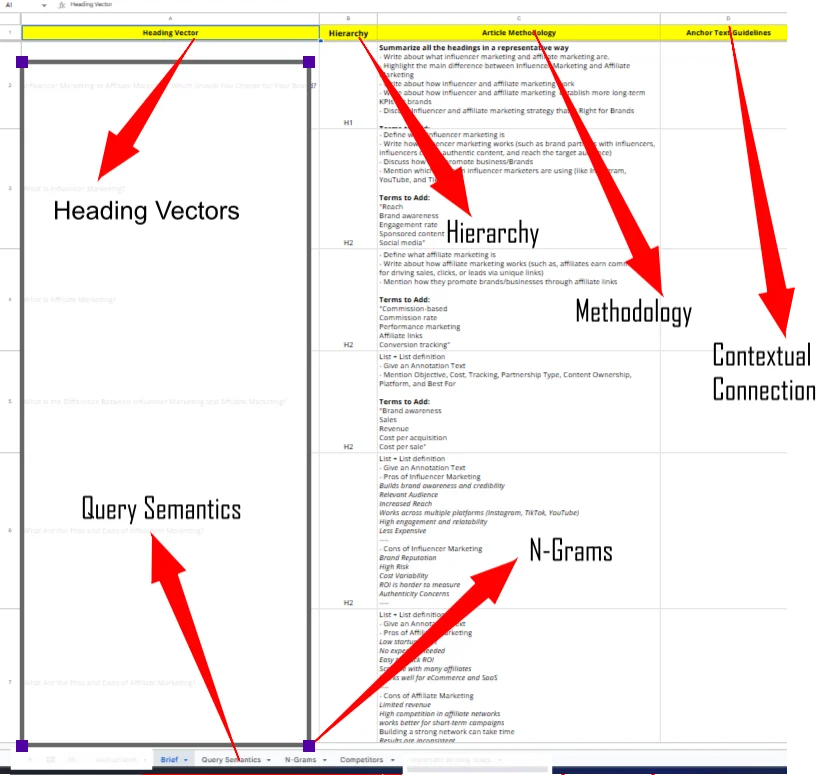
We identify the primary subject entity, its authoritative Wikidata QID, and all essential secondary entities required to establish context without spamming.
A logically sequenced H2, H3, and H4 outline designed for algorithmic passage retrieval, answering specific sub-queries directly beneath concise headings.
Every brief specifies exact target URLs and descriptive anchor texts to weave the new article into your broader topical cluster and pass internal link equity.
Vague outlines produce generic copy that gets ignored by Google. Semantic briefs give your writers the exact technical roadmap to write authoritative content effortlessly.
Writers no longer spend hours guessing what subtopics to include or how to structure the post. Every section has explicit instructions, angles, and questions to answer.
Search engines reward comprehensive answers. Our briefs guarantee that every critical entity and sub-angle in the semantic domain is covered without fluff.
We provide precise context and definition instructions so search algorithms understand exactly which real-world entity your article refers to, avoiding algorithmic confusion.
Google penalizes derivative, rehashed articles. Our briefs specify original research angles, proprietary data prompts, and real-world examples that stand out from generic AI copy.
Articles produced from semantic briefs establish topical relevance immediately upon indexing, capturing primary keywords and hundreds of long-tail semantic variants simultaneously.
Scale your content production across multiple in-house or freelance writers without losing tone, accuracy, or SEO power. Every writer produces consistent, top-tier work.
Our 5-stage proprietary process transforms raw search intent into an entity-dense, mathematically optimized editorial blueprint.
We analyze the primary query, conversational search queries, and user journey micro-moments. We classify the exact search intent (informational, commercial investigation, or transactional) and map all Google SERP features (Featured Snippets, PAA, Video, Knowledge Panels).
Using natural language processing (NLP) and Wikidata extraction, we identify the primary subject entity, parent entity classes, related attributes, and co-occurring semantic concepts required to validate topical authority in Google's Knowledge Graph.
We construct a hierarchical outline (H1, H2, H3, H4) structured for algorithmic passage indexing. Each section includes explicit guidance on what specific question it must answer, recommended target length, and unique angles to beat existing SERP competitors.
We map exact inbound and outbound internal links to reinforce your topical cluster. We also provide authoritative primary source references, statistical databases, and industry citations for your writer to cite.
Before delivery, each brief undergoes manual review by a senior semantic SEO strategist. We verify EEAT signal guidelines, readability benchmarks, and competitive differentiation before handing the brief to your writing team.
A turnkey editorial roadmap that turns writers into topical experts. Here is what you receive in every brief deliverable:
Complete entity breakdown including primary subject entity, Wikidata QIDs, entity classification, and contextual co-occurring concepts.
Complete H1, H2, H3, and H4 architecture engineered for natural user progression and passage-level search indexing.
Clear definition of the user’s search journey stage, immediate questions, underlying anxieties, and expected content format.
Explicit internal link directives connecting the new page to supporting cluster posts and revenue-generating service pages.
Original value directives that satisfy Google's Helpful Content System and separate your site from generic AI rehashes.
Curated People Also Ask questions, conversational search queries, and structured schema targets ready for FAQ integration.
Built for digital organizations and publishers that refuse to waste marketing budget on content that never ranks.
Streamline writer onboarding, eliminate endless review cycles, and guarantee brand voice matches algorithmic search criteria.
Deliver premium, mathematically sound content outlines to your clients without stretching your internal technical SEO team thin.
Establish category authority in technical spaces with deeply researched, terminology-accurate briefs that educate real buyers.
Build algorithmic topical moats that thrive through core updates and capture direct citations in AI answer engines.
See why standard keyword-stuffed SEO outlines fail in modern semantic search, and how our entity blueprints win.
| Content Dimension | Standard SEO Briefs | JustSemanticSEO Entity Briefs |
|---|---|---|
| Search Foundation | Keyword repetition & arbitrary density percentages | Wikidata entity mapping & Google Knowledge Graph alignment |
| Heading Architecture | Copy-pasted top 3 competitor headers | Algorithmic passage-optimized hierarchy with intent mapping |
| Information Gain | Rehashed SERP content with generic AI filler | Proprietary statistics, original data prompts & novel angles |
| Internal Linking | Vague suggestions like "link to other blogs" | Exact target URLs, prescribed semantic anchors & cluster directives |
| Disambiguation | None — often confuses search crawlers on polysemous terms | Explicit contextual sentences & entity class disambiguation |
| Writer Guidance | Keyword dump leaving writer to guess what to say | Crystal-clear section objectives, questions & word targets |
Equip your writers with an unfair ranking advantage. Submit your project requirements below or schedule an exploratory consultation.
Fill in your website details and target topics. We will review your semantic landscape and confirm your scope within 24 hours.
Have questions about your topical cluster or need advice on prioritizing content briefs? Book a 30-minute discovery session with Hanzala Khan.
Every brief is guaranteed to include verified Wikidata entities, passage-optimized headings, information gain directives, and internal linking models. If a brief fails to meet editorial standards, we revise it at zero cost.
Standard single briefs delivered within 48 to 72 business hours. Topical cluster batches (5-10 briefs) delivered sequentially within 5-7 business days.
Common questions about our semantic content brief process, entity extraction, and deliverables.