
Get a custom, data-driven Semantic Topical Map that structures your entire website for search engines & AI engines. Delivered in 20 days.
A Semantic Topical Map is a structured blueprint of all the topics, entities, sub-entities, and relationships within your niche. It shows what content your website must have, how it should be connected, and how Google and AI search engines understand your expertise.
Instead of publishing random articles, you get a strategic, data-driven roadmap that builds:
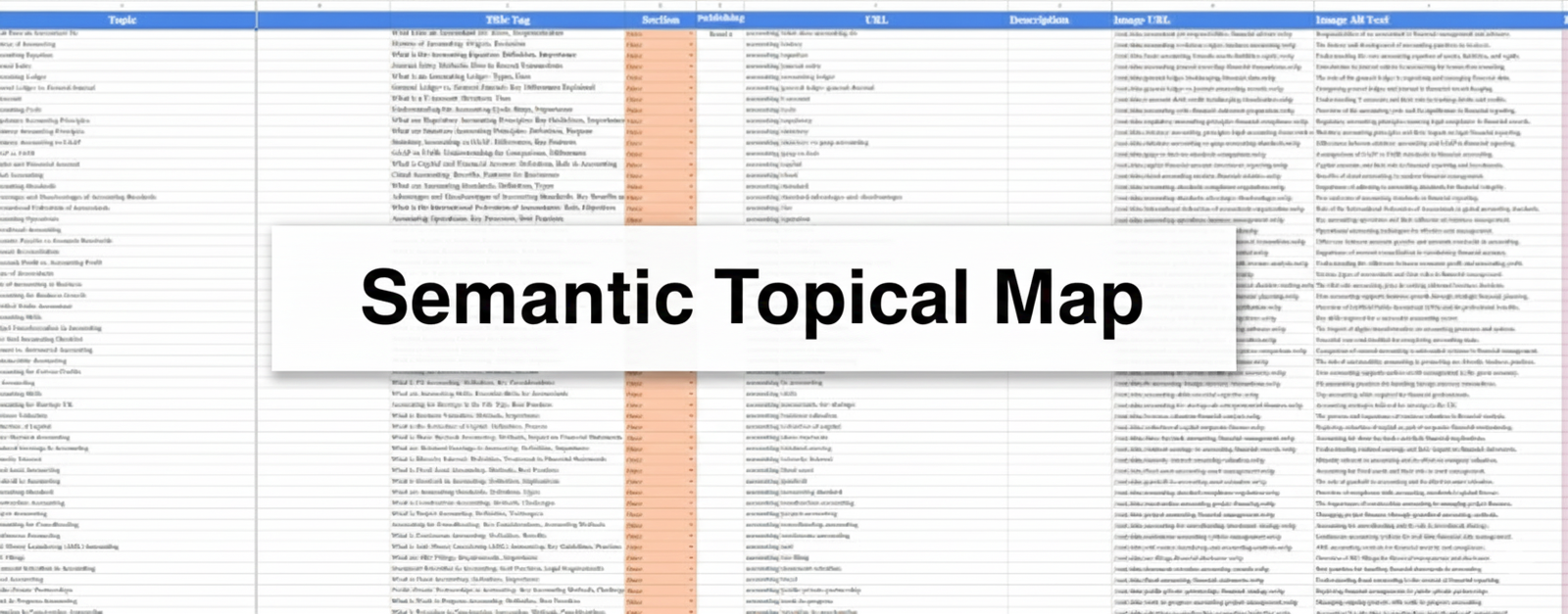
Because a topical map structures your content to align with search intent, enhances internal linking, and increases your site's relevance, ultimately improving SEO performance and driving sustained organic traffic.
Because your website becomes the most complete, authoritative resource in your niche.
Topics are grouped, connected, and organised semantically for search engines and AI models.
Every page has a strategic place and purpose, passing contextual relevance seamlessly.
No wasted articles, no keyword stuffing, no guesswork. Every topic satisfies intent.
Remove structural gaps and coverage blind spots that hold back your search rankings.
Our semantic topical map process works by breaking the entire process into clear semantic steps that build meaning, structure, and intent around your core entity, turning scattered topics into a connected knowledge system.
Core entity is the first step in building a semantic topical map. It involves identifying your main topic, the “central entity” and understanding all concepts, ideas, and intents connected to it. This creates a clear semantic foundation, ensuring every subsequent topic, cluster, and content piece aligns with the core theme and strengthens the site’s overall authority.
Semantic extraction is the step where all concepts, subtopics, entities, and user intents related to your core entity are identified and mapped. It goes beyond simple keyword lists by uncovering the meaning, context, and relationships behind each topic. This ensures your content strategy covers every relevant angle, captures user intent accurately, and builds a semantically rich foundation that search engines and AI models can fully understand.
In taxonomy structuring all extracted topics and concepts are organised into a logical, hierarchical framework. Parent, child, and sibling relationships are defined to show how each topic connects within the broader ecosystem. This structure not only helps search engines and AI models understand the site’s content clearly but also guides content creation and internal linking, ensuring every piece fits naturally within the overall semantic map.
Ontology mapping is the process where relationships between topics, such as “is-a,” “part-of,” and “related-to” are defined. This forms a knowledge graph that algorithms can easily interpret.
Real user-intent data is used to refine and filter topics. Only search-relevant and behaviour-aligned concepts stay in the map.
In contextual Hierarchy building Parent, child, and sibling relationships are shaped to show topic depth and breadth. This improves topical completeness and clarity.
Internal relationship mapping is the process where all topics are interconnected through logical and semantic pathways. By mapping these relationships, algorithms can better understand your site’s overall context, improving crawlability, relevance, and authority across the entire content ecosystem.
A content brief is the most important step. The brief includes the topic’s intent, scope, key semantic entities, recommended angles, and internal linking paths. This ensures that every piece of content is consistent, aligned with the semantic map, and structured to reinforce the site’s overall topical authority and discoverability.
You receive everything in a clean, easy-to-use format ready for immediate content production.
If you're aiming for a sustainable SEO strategy rather than random content, our service offers a structured approach for long-term success.
Our services are different because we build your entire topical authority from the ground up by using real search-intent data, semantic relationships, taxonomy and ontology structures, and LLM-ready content frameworks so your site ranks across Google, ChatGPT, Gemini, Perplexity and Grok.
Instead of producing scattered blogs or guess-based keywords, I organize your whole domain into a meaningful, interconnected ecosystem that search engines and AI models can easily understand, trust, and prioritize resulting in stronger visibility, higher relevance, and long-term authority.
Select the services you need, tell us about your website, and we'll build a tailored semantic roadmap for your domain. Sent directly to info@justsemanticseo.com.
Fill out the details below to receive your custom proposal & topical strategy options within 24 hours.
A semantic topical map helps organize content around core topics and related subtopics, improving site clarity for both users and search engines, boosting SEO performance.
It enhances topical authority by covering a topic comprehensively and linking related concepts, allowing search engines to better understand your expertise and relevance.
Elements of a semantic topical map include several key components that together create a structured, meaningful content ecosystem:
To identify core topics for topical maps, pick the main themes most relevant to your business or website purpose that your audience searches for frequently.
Semantic topical maps expand the primary topic coverage and help answer all related user questions, strengthening content depth.
They show how topics connect contextually, enabling search engines to interpret your content as a coherent knowledge ecosystem.
A central entity in a topical map is the main subject your website or page revolves around, the anchor for all connected topics.
Clusters are groups of pages covering related subtopics that provide comprehensive coverage, improving topical authority.
SEO and AI tools like semantic SEO generators and clustering tools can help automate topic research and map creation.
Internal links connect related content pieces, helping users navigate and signaling topic relevance to search engines.
Core sections target main user intent and commercial topics; outer sections cover supporting informational content that enhances overall relevance.
Research user queries to align topics with what your audience is actually searching for, including informational and transactional intents.
Yes, it serves as a strategic blueprint guiding what content to create next and how to interlink it logically.
Yes, they help even small sites build authority and organized content for better search visibility.
Synonyms and variations impact topical maps by allowing the map to cover a wider range of search queries. Incorporating them ensures greater relevance, improves search visibility, and helps capture diverse user intents within the same topic ecosystem.
Stop guessing. Start building real topical authority with a data-driven roadmap tailored to your niche.
Get Your Custom Semantic Topical Map →