
Home › Semantic SEO › llms.txt
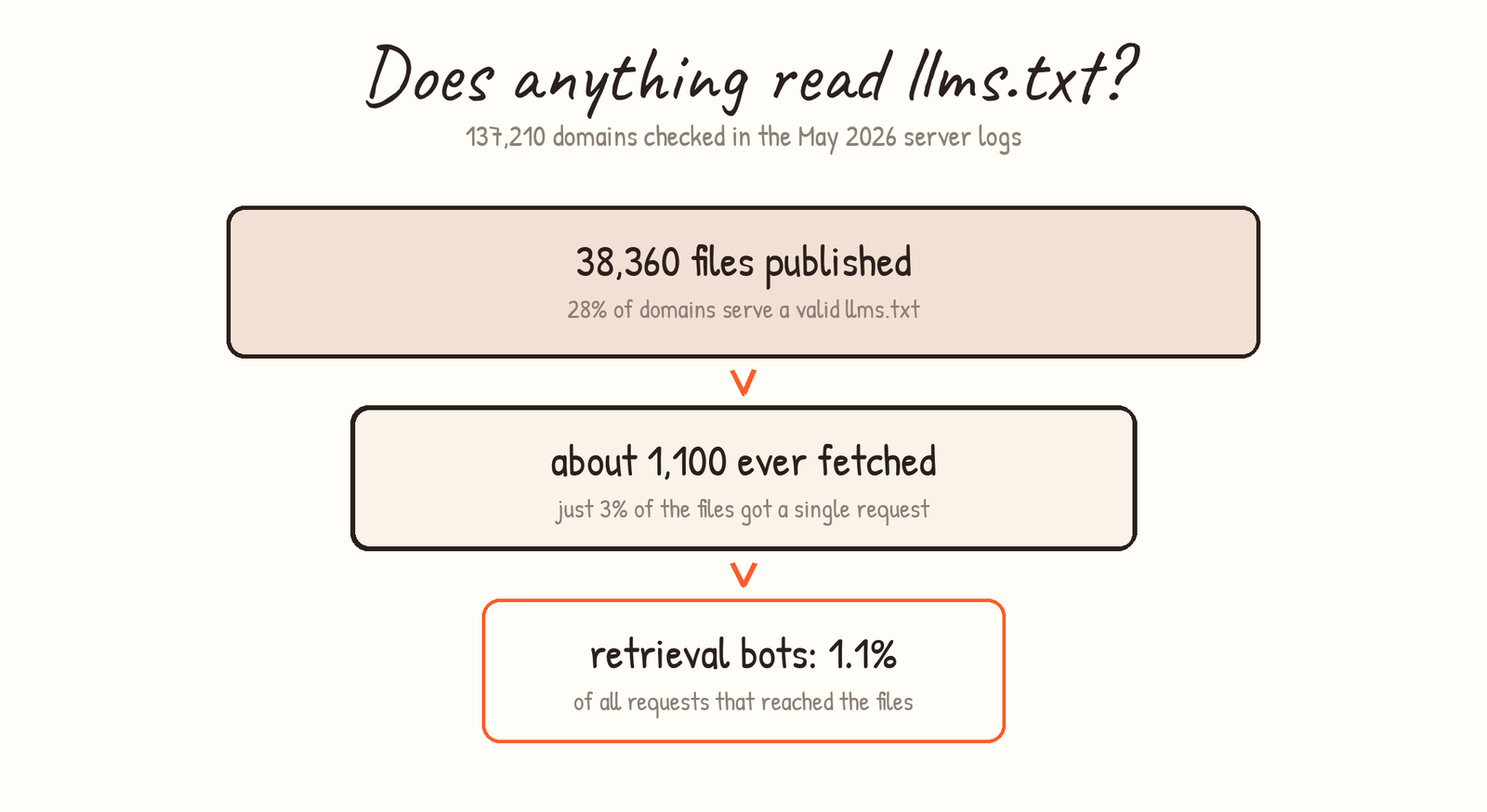
llms.txt is a proposed Markdown file that gives AI systems a curated index of a website. The evidence says it is not an AI visibility lever. Google Search ignores the file, 97% of published files were never fetched by anything in the largest log study run so far, and the only study that tested citations found no link between having the file and being cited. The file has 1 real use today. Agents that browse a site on a person’s behalf read it, and it costs minutes to publish. Treat it as hygiene, never as a strategy, and never pay for it as one.
What is llms.txt?
llms.txt is a plain Markdown file served at the root of a domain, at yourdomain.com/llms.txt. Jeremy Howard of Answer.AI proposed it on 3 September 2024, and the proposal is maintained at llmstxt.org. A second version of the proposal appeared in August 2026.
The file exists because HTML is a poor reading format for a language model. A normal page wraps its facts in navigation, scripts, layout and advertising, and a model that fetches the page spends most of its context window on that wrapping. The proposal answers with a short, clean index. 1 file tells the model what the site is, what it offers, and which pages matter most.
The format has 3 parts. An H1 heading carries the site name. A blockquote under it carries a 1 or 2 sentence summary of the site. H2 sections then group Markdown links to the key pages, and each link can carry a short description of what the page holds. A companion variant, llms-full.txt, goes further and concatenates the full text of the linked pages into a single file.
The proposal is a proposal. No standards body has ratified it, and no AI company documents support for it in its crawler documentation. Adoption is real but concentrated. About 28% of the domains in the largest log study publish a valid file, and the heaviest use sits in developer documentation, where the major AI companies publish llms.txt files for their own docs.
Does llms.txt help you appear in AI answers?
No, No AI search system has said it uses the file, and Google has said the opposite in writing.
Google published a guide to optimizing for generative AI features in May 2026. The guide states that a site does not need new machine-readable files, AI text files, markup or Markdown to appear in Google Search, including its generative AI features. A June 2026 update to the same guide went further. Google Search ignores llms.txt files, and keeping one neither helps nor hurts a site. Google’s John Mueller has compared the file to the keywords meta tag, and has said plainly that no AI system currently uses it.
The other AI operators say nothing at all, which is its own answer. OpenAI, Anthropic and Perplexity each document how robots.txt governs their crawlers. None of their crawler pages mentions reading a site’s llms.txt. A system that used the file to choose sources would document the behaviour, because it would need sites to maintain the file accurately.
Google tool does check for the file, and it is not Search. Chrome Lighthouse added an experimental Agentic Browsing category in May 2026, and that category audits whether a site provides llms.txt. The audit serves developers building for browser agents. It carries no ranking weight, and Google itself draws the line between the 2 products. Google also publishes an llms.txt file for its own developer documentation, aimed at AI coding tools that read reference material more accurately from clean Markdown.
What do the request logs show?
The direct test of whether AI systems read llms.txt is whether anything requests it. A log study published in June 2026 ran that test across 137,210 domains, using the server logs and bot analytics for every site in the sample during May 2026.
| Finding | Figure |
|---|---|
| Domains in the sample | 137,210 |
| Domains publishing a valid llms.txt | 28% |
| Published files that received zero requests in May 2026 | 97% |
| Requests to fetched files that came from bots | 96% |
| Requests to fetched files that came from named AI bots | 19.5% |
| Requests to fetched files that came from AI retrieval bots | 1.1% |
| Requests for llms.txt files that do not exist | 0 from AI bots |
Read the shape of that data, not just the headline. About 38,000 valid files existed across the sample, and roughly 1,100 of them received any traffic at all. Of the traffic that did arrive, the largest single share came from the industry studying itself. SEO audit tools, llms.txt checker tools and researchers account for a large slice of the fetches, and the Lighthouse audit alone produced about 1 in 1,000. The retrieval bots that build AI answers, the crawlers whose behaviour the file is supposed to influence, made 1.1% of the requests.
A second log analysis, run over 90 days on a single site and published in February 2026, found the same pattern at site level. The site logged more than 62,100 visits from AI bots. 84 of them requested the llms.txt file, about 0.1%. An average content page on the same site drew about 265 requests in the same period.
The study’s authors add a caveat that cuts against the file, not for it. A request proves a fetch, not a read, so every figure in the study is a ceiling on real consumption. The true readership is smaller than the numbers above.
Does having an llms.txt file increase citations?
No study has found that it does. The only research that tested citations directly analysed about 300,000 domains and compared the domains that publish an llms.txt file with the domains that do not. 10.13% of the domains had the file. Having it showed no measurable correlation with how often AI tools cited the domain.
A third analysis explains where the few citations that do occur come from. It sampled 108,417 answers from 8 AI assistants between July and October 2026 and found 303 answers that cited an llms.txt file, 0.28% of the total. Those citations cluster on documentation sites, where an agent working through a developer’s question cites the index it was handed. They are not brand citations in commercial answers, and they do not transfer to service or product queries.
The conclusion the 3 studies support together is narrow and solid. The file does not earn citations. Citations come from the pages themselves and from what other trusted sites say about you, and the file can only point at that material. It cannot substitute for it.
Who actually reads llms.txt?
Agents acting for a person read it. Crawlers building an index almost never do. That split explains every number above.
The 90-day analysis of 1,877,319 AI bot requests separates the 2 populations cleanly. Crawlers such as GPTBot, ClaudeBot, OAI-SearchBot and PerplexityBot requested llms.txt 85 times in 90 days. In the same period they requested robots.txt 12,059 times, because robots.txt is the file their work actually runs on. Agents such as ChatGPT-User, Claude and the coding agents Cursor and OpenCode made 92% of all llms.txt requests. Per 1,000 requests, agents ask for the file at 27 times the crawler rate.
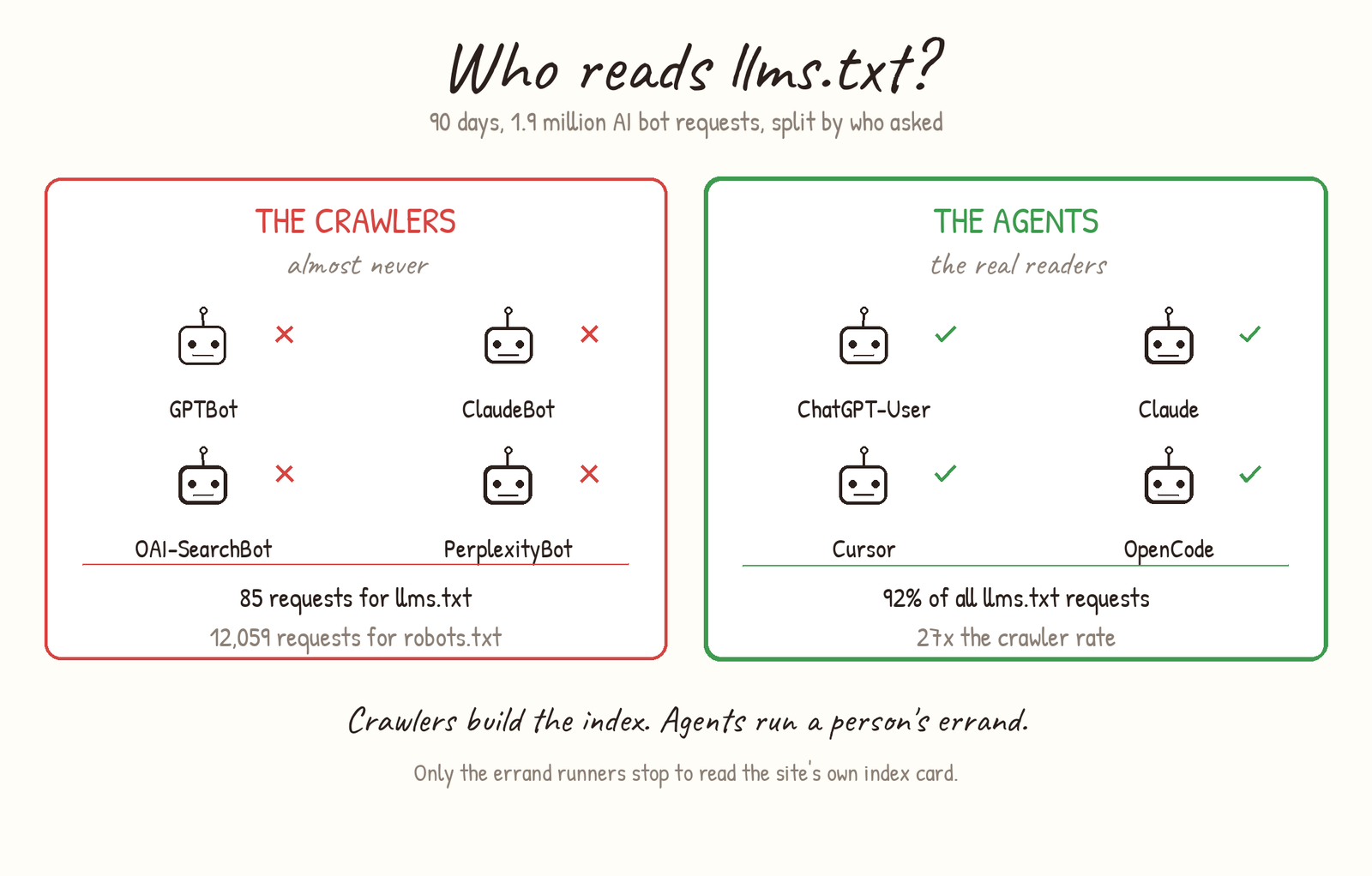
The behaviour difference follows from the job difference. A crawler works from its own index and its own schedule, and it has no use for a site’s self-selected reading list. An agent arrives with a person’s task, lands on an unfamiliar site, and needs the site’s structure fast. A short curated index saves it a crawl. This is why the file’s real readership concentrates in developer documentation, where coding agents work through docs on a programmer’s behalf, and why the reads cluster on pages that link to the file from inside the documentation itself.
For a service business, the practical reading is simple. The agent use case is real and growing, and it is also narrow. It justifies publishing an accurate file. It does not justify a project, a plugin subscription, or a line item sold as AI visibility work.
Why do retrieval systems ignore self-declared files?
Because a self-declared file cannot help a retrieval system choose between sites. Every site can publish one, every claim inside one is unverified, and the file costs nothing to fake. A signal that every source can assert about itself, with no external check, carries no discriminating power, and ranking systems are built to discard signals with no discriminating power. The keywords meta tag died on exactly this logic, which is why the comparison from Google’s side is precise rather than dismissive.
Retrieval systems build their picture of a site from evidence the site does not fully control. They read the pages themselves, extract the entities and facts those pages state, and weigh that record against what independent sources say about the same entities. That is the mechanism behind AI citation. A page earns its place in an answer when its facts are complete, extractable and corroborated, a standard our entity SEO guide works through in full.
llms.txt sits outside that mechanism by design. It is a claim about the site, made by the site, in a format nothing verifies. Publishing 1 is harmless. Expecting it to move citations misunderstands what the systems are measuring.
llms.txt vs robots.txt
The 2 files are confused constantly, and they do opposite kinds of work. robots.txt governs access. llms.txt suggests reading material. llms.txt controls nothing and blocks nothing.
| Question | robots.txt | llms.txt |
|---|---|---|
| What does it do? | Tells crawlers which paths they may fetch | Lists the pages the site considers important |
| Who reads it? | Every major crawler, as the first file fetched | Some AI agents, on some visits |
| Can it block an AI crawler? | Yes, per user agent | No |
| Can it get a page cited? | No | No |
| Is it a recognised convention? | Yes, a formal standard since 2022 | No, a 2024 proposal |
| What happens if it is wrong? | Pages go uncrawled | Nothing measurable |
Keep both files accurate for different reasons. robots.txt is load-bearing infrastructure that decides whether AI crawlers can reach your pages at all. llms.txt is an optional courtesy index for agents that choose to look at it.
What should an llms.txt file contain?
A short file beats a complete one. The agents that read the file are spending a person’s context window, and a file that lists every page on the site repeats the sitemap at higher cost. List only the pages a stranger would need to understand the site, group them under plain H2 headings, and give each link a 1-line description with a fact in it.
This site’s own file shows the shape. It is generated from the site’s pages and posts, and a hand-written curated section sits inside it.
# justsemanticseo.com

> Semantic SEO agency: topical maps, semantic content briefs and
  writing, AI SEO (GEO) and technical semantic audits.

## Curated: Services and key guides
- [Semantic SEO Services](https://justsemanticseo.com/seo-services/)
- [AI SEO Services](https://justsemanticseo.com/seo-services/ai-seo-services/)
- [Semantic SEO](https://justsemanticseo.com/semantic-seo/)
- [Site Audit Tool](https://justsemanticseo.com/site-audit/)
3 rules govern the content. First, link only public, canonical pages that return a 200, because an agent that follows the index into a redirect or a dead page discounts the whole file. Second, write descriptions that state what the page does, in the same terms the page itself uses, because the file is an index of the site’s entity record and contradictions between the file and the pages cost more than the file can gain. Third, keep the file current when the site’s structure changes, or remove it. A stale index that points at retired services is the 1 version of this file that can actively mislead an agent about your business.
The llms-full.txt variant needs a warning. Concatenating full pages into 1 file multiplies the token cost of every read, and an agent with a task budget will sample it or skip it. Publish the full variant only where the audience is documentation readers whose agents genuinely work through complete references.
Should your site publish an llms.txt file?
It depends on what your site is, and the decision should take minutes, not a meeting.
Developer documentation and technical products get the clearest value. Coding agents already read these files while working through docs, the major AI companies publish them for their own documentation, and the Lighthouse audit now checks for one. Publish a curated file and keep it in step with the docs.
Service and content businesses get a small, honest return. An agent researching your company on a prospect’s behalf reads the file when it finds one, and the file makes that reading faster and more accurate. Publish 1 if your platform generates it or you can write it in under an hour. This site runs 1 on exactly that reasoning. Do not commission it as a project, and do not let it displace a single hour of page work.
Anyone being sold llms.txt as a citation or ranking service should decline. The log data and the citation data are both public, and neither supports the pitch. A provider selling the file as an AI visibility lever is selling the 1 intervention in this space with published evidence against it.
What earns citations instead is the work the file only points at. Pages that are indexed and snippet-eligible, so an engine is allowed to cite them. Facts stated as complete, extractable passages rather than hints. A brand entity record that independent sources corroborate. Coverage of the topic deep enough that the answer needs your pages. Our AEO playbook sets out that page-level craft step by step, and the difference between the citation game and the file game is the subject of our GEO vs SEO comparison.
Still guessing which AI tactics are real?
The free site audit shows how your pages are actually read today, which entities they establish and where the record has holes.
Frequently asked questions
Does Google use llms.txt?
No. Google’s guide to optimizing for generative AI features states that Search ignores llms.txt files and that keeping 1 neither helps nor hurts a site. Chrome Lighthouse checks for the file in an experimental agentic browsing audit, and that check belongs to Chrome’s developer tooling, not to Search.
Does llms.txt improve SEO rankings?
No. The file is not a ranking signal for Google or for any AI answer system that has documented its behaviour. Rankings and citations both come from the pages themselves, their facts, their corroboration and their links. The file only lists those pages.
Can llms.txt block AI crawlers from training on my content?
No. The file controls nothing. Access control lives in robots.txt, where each AI crawler is governed by its own user agent, and in server-level rules. An llms.txt file can neither allow nor deny any bot.
What is the difference between llms.txt and llms-full.txt?
llms.txt is an index. It lists key pages with short descriptions and leaves the content on the pages. llms-full.txt concatenates the full text of the pages into 1 file. The full variant costs far more tokens per read, and it suits complete documentation references rather than ordinary websites.
How can I check whether AI bots fetch my llms.txt?
Search your server logs or your analytics bot report for requests to the /llms.txt path, and read the user agents on those requests. Expect most of them to be audit tools and checkers rather than AI systems. A fetch also proves only that the file was requested, not that its content shaped any answer.
Is llms.txt worth paying for?
No. The file is a short Markdown document that takes minutes to write by hand, and most platforms now generate 1 automatically. Paying for the file itself buys nothing. The work worth paying for is the page quality and entity corroboration that AI systems actually cite, which is the work an AI SEO service exists to do.
The short version
llms.txt is a tidy idea that the evidence has already judged. Crawlers ignore it, Google ignores it, citations do not follow it, and agents read it in 1 narrow setting that suits documentation sites best. Publish an accurate file if it costs you an hour. Spend everything else on the pages, the facts and the corroboration, because those are what the answers are built from.

Written by Hanzala Khan
Hanzala Khan has over 5 years of specialized experience in entity-based search optimization, Knowledge Graph engineering, and topical authority architectures. He specializes in designing custom semantic topical maps, advanced Schema.org data layers, and algorithmic authorship frameworks that help enterprise brands achieve durable search dominance and AI citation authority across Google, Perplexity, and ChatGPT.