
What Is a Semantic Content Brief? How to Create One
- 1. What Is a Semantic Content Brief?
- 2. Semantic vs. Traditional SEO Brief
- 3. Why Entities & Attributes Matter
- 4. What Should a Brief Include?
- 5. How to Create One Step by Step
- 6. Writing Section by Section
- 7. Copyable Template & Workspace
- 8. Semantic Internal Linking Strategy
- 9. Quality Assurance & Validation
- 10. Worked Example: Query to Brief
- 11. Common Mistakes to Avoid
- 12. Frequently Asked Questions
What Is a Semantic Content Brief?
A semantic content brief is an entity-driven editorial specification document that maps user search intent, knowledge graph entities, attributes, values, and heading vectors to guide a writer in producing comprehensive, self-contained content that search engines and Large Language Models (LLMs) can reliably index, extract, and cite.
Unlike conventional briefs that focus primarily on target keywords and estimated word counts, a semantic content brief defines the macro context of a document. It treats content as a structured node within a broader semantic topical map. By specifying exact conceptual relationships, required factual evidence, and contextual internal links before a writer begins drafting, the brief removes guesswork and prevents costly editorial revisions.
What does a semantic content brief contain?
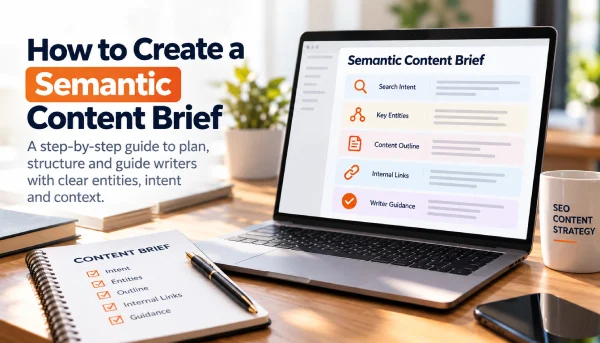
A complete semantic content brief contains eleven operational fields that define the asset from intent to validation:
- Central Entity: The primary concept or real-world subject that defines the macro context of the document.
- Search Intent Classification: The specific informational, commercial, or transactional problem the reader needs to solve.
- Target Audience Profile: The prior knowledge level, technical sophistication, and operational role of the reader.
- Clustered Query Set: A unified group of lexical variations and related questions sharing identical underlying intent.
- Entity–Attribute–Value (E-A-V) Map: The specific properties, factual values, and predicates that describe the central entity.
- Linear Heading Vector: A hierarchical H1–H3 outline engineered to advance the user from definition to execution without topical drift.
- Section-Level Writing Instructions: Answer-first directives, required entity mentions, and specific constraints for every heading.
- Evidence & Source Attributions: Official documentation, patents, and benchmark data required to back empirical claims.
- Contextual Internal Linking Matrix: Verified destination URLs and descriptive anchor concepts that connect related site assets.
- Conversion CTA: A natural, contextual next step aligned with the reader’s stage in their research process.
- Semantic QA Rubric: An objective 12-point pre-publication checklist to verify information gain and passage clarity.
What makes a brief semantic rather than keyword-focused?
A brief becomes semantic when its underlying organizing principle is meaning and entity relationships rather than keyword repetition. Traditional SEO briefs assemble a list of primary and secondary keywords, often scraped from competitor SERPs using statistical TF-IDF tools. Writers are instructed to sprinkle these terms across headings and paragraphs to hit frequency thresholds.
In contrast, an entity-first brief models search engines as semantic retrieval systems. Google’s Knowledge Graph, MUM, and neural rankers do not evaluate pages by string matching; they identify real-world entities, extract their attributes, and evaluate whether a document provides authoritative answers. A semantic brief defines the predicates (e.g., defines, contains, validates) that connect entities, ensuring that every sentence communicates clear, unambiguous relationships.
How Is a Semantic Content Brief Different From a Traditional SEO Content Brief?
A traditional SEO content brief instructs writers on what keywords to include, whereas a semantic content brief instructs writers on what factual questions to answer, what entity attributes to establish, and how concepts relate within an interconnected topical ecosystem.
The table below provides a fair, balanced comparison between traditional keyword-focused briefs and semantic entity-driven briefs across their six primary architectural dimensions:
| Dimension | Traditional SEO Brief | Semantic Content Brief |
|---|---|---|
| Primary Objective | Rank for specific high-volume search queries through keyword inclusion and target word counts. | Satisfy a defined search intent by establishing entity authority, comprehensive attribute coverage, and information gain. |
| Core Inputs | Keyword search volume, keyword difficulty scores, and competitor heading scraping. | SERP intent analysis, Knowledge Graph entity research, internal topical maps, and domain business goals. |
| Outline Structure | Arbitrary heading collections often repeating synonymous variations across multiple subheadings. | Linear heading vectors (H1 → H2 → H3) moving logically from definition to difference, process, and validation. |
| Writer Guidance | Target density metrics (e.g., “Use term X 4–8 times”) and broad tone notes. | Direct answer-first directives, explicit predicate verbs, required source citations, and acceptance criteria per heading. |
| Internal Linking | Generic notes to “add 3–5 internal links” or exact-match anchors placed arbitrarily. | Contextual bridges connecting specific conceptual prerequisites to verified URLs within the topical graph. |
| Quality Assurance | Keyword density checks, readability grade scores, and basic plagiarism detection. | 12-point semantic QA auditing entity clarity, passage independence, factual evidence, and zero topical drift. |
How do the inputs, structure, and writing instructions differ?
The differences between these two methodologies appear across three critical workflows:
- Inputs: Traditional briefs rely heavily on third-party keyword tools that aggregate search volume. Semantic briefs start with ontological research: What is the central entity? What are its intrinsic attributes? Which supporting entities must be mentioned to satisfy the reader’s micro-context?
- Structure: Traditional outlines often create separate H2 sections for minor keyword variants (such as “What is X?”, “What does X mean?”, and “Definition of X”). A semantic brief collapses lexical variants into a single, decisive answer section, using headings exclusively to advance the reader’s workflow.
- Writing Instructions: Rather than vague guidance like “write authoritatively,” semantic briefs provide precise instructions: “In the first sentence of H2, provide a 25-word definition naming Entity X, its primary function, and its key deliverable. In paragraph 2, compare Entity X to Entity Y using the provided E-A-V table.”
When is a standard SEO brief enough?
A standard brief may suffice for low-competition, transactional e-commerce categories or simple localized queries where search intent is purely navigational (e.g., “shoe repair near me” or “blue cotton t-shirt”). However, for B2B services, technical guides, SaaS products, and competitive informational topics, a standard brief inevitably leads to shallow content that fails to earn citations in Google AI Overviews or establish lasting semantic SEO authority.
Why Do Entities and Attributes Matter in a Semantic Content Brief?
Entities and attributes matter because modern search engines build knowledge graphs to understand the real world. By defining entities and their attributes explicitly in a brief, you ensure your content speaks the exact relational language search algorithms and AI systems use to retrieve and synthesize facts.
An entity is a distinct, well-defined thing or concept (e.g., Semantic Content Brief, Search Intent, or Google Knowledge Graph). An attribute is a property or characteristic of that entity (e.g., Purpose, Input Data, or Validation Method). A value is the specific fact or explanation assigned to that attribute.
How does entity–attribute–value mapping work?
Entity–Attribute–Value (E-A-V) mapping provides the factual backbone of a semantic brief. Instead of letting writers guess what to cover, the strategist specifies the exact properties that must be explained. The following table illustrates an accurate E-A-V map for the central entity of this guide:
| Entity | Attribute / Relation | Expected Value or Explanation | Semantic Role |
|---|---|---|---|
| Semantic content brief | Purpose | Guides a writer to create one content asset that completely satisfies a defined intent. | Primary definition |
| Semantic content brief | Inputs | Query research, audience task analysis, entity research, existing site content, business objective. | Operational boundary |
| Semantic content brief | Core Fields | Intent, central entity, E-A-V map, query groups, outline, section directives, evidence, links, CTA, QA. | Component specification |
| Heading vector | Function | A logical sequence moving the reader from definition to comparison, process, application, and validation. | Structural constraint |
| Information gain | Editorial Test | Useful insight beyond competitor repetition, including worked templates, decision rules, and QA methods. | Quality differentiator |
How do entity relationships connect related concepts?
In semantic SEO, knowledge is represented as a directed graph where entities are nodes and predicates are connecting edges. In a semantic content brief, this relationship structure is formalized as follows:
- Brief → [defines] → Document Scope
- Brief → [contains] → Intent, E-A-V Map, and Heading Vectors
- Brief → [guides] → Writer and Subject Matter Expert
- Brief → [links to] → Supporting Pillar Pages and Services
- Brief → [is validated by] → Semantic QA Checklist
When writers construct sentences around these explicit relationships, search crawlers can parse subject-predicate-object triples effortlessly, significantly improving the page’s topical confidence score.
How do you distinguish a core entity from a supporting entity?
The central entity represents the main subject of the document (the macro context). Every section of the page must directly describe, evaluate, or apply this entity. A supporting entity is a secondary concept necessary to explain an attribute of the central entity (such as Search Intent or Internal Linking).
Topical drift occurs when a writer allows a supporting entity to hijack the macro context. For example, if a brief on semantic briefs spends four paragraphs explaining how to configure Google Search Console, the macro context has drifted. Supporting entities must be addressed strictly to the extent required to complete the main user task, with in-depth explorations delegated to specialized guides via contextual internal links.
What Should a Semantic Content Brief Include?
A comprehensive semantic content brief includes six core operational modules: (1) editorial objective & intent, (2) query clustering, (3) E-A-V knowledge map, (4) heading vector outline with section directives, (5) original information gain assets, and (6) contextual internal links with QA acceptance criteria.
Topic, audience, purpose, and search intent
This module establishes the document’s reason for existing. It records the primary audience’s job-to-be-done, their baseline technical understanding, the commercial goal of the page, and the primary search intent. The brief must cite concrete SERP evidence proving why the chosen intent format (e.g., step-by-step tutorial vs. conceptual guide) is the optimal vehicle.
Primary query, query variations, and related questions
Instead of listing dozens of disjointed keywords, the strategist groups lexical variations by their underlying attribute need. For example, queries like “how to write an SEO brief”, “SEO content brief template”, and “what to include in a content brief” are grouped under their shared functional intent. The brief explicitly instructs the writer not to turn every slight query variation into a separate heading.
Entity map, attributes, values, and relationships
This section outlines the central entity, primary supporting entities, and the E-A-V table. It identifies the specific predicates that must connect concepts and flags any disputed technical facts that require verification against primary sources.
H1–H3 outline and section-level instructions
The outline is the heart of the brief. For every single H2 and H3, the strategist specifies:
- Direct Answer Requirement: The exact factual conclusion the writer must state in the opening sentences.
- Required Supporting Points: Specific concepts, constraints, or nuances to unpack.
- Evidence / Citations: Authoritative data, documentation, or case study results to incorporate.
- Acceptance Criteria: Objective checks the editor will use to approve the section.
Evidence, sources, and original information gain
Google’s Information Gain patents reward documents that provide unique utility beyond existing SERP consensus. The brief must specify what original value the page contributes—whether that is a downloadable template, a real-world worked case study, an original comparison matrix, or proprietary research findings.
Internal links, CTA, metadata, and quality checks
The final module details verified internal link destinations with descriptive anchor concepts, the page’s title tag, meta description, and the pre-publication QA checklist.
How Do You Create a Semantic Content Brief Step by Step?
Creating a semantic content brief follows a 7-step engineering process: define macro context → audit live SERP intent → group queries by attribute → map E-A-V relationships → construct linear heading vectors → integrate evidence and links → write section-level acceptance criteria.

Step 1: Define the central entity and macro context
Formulate the scope of the document in two concise sentences: (1) A definition sentence naming the central entity and its fundamental category, and (2) An objective sentence defining what problem the reader will be equipped to solve upon finishing the page. This locks the document’s boundary and prevents scope creep.
Step 2: Research the SERP and classify search intent
Examine top-ranking organic results, People Also Ask boxes, and AI Overview summaries for the target market and device. Identify the dominant format expectations (e.g., definitions, step-by-step walkthroughs, downloadable tools). Use SERP findings as empirical evidence of user needs, never as a mandate to blindly copy competitor outlines.
Step 3: Build the query set and group queries by attribute
Harvest relevant queries and cluster them into logical attribute buckets. Create separate pages only when query intent represents an entirely distinct user task that cannot be answered comprehensively within the current document’s macro context.
Step 4: Map entities, attributes, values, and relationships
Construct the E-A-V matrix. Identify the central entity, 3–6 supporting entities, and their required attributes. Filter out any tangential entities that do not directly advance the user’s primary objective.
Step 5: Design the heading vector from answers, not keywords
Structure the H2 and H3 headings in a strict, progressive vector: Definition → Difference → Core Components → Step-by-Step Workflow → Practical Application → Quality Validation. Ensure every heading represents a meaningful question or phase in the reader’s workflow.
Step 6: Add evidence, internal links, and supplementary content
Identify claims requiring empirical support and map internal links to relevant existing content hubs on your domain (such as your entity-based semantic SEO guide or service pages). Specify necessary diagrams, tables, or calculators.
Step 7: Write section briefs and run semantic QA
Equip the writer with explicit answer-first requirements, required attribute coverage, and acceptance criteria for every heading. Perform a final audit against the 12-point QA rubric before handing the brief over to production.
How Do You Write Each Section of a Semantic Content Brief?
To write each section of a semantic content brief, apply four strict editorial rules: deliver direct answers in paragraph one, use explicit entity names and strong predicate verbs, make key passages self-contained, and deploy structured tables or diagrams wherever relational data is presented.
Answer the heading before expanding
Every H2 and H3 section must begin with a clear, direct answer to the question posed by the heading. The first 1–2 sentences must satisfy the immediate query need. Only after this initial resolution should the writer expand into mechanistic explanations, edge cases, implementation steps, or supporting examples. This answer-first architecture aligns directly with how Google’s Passage Ranking and AI Overviews extract featured snippets.
Use explicit entities and precise predicates
Vague phrasing degrades semantic clarity. Writers should minimize ambiguous pronouns (such as it, this, these, or they) when introducing or linking concepts. Use explicit entity names and strong, domain-specific predicates such as defines, configures, contains, connects, indexes, and measures instead of generic verbs like deals with or is about.
Make important passages self-contained
Search algorithms index and evaluate content in passages. A key definition, process step, or comparison must be fully understandable on its own without requiring the reader (or crawler) to reference a paragraph three sections earlier. Reinforce the subject entity whenever transitioning between distinct concepts.
Use examples, tables, and diagrams when they clarify relationships
Avoid decorative visuals. Every table, chart, or infographic must serve an analytical purpose by displaying structured relationships, comparing attributes, or illustrating workflows that prose alone cannot convey with equal speed and precision.
Semantic Content Brief Template: What Should the Writer Receive?
The writer should receive a clean, structured specification document containing the editorial header, entity-attribute-value matrix, heading vector writing plan with section directives, and internal linking checklist.
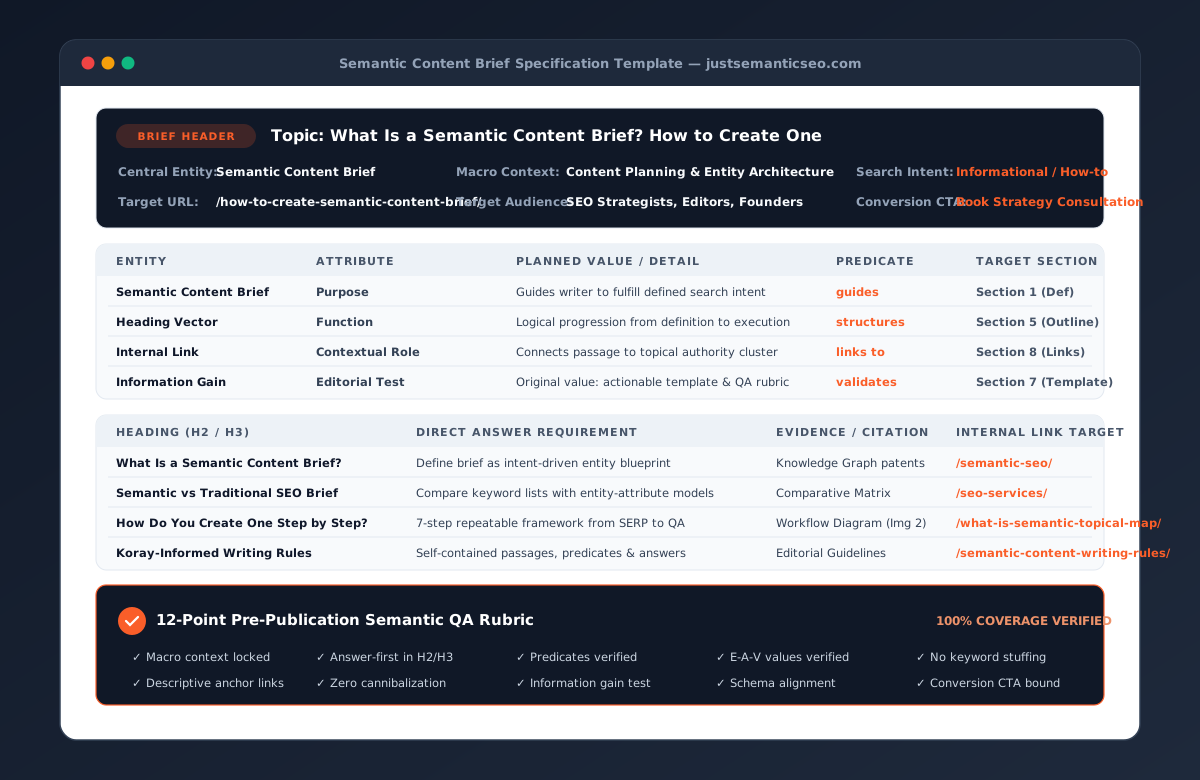
Below is the complete, copyable Markdown template you can adapt for your editorial operations. Click the button in the top right to copy the entire blueprint to your clipboard:
# SEMANTIC CONTENT BRIEF: [Insert Document Title]

## 1. EDITORIAL HEADER & METADATA
- **Target URL / Slug:** /[slug]/
- **Primary Search Query:** [Target Query]
- **Search Intent:** [Informational / Commercial / Transactional / Navigational]
- **Target Audience & Role:** [e.g., SEO Directors, Enterprise Marketing Leads]
- **Reader Problem / Task:** [The specific challenge this asset solves]
- **Central Entity:** [The primary subject defining the macro context]
- **Macro Context:** [1-sentence boundary definition]
- **SEO Title (Tag):** [Primary Query - Benefit | Brand] (Max 60 chars)
- **Meta Description:** [Action-oriented summary answering intent] (Max 155 chars)
- **Conversion Goal / CTA:** [e.g., Book Consultation / Download Template / Contact]

---

## 2. CLUSTERED QUERY SET & ATTRIBUTES
- **Primary Query:** [Primary query]
- **Intent-Matched Lexical Variants:**
  - [Variant query 1]
  - [Variant query 2]
  - [Variant query 3]
- **Direct Questions to Answer:**
  - [Question 1]
  - [Question 2]
  - [Question 3]
- **Editorial Rule:** Do NOT create separate headings for minor keyword variations.

---

## 3. ENTITY–ATTRIBUTE–VALUE (E-A-V) MATRIX
| Entity | Attribute / Relation | Expected Value / Fact | Predicate | Outline Section |
| :--- | :--- | :--- | :--- | :--- |
| [Central Entity] | Purpose | [Direct purpose statement] | guides | Section 1 |
| [Central Entity] | Core Components | [List of required components] | contains | Section 3 |
| [Supporting Entity 1] | Function | [Explanation of role] | structures | Section 4 |
| [Supporting Entity 2] | Relation | [Connection to central entity] | links to | Section 5 |

---

## 4. HEADING VECTOR & WRITING DIRECTIVES

### H1: [Direct Document Title Incorporating Primary Query]

### H2: [Section 1: Definitional Question]
- **First-Sentence Requirement:** State a direct 25–35 word definition answering the heading immediately.
- **Required Supporting Points:** [Point 1, Point 2, Point 3]
- **Entities & Predicates:** Mention [Entity A] connecting to [Entity B] via predicate [verb].
- **Evidence / Citation:** [Official documentation / patent / research source].
- **Acceptance Criteria:** [Objective approval rule].

### H2: [Section 2: Comparative Distinction]
- **First-Sentence Requirement:** Differentiate [Concept A] from [Concept B] directly.
- **Required Format:** Include a comparison table with dimensions: Objective, Inputs, Structure, QA.
- **Internal Link:** Anchor: [descriptive anchor] → Target: /[relevant-pillar-url]/

### H2: [Section 3: Step-by-Step Implementation Framework]
- **First-Sentence Requirement:** State the complete multi-step process overview.
- **Numbered Steps:** [Step 1 to Step N with actionable instructions].
- **Visual Asset:** [Embed workflow diagram or screenshot].

### H2: [Section 4: Practical Template & Worked Example]
- **First-Sentence Requirement:** Introduce the practical resource and explain each field.
- **Required Deliverable:** Provide copyable template and worked walkthrough.

### H2: [Section 5: Common Mistakes & Corrections]
- **First-Sentence Requirement:** Identify the most critical failure mode and how to avoid it.
- **Format:** Subheadings for each mistake with explicit correction instructions.

### H2: Frequently Asked Questions
- **FAQ 1 (H3):** [Question]? → Direct 2–3 sentence answer.
- **FAQ 2 (H3):** [Question]? → Direct 2–3 sentence answer.
- **FAQ 3 (H3):** [Question]? → Direct 2–3 sentence answer.

---

## 5. CONTEXTUAL INTERNAL LINKING MATRIX
| Source Section | Target URL | Suggested Descriptive Anchor | Conceptual Reason |
| :--- | :--- | :--- | :--- |
| Section 1 | /seo-services/ | semantic SEO services | Explains implementation execution |
| Section 2 | /what-is-semantic-topical-map/ | semantic topical map | Connects document to site-wide strategy |
| Section 4 | /semantic-content-writing-rules/ | semantic content writing rules | Provides writer sentence-level framework |

---

## 6. PRE-PUBLICATION SEMANTIC QA CHECKLIST
- [ ] 1. Opening paragraph directly answers the primary search intent.
- [ ] 2. One coherent central entity guides the entire document without scope drift.
- [ ] 3. Every H2 and H3 begins with a direct answer before expanding.
- [ ] 4. All E-A-V table facts are verified against authoritative primary sources.
- [ ] 5. Outline follows a linear heading vector (Definition → Process → Execution → QA).
- [ ] 6. Sentences use strong, explicit predicate verbs (defines, maps, connects, validates).
- [ ] 7. Important passages are self-contained and clear without ambiguous pronouns.
- [ ] 8. Internal links connect to verified URLs using natural, descriptive anchor text.
- [ ] 9. No keyword stuffing, arbitrary word-count filler, or unsupported ranking claims.
- [ ] 10. Article and FAQ schema markup validate cleanly and match visible page content.
How Should Internal Links Work in a Semantic Content Brief?
Internal links in a semantic content brief must function as conceptual bridges that connect the current document to relevant prerequisite concepts, parent topical clusters, and conversion endpoints using descriptive, natural anchor text.
Link to pages that explain a necessary concept
A semantic link strategy treats each page on your website as a node within a connected knowledge graph. When your article introduces a complex concept that requires its own deep exploration, you link to the designated authority page for that topic. For example:
- When referencing high-level site architecture, connect to your semantic topical map guide.
- When referencing sentence-level drafting standards, bridge to the Koray-informed semantic content writing rules.
- When readers require hands-on strategic assistance, link to professional semantic content brief creation services or agency semantic SEO services.
Use descriptive anchors and natural contextual bridges
Avoid generic anchor text (such as click here, read more, or this article) and avoid awkward exact-match keyword stuffing. The anchor text should clearly describe the destination topic so both users and search crawlers anticipate the subject of the target page before navigating.
Check topical overlap and cannibalization
Before commissioning a brief, the strategist must check the domain’s existing index in Google Search Console. If an existing URL already ranks for the primary query or satisfies the same underlying intent, do not publish a competing article. Instead, either consolidate the legacy URL by updating it with the semantic brief or create a net-new page only if there is a distinct search intent and unique information gain to justify it.
How Do You Measure and Validate a Semantic Content Brief?
A semantic content brief is measured and validated through a rigorous pre-publication editorial audit that checks entity coverage, factual evidence, passage independence, and structural hierarchy before any drafting is approved.
Check intent and entity coverage
Verify that every core user task identified during SERP analysis is comprehensively answered within the outline. Confirm that all required attributes in the E-A-V matrix have designated sections and that no essential entity has been omitted.
Check factual support and passage clarity
Audit every empirical claim, percentage, date, and technical specification against primary sources (such as official Google Search Central documentation, W3C standards, or peer-reviewed research). Eliminate unsupported assertions or hype-driven ranking guarantees.
Check structure, links, and duplication
Ensure that heading tags follow an unbroken sequence (H1 → H2 → H3) with no skipped levels for visual formatting. Confirm that all internal link URLs return 200 OK status codes and that no sections repeat the same answer under different headings.
Review performance after publication
Track the published document in Google Search Console over 30, 60, and 90-day intervals. Monitor impressions across long-tail semantic query variations, evaluate citation frequency in AI Overviews, and review on-page engagement metrics to iterate on the brief if secondary intents emerge.
Semantic Content Brief Example: From Query to Writing Plan
Here is a real-world demonstration showing how the query “semantic content brief” was translated from raw search data into an actionable E-A-V map and section-level writing instruction for this very guide.
Example query and intended answer
- Target Query:
semantic content brief - Target Audience: SEO managers, in-house content strategists, and agency founders looking to upgrade writer output.
- Identified Search Intent: The reader needs to understand what differentiates a semantic brief from standard keyword templates and requires an actionable, repeatable process to construct one immediately.
- Intended First Sentence Answer: “A semantic content brief is an entity-driven editorial blueprint that maps search intent, Knowledge Graph entities, attributes, values, and heading vectors to direct a writer in producing self-contained, high-authority content.”
Example entity–attribute–value map
During the planning phase, the strategist established the following core relational triples:
- Entity:
Semantic content brief• Attribute:Purpose• Value: Guides one content document for a defined search intent • Predicate: guides - Entity:
Heading vector• Attribute:Function• Value: Logical progression from definition to execution • Predicate: orders - Entity:
Information gain• Attribute:Deliverable• Value: Copyable template and 12-point QA rubric • Predicate: provides
Example heading with a writing instruction
The strategist provided the following explicit directive for Section 5 of this guide:
“Heading: How Do You Create a Semantic Content Brief Step by Step?
Directive: Open with a direct sentence stating the 7-step process. Embed the workflow diagram (Figure 2). For each step (H3), provide a 2-sentence actionable rule with zero generic fluff. In Step 6, include a contextual link to /semantic-seo/ using the anchor ‘entity-based semantic SEO’.”
Common Semantic Content Brief Mistakes to Avoid
The four most damaging mistakes in semantic brief creation are: treating related terms as a keyword stuffing checklist, adding redundant headings that fracture macro context, making unverified AI-citation promises, and writing vague directives that leave writers guessing.
Treating related terms as a checklist
Some strategists extract 50 “entities” from NLP tools and dump them into a brief with instructions to “mention each term at least once.” This is simply legacy keyword stuffing disguised as semantic SEO. Include an entity only if it represents an attribute that genuinely answers the user’s intent or establishes a meaningful technical connection.
Adding headings without a distinct purpose
Creating separate subheadings for near-identical search queries (e.g., having an H2 for “Why are semantic briefs important?” followed immediately by an H2 for “Benefits of semantic briefs”) dilutes topical focus. Consolidate overlapping questions into a single authoritative section that answers the topic once and for all.
Making unsupported ranking or AI-citation promises
Semantic content engineering improves structural clarity, information extraction, and topical authority. It is not a magical hack that guarantees immediate #1 rankings or automated citations in ChatGPT and Google AI Overviews. Present semantic briefs as an editorial rigor methodology, not an algorithmic guarantee.
Writing a brief that is too vague to execute
A brief that merely lists headings without section-level answers, evidence requirements, and acceptance criteria forces the writer to conduct their own unstructured research. This defeats the purpose of the brief and inevitably produces generic, fluff-filled articles.
Frequently Asked Questions About Semantic Content Briefs
Yes. By establishing clear entity relationships, satisfying complete search intent, and organizing content into self-contained passages, a semantic brief significantly improves a page’s indexability, topical confidence score, and eligibility for passage ranking and AI citations.
Yes. Query research remains essential because it reveals the exact vocabulary, intent, and recurring questions searchers use. However, a semantic brief uses query data to map underlying user problems and entity attributes rather than as a checklist for mechanical keyword repetition.
No. A semantic topical map is a site-wide architectural plan that organizes dozens or hundreds of topics into topical clusters. A semantic content brief is a tactical, document-level specification designed to plan and execute a single individual URL within that map.
There is no fixed quota. A brief should define exactly one central entity to anchor the macro context, supported by 3 to 8 essential supporting entities that directly explain necessary attributes. Adding irrelevant entities introduces topical noise and weakens contextual clarity.
No. Synonymous query variations sharing the same underlying intent must be grouped together and answered within a single, authoritative section. A new heading should only be created when it introduces a distinct user task, comparative dimension, or process step.
AI tools can accelerate initial query clustering and SERP summaries, but they cannot independently verify domain architecture, audit internal link opportunities, ensure factual precision, or create original information gain. A qualified SEO strategist must oversee entity mapping and quality control.
A semantic brief typically ranges from 1,200 to 2,500 words depending on topic complexity. Completeness, actionable section directives, and verified evidence sources matter far more than an arbitrary word count.
Conclusion: Build Briefs Around Meaning, Not Just Keywords
A high-performing semantic content brief transforms content creation from a subjective, hit-or-miss writing exercise into a predictable, engineered process. By anchoring your articles in one clear macro context, explicitly mapping entity–attribute–value relationships, and requiring answer-first passage construction, you produce content that both users and intelligent search systems recognize as authoritative.
Ready to Scale Your Semantic Content Engine?
Stop wasting budget on shallow keyword articles. Let JustSemanticSEO architect your topical maps, entity graphs, and production-ready semantic content briefs.
Book a Free Semantic SEO Consultation →