
Home › Semantic SEO › Semantic SEO Audit
A semantic SEO audit is a structured check of whether each page on a site owns one clear search intent, covers its topic completely, and names the right entities with the right attributes. It ends in one decision per page. Keep, enrich, merge, create, delete or noindex. Most guides for this work hand you a checklist to read and thresholds with no source behind them. This guide runs the audit differently. Every step below maps to a measurement you can produce yourself, free, and the limits of each measurement are stated next to it, because an audit that hides what it cannot settle is a sales document, not a diagnostic.
What is a semantic SEO audit?
A semantic SEO audit examines meaning, coverage and intent ownership, where a technical audit examines crawlability and a content audit examines quality. The 3 audits answer different questions, and running the wrong one produces confident work on the wrong problem.
| Audit | The question it answers | What it examines |
|---|---|---|
| Technical SEO audit | Can search engines reach and render the pages? | Crawl rules, indexation, status codes, speed, structured data validity |
| Content audit | Is the content good enough to keep? | Accuracy, freshness, engagement, duplication at the text level |
| Semantic SEO audit | Does each page own the right intent with complete topical coverage? | Query ownership, entity coverage, topical gaps, internal link meaning, decision per page |
A site can pass a technical audit completely and still fail a semantic one. Every page returns 200, every page is indexed, and 2 pages still answer the same query while the topic buyers actually search for has no page at all. That failure is invisible to crawl reports. It is the failure this audit exists to find. The wider difference between the 2 approaches sits in our guide to semantic SEO vs traditional SEO.
What does a semantic SEO audit need before it can judge a page?
It needs the evidence every meaning judgement in the audit is made from. The site’s full crawl, the queries its pages already earn, the services the business actually sells, and the live results for its core topics. A semantic audit compares what each page means against what its topic demands, so without those 4 inputs there is nothing to compare against. Audits that start by running a tool produce tool output, not findings.
A full crawl of the site. Every URL, its status, its title, its heading structure and its internal links. The crawl is the inventory the audit works on, and a partial crawl produces decisions about a site that does not exist.
Search Console queries for at least 3 months. The queries a site already earns impressions for are the ground truth of query ownership. They show which page Google has chosen for each query, which is sometimes not the page the site intended. Shorter windows miss seasonal queries and give new pages no history at all.
The services and facts of the business, from the business. The audit compares the site against what the company actually sells. A page cannot be judged as a gap or a strength until the real offer is known, and this input cannot be crawled.
The live search results for the core queries. The results page shows the intent Google currently rewards and the coverage the ranking pages carry. Auditing a page against an imagined intent produces edits aimed at a target that moved.
How do you run a semantic SEO audit?
You run it in gate order, because each step depends on the one before it, and you finish with exactly one decision for every page. Skipping ahead is how audits produce recommendations that contradict each other. A page marked for enrichment in step 4 cannot be merged in step 8, and the order below is what prevents that.
Step 1. Build the inventory and assign query ownership
List every indexable page and write down the one query pattern each page is meant to own. Koray Tuğberk GÜBÜR’s framework calls this the query demand pattern. One pattern of demand, one page built to satisfy it. Pages with no pattern written beside them are the audit’s first finding, because a page nobody assigned an intent to is a page answering by accident.
Step 2. Test one page, one intent
Read each page and state its intent in one sentence, then compare that sentence with the queries the page actually earns. A page whose stated intent and earned queries disagree is misaligned, whatever its traffic looks like. A service page earning informational queries is not a success story. It is a page Google had to place somewhere, placed where the meaning fit least badly.
Step 3. Find cannibalization and misalignment
Group the earned queries by pattern and count how many pages compete for each pattern. 2 pages splitting one pattern split the signals with it, and both rank below what one consolidated page would hold. The reverse defect matters too. One page earning queries from 2 different patterns is serving neither intent fully, and it is a split candidate rather than an enrichment candidate.
Step 4. Measure topical coverage
Compare the site’s page set against the full topic, not against the pages it happens to have. The topic defines the coverage, through the entities, subtopics and questions the search results and reference sources carry. A site covering 1 branch of its topic deeply and the rest not at all has a coverage shape problem that no amount of editing inside the existing pages will fix. Our topical map example shows a complete coverage map built this way, node by node, before any page was written.
Step 5. Find the entity gaps
Extract the entities each page names, with their attributes, and compare them against the entity set the topic requires. A gap takes 3 forms. The entity is missing entirely, the entity is named but its defining attributes are absent, or the entity is present but disconnected from the entities around it. Each form has a different fix, which is why the audit records the form and not just the gap. Our entity SEO guide covers the entity attribute value structure these checks read.
Step 6. Read the internal links as meaning
Check whether internal links connect pages the way the topic connects ideas. A link tells the crawler and the reader that 2 pages belong to one context. Links placed for count, or pointed at pages whose intent is unrelated to the passage carrying them, dilute that signal. The audit records links that contradict the topic structure separately from links that are merely missing, because the fix for a wrong link is removal, not addition.
Step 7. Check the schema against the page
Confirm the structured data states the same entities and facts the visible page states, no more and no less. Schema that claims what the page does not say is a liability, and schema absent where the page names clear entities is a missed reinforcement. This step is a consistency check. It comes last among the page checks because it can only be judged once the page’s real meaning is settled by the steps above.
Step 8. Decide, one decision per page
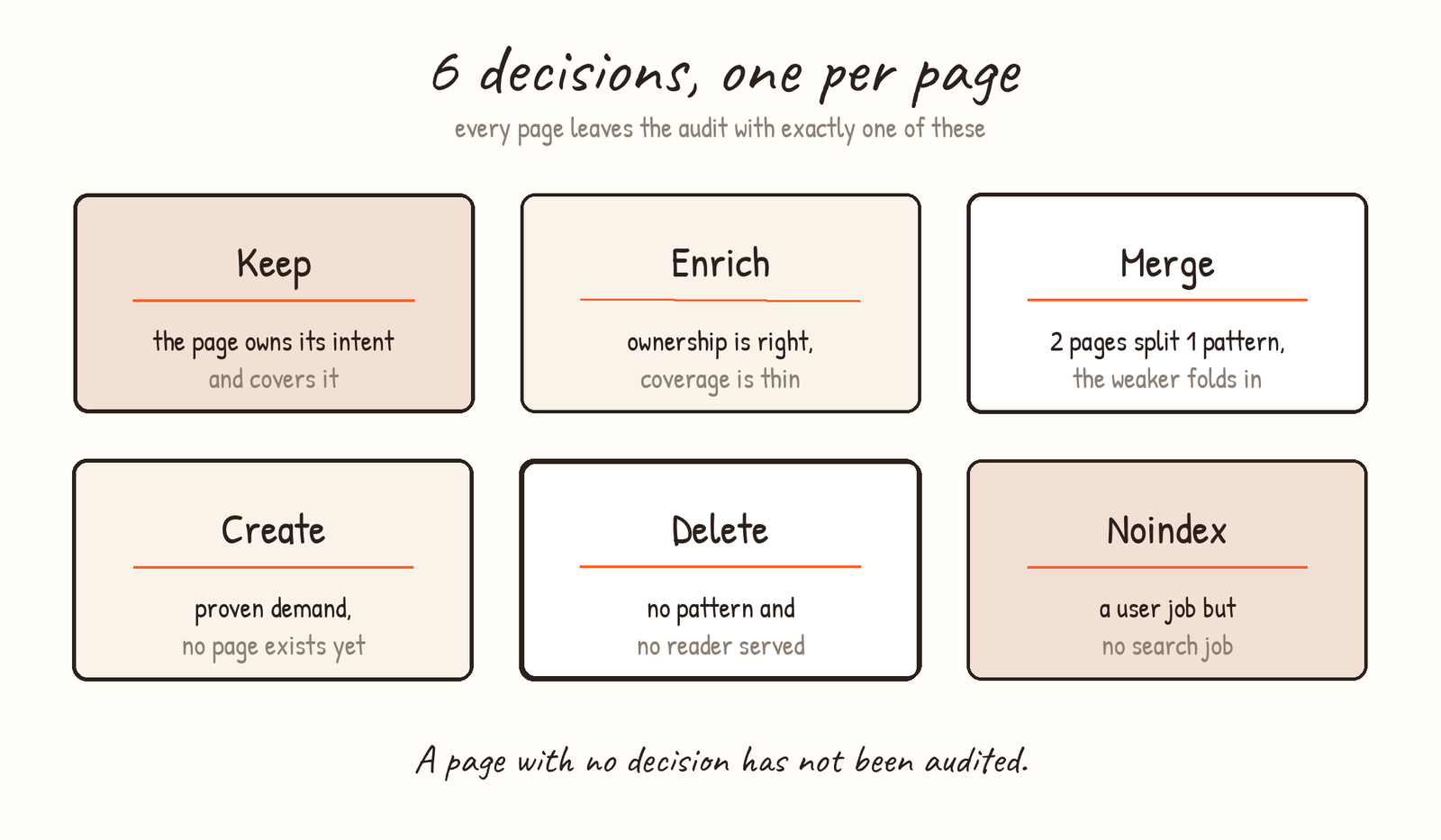
Every page leaves the audit with exactly 1 of 6 decisions, and a page with no decision has not been audited. Keep means the page owns its intent and covers it. Enrich means the ownership is right and the coverage or entity depth is thin. Merge means 2 pages split one pattern and the weaker folds into the stronger. Create means a pattern with proven demand has no page. Delete means the page serves no pattern and no reader. Noindex means the page has a user job but no search job, the login and account pattern. A create decision then becomes a content brief before it becomes a page, and our guide to semantic content briefs covers that handover.
How do you measure each step?
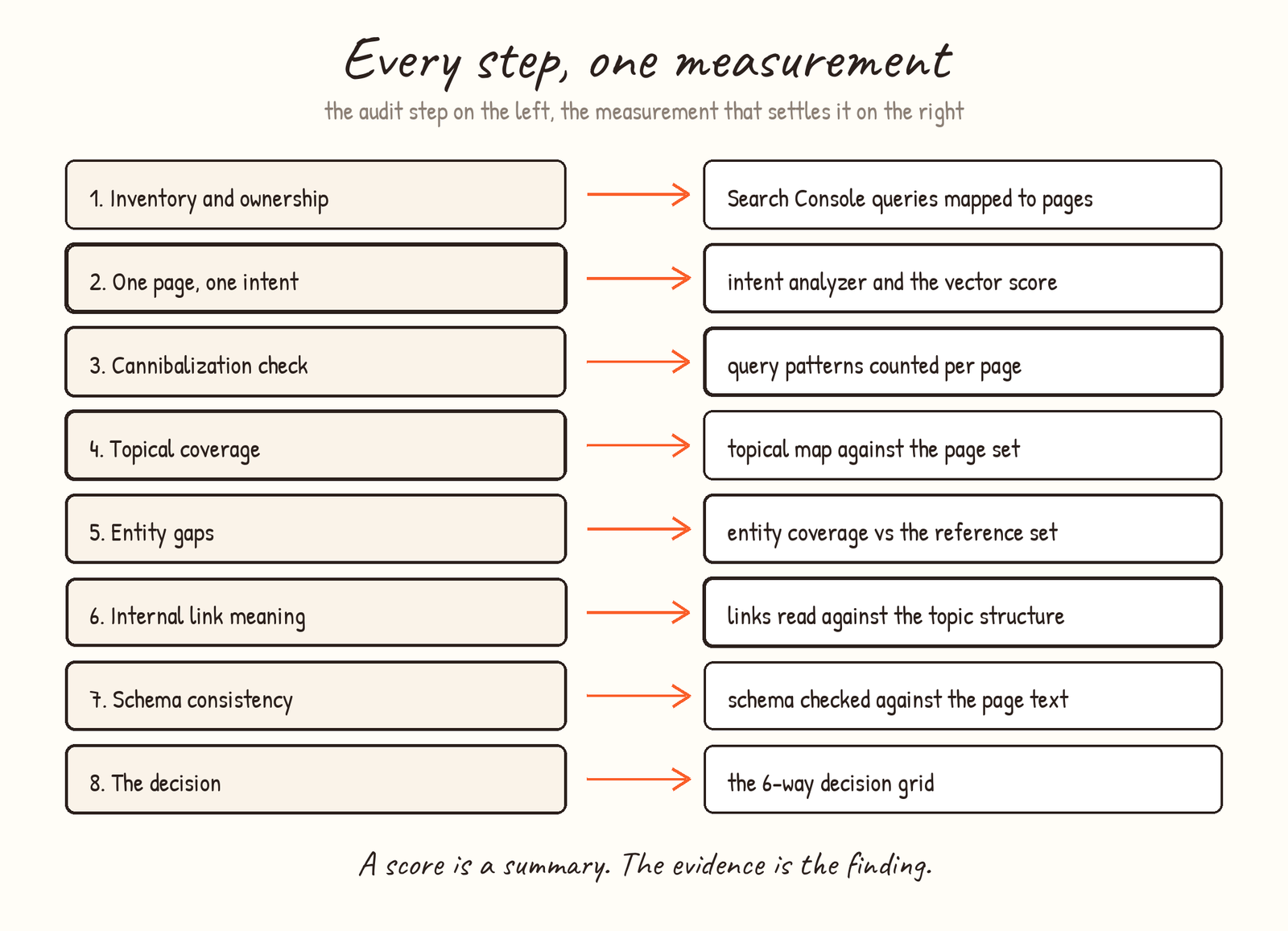
You measure with tools that quote evidence, and you treat every score as a summary of findings you can open, never as the finding itself. The free suite on this site was built for exactly this method, 14 tools under one audit page, each producing the measurement for its step. The main audit runs 36 semantic checks and 40 E-E-A-T checks on a single page and quotes the page evidence behind every result.
| Audit step | Measurement | What a pass looks like |
|---|---|---|
| Query ownership | Search Console queries mapped to pages | 1 page earns each query pattern |
| Intent match | Search Intent Analyzer and Vector Relevance Checker | The page classifies to its stated intent and scores close to its query |
| Topical coverage | Topical Map Generator | Every core node in the map has a page |
| Entity gaps | Entity Coverage Checker | The page names the entities in the topic’s Wikipedia reference set |
| Wording gaps | N-gram Reference Compare | The page’s phrases cover the reference article’s core phrases |
| Schema | Schema Generator | Generated markup matches the entities the page states |
| Page structure and trust | Main audit, Semantic and E-E-A-T panels | Findings quoted from the page, each one openable |
The Vector Relevance Checker deserves a plain explanation, because it is the measurement most guides fake. It computes real vector embeddings of your page text and your target query in the browser and reports the similarity between them. A high score means the page’s meaning sits close to the query’s meaning. A low score on a page you believed was on topic is one of the most useful findings an audit produces, because it is a number, not an opinion.
Now the honest limits, which the guides selling threshold checklists leave out. The main audit examines 1 page deeply. A site-wide audit needs the crawl comparison across pages, which is method work, not a single run. Where a check cannot be settled from the fetched page, the tool marks it not verified and removes it from the score instead of guessing. And the thresholds printed in most semantic audit checklists, a 40 to 60 word answer under every heading, entity salience above 0.3, 70 percent topical coverage, are rules of thumb from practitioner posts. No Google document states them. Treat any threshold without a source as a prompt to look closer, never as a pass mark.
What does a worked pass look like?
Take one page type every service business has, the core service page, and run the gates in order. No client is named and no figures are quoted, because the shape of the pass is the lesson.
The inventory step finds the service page and, beside it, a blog post written a year earlier that drifted onto the same query pattern. Ownership is split before the audit reads a word of content. The intent step shows the service page opening with educational material, so its first screen answers an informational intent while the page exists to convert a commercial one. The cannibalization step confirms the split in the query data, with both pages earning impressions for the same pattern and neither holding a stable position.
The coverage step finds the service page naming the service but skipping 2 subtopics the ranking pages all carry. The entity step finds the main entity named with none of its defining attributes stated, so the page says what the service is called and almost nothing about what it consists of. The link step finds the blog post linking to the service page from an unrelated passage, and the schema step finds markup describing a service the page text describes differently.
The decisions write themselves once the gates have run in order. Merge the blog post into the service page, keeping its 1 section that answers a genuine sub-question. Enrich the merged page with the missing subtopics and the entity attributes. Fix the schema to match the corrected text. 3 decisions, each traceable to a step, none of them a rewrite-everything recommendation.
What does not work in a semantic SEO audit?
The failures below fail because they substitute a shortcut for a measurement. They are the items most often sold as semantic auditing.
LSI keywords. There is no such layer in how search engines process text, and no Google source has ever described one. A tool selling LSI keyword lists is selling a word list with a technical name, and an audit built on it measures nothing.
Word count as a pass criterion. A page passes on coverage and intent match, not on length. A 900 word page can cover a topic completely and a 4,000 word page can circle it without landing. Audits that fail pages for being short produce longer pages, not better ones.
Schema treated as meaning. Markup restates what a page says in a machine-readable form. It does not add meaning the page lacks, and generating schema for entities the text never establishes produces claims the page cannot support.
Thresholds quoted without a source. The 40 to 60 word answer, the 0.3 salience line and the 70 percent coverage figure travel from guide to guide with no document behind any of them. An audit is only as honest as its evidence, and a number nobody can source is not evidence.
When does a semantic SEO audit need outside help?
Outside help pays when the audit’s decisions are clear and the business cannot execute them, or when nobody inside can read the query data honestly. The warning signs are concrete. The same pages have been edited repeatedly without the positions moving. The site has grown by accumulation, with no page ever assigned an intent. The team argues about which page should rank because the ownership question was never settled. The audit itself is a defined piece of work. 4 inputs, 8 steps, 1 decision per page, and a brief for every create decision that follows.
Start with the page that matters most
The free site audit quotes the evidence behind every finding, and the 14 tools beside it produce the measurement for each step in this guide.
A full programme runs the audit across the whole site and then executes the decisions in priority order, merges and enrichments before new creation. Our AI SEO services page sets out how that work is scoped when it sits outside your team. Whether the work is internal or external, the discipline is the same. Measure first, decide once per page, and let the evidence carry the argument.
Frequently asked questions
How is a semantic SEO audit different from a technical SEO audit?
A technical audit asks whether search engines can reach the pages, and a semantic audit asks whether the pages deserve to be reached for the queries that matter. The technical audit covers crawl rules, indexation, status codes and rendering. The semantic audit covers query ownership, intent match, topical coverage and entity depth. A site needs both, in that order, because semantic findings on pages Google cannot crawl are theoretical.
How long does a semantic SEO audit take?
The page-level measurements take minutes per page, and the site-wide method takes days on a large site because the decisions are the work. Running the tools is the fast part. Reading 3 months of query data, settling ownership disputes between pages and writing a defensible decision for every URL is where the time goes. An audit delivered in an hour is a tool export with a logo on it.
How often should you run a semantic SEO audit?
Run the full audit when the site changes shape, and re-run the measurements on key pages after every significant edit. A new service line, a restructure or a traffic drop with no technical cause all justify the full pass. Between those events, the per-page tools catch drift cheaply, because a page edited 5 times in a year can wander off its intent without anyone noticing.
Can a tool run a semantic SEO audit for you?
A tool can produce every measurement in this guide, and it cannot make the decisions. Ownership disputes, merge calls and delete calls carry business consequences a tool cannot weigh, including which service the company wants to sell more of. The honest division of labour is tools for evidence, a person for decisions. Any service claiming the tool alone is the audit is skipping the part that makes an audit worth paying for.
What is the first thing to fix after a semantic SEO audit?
Fix split ownership first, because every other improvement is weakened while 2 pages divide one pattern. Merges consolidate the signals the enrichment work then builds on. Enriching both competing pages separately is the most common wasted spend after an audit, since the audit already showed that the pattern supports 1 strong page, not 2 adequate ones.
Is a semantic SEO audit the same as an AI visibility audit?
No, and the overlap is partial in both directions. A semantic audit settles whether your pages own their intents with complete coverage, which is the foundation AI systems retrieve from. An AI visibility audit measures whether the engines actually name and cite you, which depends on retrieval and third-party sources as well. The cross-engine discipline is covered in our answer engine optimization playbook.

Written by Hanzala Khan
Hanzala Khan has over 5 years of specialized experience in entity-based search optimization, Knowledge Graph engineering, and topical authority architectures. He specializes in designing custom semantic topical maps, advanced Schema.org data layers, and algorithmic authorship frameworks that help enterprise brands achieve durable search dominance and AI citation authority across Google, Perplexity, and ChatGPT.