
What is a Semantic Topical Map? – Complete Guide
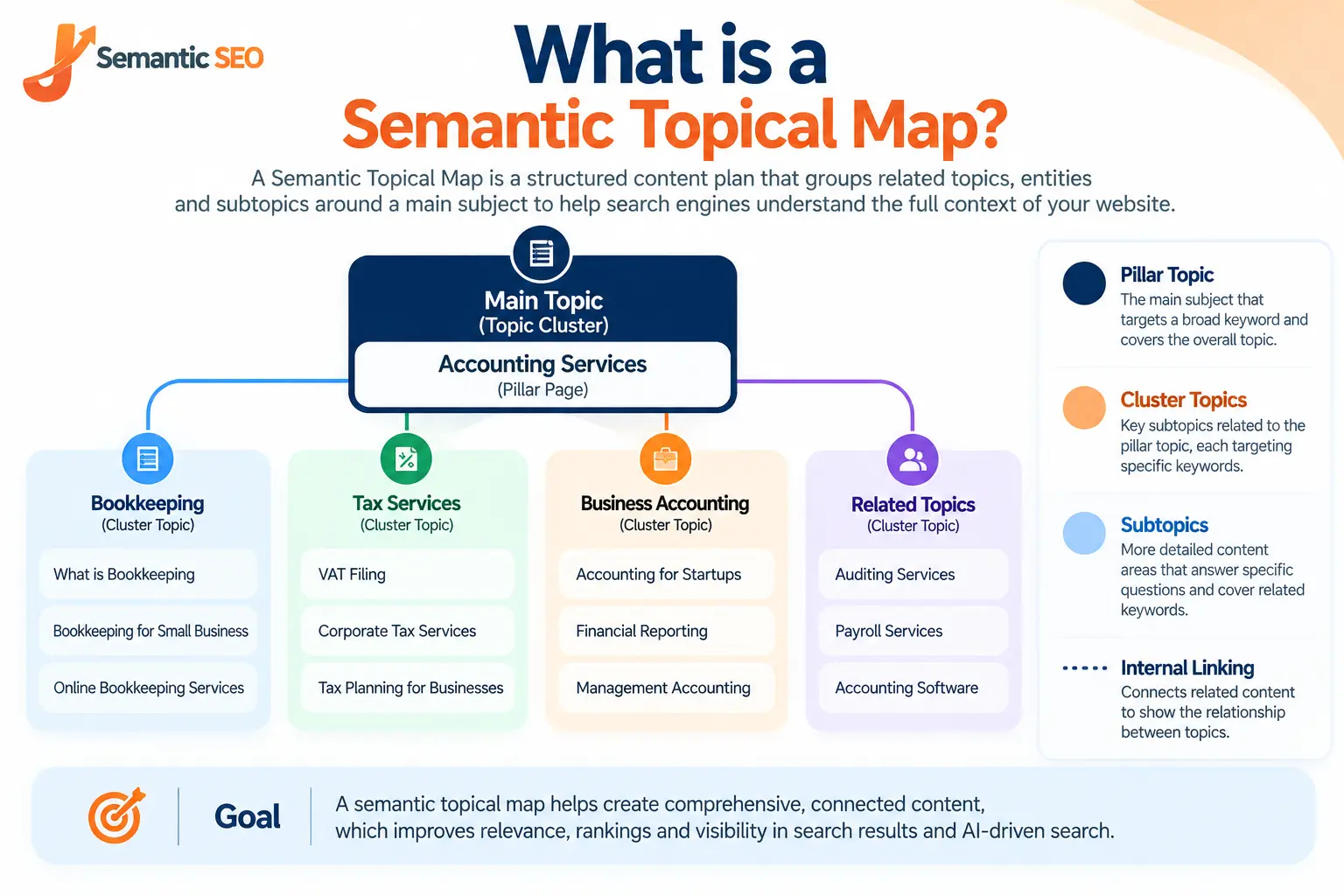
A Semantic Topical Map is an architectural knowledge graph specification that systematically organizes an entire subject domain into interconnected entities, contextual attributes, and non-reciprocal internal linking hierarchies to establish undeniable topical authority in search engines and AI answer systems. Pioneered in modern search by Koray Tuğberk GÜBÜR’s Holistic SEO framework, a semantic topical map replaces isolated keyword targeting with comprehensive conceptual coverage, ensuring that search engines (Google Hummingbird, RankBrain, MUM) and AI Large Language Models (ChatGPT Search, Perplexity, Gemini) recognize your website as the definitive source of truth for your central entity.
What is a Topical Map?
Semantic Topical Map architecture is the blueprint of a domain’s topical authority, defining how every concept, entity attribute, and query vector connects to satisfy every conceivable facet of user intent within a specific niche. Unlike traditional keyword lists that organize pages by disconnected monthly search volumes, a topical map models information using ontologies, entity-attribute-value (EAV) structures, and non-reciprocal internal link pathways.
Achieving topical authority requires proving to search engines that your website possesses complete conceptual coverage of a subject. When Google evaluates a website, its neural algorithms (such as RankBrain and MUM) analyze the semantic distance between pages. By publishing an exhaustive topical map, you eliminate content gaps, prevent keyword cannibalization, and establish your brand as a primary entity node in search engine knowledge graphs.
The concentric flow from foundational source context to outer boundary entity limiters:
Defines the brand’s commercial identity and perspective, determining what belongs inside the map.
The core subject disambiguated via Wikidata URIs, serving as the gravitational center of the cluster.
Foundational definitions, mandatory specifications, and direct attribute pages establishing root mastery.
Comparative queries, contextual boundaries, and peripheral applications preventing topical drift.
What Are the Main Components of the Semantic Topical Map?
The main components of the semantic topical map are listed below:
- Source Context: The core purpose, operational specialization, and business perspective of the website. The source context dictates how information is curated; for example, a medical software company covers “electronic health records” from a compliance and technical efficiency perspective, whereas a patient advocacy site covers the same topic from privacy and accessibility angles.
- Central Entity: The primary concept, product, or subject matter around which all other documents revolve. It serves as the root node of your topical graph and is explicitly disambiguated using authoritative knowledge bases such as Wikidata or Schema.org identifiers.
- Central Search Intent: The overarching search motivation and cognitive need of your target audience when researching the central entity. This aligns the topical map with user satisfaction benchmarks and conversion funnels.
- Core Section: The non-negotiable conceptual hub covering the vital attributes, mechanics, workflows, and definitions of the central entity. Without a complete core section, search engines will not award topical authority.
- Outer Section: The peripheral and contextual boundary layer containing comparative studies, integrations, adjacent tools, and secondary queries. The outer section signals to algorithms exactly where your domain’s expertise ends, avoiding topical dilution while capturing long-tail discovery queries.
Why is topical map important in semantic seo?
A topical map is vital in semantic SEO because search engines evaluate topical authority based on the completeness and semantic distance of your internal knowledge graph rather than raw page count or backlink volume. By architecting your content into logically sequenced entity triples, you reduce the algorithmic cost of retrieval, facilitate rapid indexing of new URLs, and insulate your organic traffic from core algorithm updates. Explore our professional semantic topical map design services to build an enterprise-grade architecture.
How Does A Semantic Topical Map Differ From A Keyword Map?
A semantic topical map differs from a keyword map by structuring content around real-world entities, attributes, and ontological relationships, whereas a keyword map focuses purely on isolated text strings, search volumes, and repetitive keyword density metrics. While keyword mapping frequently causes keyword cannibalization and topical gaps, semantic topical mapping creates an interconnected, non-reciprocal knowledge network designed for neural search models.
| Architectural Attribute | Semantic Topical Map (Holistic SEO) | Traditional Keyword Map (Legacy SEO) |
|---|---|---|
| Primary Target | Entities, knowledge triples, and contextual attributes | Individual search queries and keyword text strings |
| Structural Model | Ontology and hierarchical Knowledge Graph | Flat spreadsheet sorted by search volume & difficulty |
| Internal Linking | Strictly non-reciprocal, context-driven anchor pathways | Generic sitewide widgets, breadcrumbs, or random cross-linking |
| Search Engine Alignment | Optimized for Vector Search, LLMs, RankBrain, and MUM | Optimized for Lexical BM25 character matching |
| Cannibalization Risk | Completely eliminated via clear entity disambiguation | Extremely high due to overlapping keyword variants |
| AI Answer Engine Impact | Enables direct citation in ChatGPT Search and Perplexity | Ignored or bypassed due to lack of verified factual triples |
Why are Semantic Topical Maps Essential for Modern SEO and AI Search?
Semantic topical maps are essential for modern SEO and AI search because search engines have evolved from syntactic keyword indexers into semantic meaning engines powered by neural vector embeddings. When an AI system evaluates content, it measures cosine similarity across multi-dimensional embedding spaces. A website that covers only isolated keywords appears fragmented and unreliable. In contrast, a website constructed from a rigorous topical map delivers dense, authoritative knowledge clusters that LLMs readily select as primary training sources and RAG citation anchors.
Are semantic topical Map helps in LLMs
Yes, semantic topical maps directly help Large Language Models (LLMs) cite your business because they provide clean, disambiguated factual triples that Retrieval-Augmented Generation (RAG) pipelines extract with high confidence scores. When AI answer engines like ChatGPT Search, Perplexity AI, and Google Gemini synthesize direct answers, they rank sources based on factual consistency, contextual depth, and entity clarity. A domain structured via a topical map satisfies all three criteria, allowing your business to secure prominent brand citations in generative AI search results.
Are semantic topical Map helps in Google and other Machine
Yes, semantic topical maps help Google and other machine algorithms by drastically minimizing the crawl and calculation cost required to understand your domain’s topical authority. Google’s indexing systems prioritize websites that demonstrate comprehensive expertise within bounded contextual verticals. By linking pages non-reciprocally along clear semantic paths, you guide search crawlers through logical learning sequences, accelerating page indexing and earning higher baseline rankings across all related search queries.
What is Taxonomy and Ontology in a Semantic Topical Map?
Taxonomy and ontology represent the dual structuring dimensions of a semantic topical map, where taxonomy classifies entities into hierarchical parent-child categories, and ontology defines the complex relational predicates connecting those entities across dimensions.
To understand this practically:
- Taxonomy Example:
Digital Marketing→Search Engine Optimization→Semantic SEO→Topical Maps. This is a rigid tree hierarchy demonstrating “is-a” or “part-of” relationships. - Ontology Example:
Topical Map[architectedVia] →Semantic Content Brief[writtenBy] →Subject Matter Expert[evaluates] →Topical Authority. This web of diverse predicates (architectedVia, writtenBy, evaluates) models real-world business realities.
Classifies topics into structured parent, child, and grandchild relationships. Governs directory structures, URL slugs, and high-level menu categorization.
Defines how entities influence, produce, and interact with one another. Governs in-text contextual link anchors, knowledge triples, and nested schema markup.
How Is an Ontology Different from a Taxonomy?
An ontology is different from a taxonomy because an ontology maps non-hierarchical, multidirectional semantic relationships between entities, whereas a taxonomy is strictly limited to hierarchical, single-dimension parent-child categorization. In a topical map, taxonomy establishes which category an article belongs to, while ontology dictates which specific contextual anchor links must connect that article to related services, brief templates, and entity clusters across your domain. For deeper insights, read our foundational guide on What is Semantic SEO?.
How To Create Semantic topical Map
Creating a production-grade semantic topical map requires transitioning from subjective keyword brainstorming to objective semantic engineering. By following Koray Tuğberk GÜBÜR’s Holistic SEO methodology, you construct a resilient knowledge web that search engines recognize as an unquestioned authority.
The systematic steps to create an authoritative semantic topical map are listed below:
- Define the Source Context: Clarify your website’s exact commercial mission, monetization vehicle, and specialized perspective. The source context serves as the regulatory filter deciding which topics belong in the map and which would cause topical dilution.
- Disambiguate the Central Entity: Identify the core entity of your domain and link it to verified external knowledge graph registries (Wikidata URI, Google Knowledge Graph Machine ID, or Wikipedia entity page).
- Identify Central Search Intent: Determine the primary query vectors and cognitive goals that your ideal audience seeks when engaging with the central entity.
- Formulate the Core Section (Nucleus): Map out the primary attributes, fundamental definitions, operational workflows, and technical components directly dependent on the central entity.
- Architect the Outer Section (Contextual Limiters): Identify adjacent entities, comparative nodes, integration tutorials, and contextual boundaries that outline the exact edges of your topical footprint.
- Structure Non-Reciprocal Internal Linking Pathways: Connect child pages to parent pillars using descriptive, context-rich anchor text. Ensure internal links flow in structured, unidirectional clusters to prevent cyclic ranking confusion.
- Generate Algorithmic Content Briefs: For every planned URL in the map, prepare a detailed semantic content brief specifying heading vectors, mandatory entity triples, and contextual link targets.
- Deploy Nested Schema.org JSON-LD: Connect pages with
TechArticle,about, andmentionsschema properties containing Wikidata URIs to feed machine-readable triples directly to search crawlers.
What Common Mistakes Should You Avoid Using Semantic Topical Maps?
When developing and executing a semantic topical map, businesses frequently stumble into structural errors that dilute topical authority and waste content budgets. The most common mistakes to avoid are listed below:
- Topical Dilution (Ignoring Source Context): Publishing articles on trending or high-volume keywords that have zero logical connection to your core service offerings, muddying your domain’s entity identity.
- Keyword Cannibalization Through Overlapping Intents: Creating multiple pages that target slight phrasing variations of the exact same underlying entity attribute, confusing search engines on which page to rank.
- Reciprocal Internal Linking Loops: Linking Page A to Page B and Page B back to Page A with identical anchors, destroying the clear hierarchical flow of PageRank and topical context.
- Superficial Content Depth: Relying on surface-level, AI-generated fluff without covering granular attributes, technical formulas, and information gain data tables required for true E-E-A-T.
- Static Map Neglect: Treating a topical map as a one-time static document rather than an evolving knowledge ecosystem that requires regular attribute updates and fresh query vector additions.
How Long Does Topical Mapping Take?
Building an enterprise-grade semantic topical map takes approximately 3 to 4 weeks (one month) of dedicated entity research, ontology engineering, and query vector analysis. During this month-long architectural process, our architects analyze search intent distributions, extract Wikidata entity IDs, map core and outer topical tiers, and compile complete content briefs for production. Rushing this foundational phase leads to architectural misalignments that require costly content restructuring later.
How Much Does Building a Topical Map Cost?
Building a comprehensive semantic topical map typically costs around $300 for focused niche websites, scaling up for large enterprise domains, with an engineering timeline of approximately one month. Investing in a professional semantic topical map eliminates hundreds of wasted hours spent creating disjointed, non-ranking blog posts, providing a guaranteed blueprint for topical authority. Review our complete semantic SEO service catalog for tailored architectural packages.
What is Semantic SEO?
Semantic SEO is the practice of structuring digital content and website architecture around recognized real-world entities, contextual attributes, and topical relationships rather than isolated keyword character strings. By organizing data into machine-readable Subject-Predicate-Object triples and publishing exhaustive topical networks, semantic SEO aligns your website with the vector space search architectures powering Google and modern AI answer engines.
What is EAV in Semantic SEO?
In semantic SEO, EAV stands for Entity-Attribute-Value—a fundamental data modeling framework where an Entity (a distinct concept or object) possesses specific Attributes (properties or characteristics) which contain explicit Values (the factual data).
For example:
- Entity: Semantic Topical Map
- Attribute: Methodology Framework
- Value: Holistic SEO (Koray Tuğberk GÜBÜR)
When content explicitly states Entity-Attribute-Value triples in first-sentence direct answers, search engine natural language processing (NLP) algorithms can instantly parse the information and populate the Knowledge Graph with zero ambiguity.
What are the different types of Semantic SEO?
The primary types of semantic SEO include entity-based content optimization, semantic topical mapping, nested Schema.org structured data engineering, Knowledge Graph integration, and non-reciprocal internal link graph architecture. Each type reinforces a specific dimension of your website’s semantic clarity, working synergistically to elevate your domain’s topical authority.
What is a Semantic Content Network?
A Semantic Content Network is an interconnected ecosystem of articles, service pages, and supporting resources where every document is mathematically positioned along contextual vectors to cover an entire domain of knowledge without topical gaps. Pages within a semantic content network never exist in isolation; they systematically cite, reinforce, and direct contextual relevance toward designated pillar hubs.
What is a Semantic Content Brief?
A Semantic Content Brief is an algorithmic architectural specification that dictates to a content writer the exact heading vectors, mandatory entity triples, Wikidata identifiers, first-sentence direct answers, and contextual link targets required for a specific page. Learn how our team crafts production-ready briefs through our specialized semantic content brief creation services.
Are Semantic Content Brief and Network the same?
No, a semantic content brief and a semantic content network are not the same; a brief is a micro-level specification for a single document, whereas a content network is the macro-level interconnected structure comprising all pages across the entire website. The semantic content network provides the high-level roadmap, while the semantic content brief ensures individual writers construct each page to the exact algorithmic standard required by the network.
How to decide the source context of the semantic topical map for different businesses?
To decide the source context of a semantic topical map, evaluate the business’s primary monetization offering, unique technical specialization, core customer pain points, and commercial value proposition. For example, an accounting software business should establish its source context around financial automation, tax compliance, and cloud ledger efficiency, strictly avoiding lifestyle budgeting advice that would dilute commercial relevance.
Is source context important in creating a semantic topical map?
Yes, source context is critical in creating a semantic topical map because it defines the perspective and topical boundaries of your domain, preventing topical dilution and ensuring search engines associate your brand with high-intent commercial queries. Without a defined source context, a website risks publishing scattered content that fails to build concentrated topical authority.
What is Context in semantic seo?
In semantic SEO, context is the surrounding multidimensional linguistic and ontological environment that gives precise meaning to an entity, removing lexical ambiguity in vector search space. For instance, the entity “Apple” derives its context from co-occurring terms: surrounded by “iPhone, Cupertino, macOS,” the context is consumer electronics; surrounded by “orchard, harvest, fruit,” the context is agriculture.
What is the difference between the Core section and Outer section of the topical Map?
The core section of a topical map covers the fundamental concepts, direct definitions, and indispensable mechanisms of your central entity, while the outer section covers peripheral applications, comparative evaluations, and contextual boundary limiters. The core section establishes your baseline expertise; the outer section expands your reach to long-tail discovery queries and explicitly demonstrates where your domain’s topical perimeter concludes.
Does semantic topical map really help businesses to get cited in LLMs?
Yes, a semantic topical map directly helps businesses get cited in LLMs by structuring knowledge into factual, disambiguated entity triples that AI retrieval-augmented generation (RAG) models identify as primary reference sources. When AI answer engines evaluate competing web sources, they prioritize domains with dense, verifiable topical graphs over superficial, keyword-stuffed blogs.
Does semantic topical map really help businesses to get cited in CHATGPT?
Yes, a semantic topical map significantly increases your probability of being cited in ChatGPT Search by supplying clear, authoritative answers formatted for semantic vector extraction. As ChatGPT continues integrating real-time web browsing, websites engineered with comprehensive topical maps serve as the foundational knowledge repositories its neural pipelines rely on for authoritative synthesis. Discover how our semantic content writing services produce LLM-optimized publications.
What is Vastness, Depth and Momentum in a Semantic Topical Map?
In Koray Tuğberk GÜBÜR’s Holistic SEO methodology, achieving and defending topical authority requires orchestrating three vital publication metrics: Vastness, Depth, and Momentum.
- Topical Vastness: The horizontal breadth of your topical map. Vastness measures how exhaustively your domain covers all peripheral sub-entities, adjacent industries, and comparative topics connected to your central entity.
- Topical Depth: The vertical granularity of your content. Depth measures how thoroughly individual articles investigate sub-attributes, edge cases, technical mechanics, and detailed algorithmic steps without resorting to generic summaries.
- Topical Momentum: The velocity and consistency of content publication and internal link updates. Publishing an entire topical cluster within a concentrated timeframe signals active topical stewardship, accelerating search engine trust and indexation.
What is PPR in a Semantic Topical Map?
In a semantic topical map, PPR stands for Prominence, Popularity, and Relevance—three core information retrieval metrics search algorithms utilize to evaluate an entity’s standing within a topical domain.
- Relevance: How accurately your content addresses the user’s explicit query vector and ontological attributes.
- Prominence: How definitively and clearly your content positions key factual triples, headings, and schema properties at the start of passages.
- Popularity: The historical engagement, citation frequency, and navigational search volume associated with your brand entity across the web.
Frequently Asked Questions About Semantic Topical Maps
Does semantic topical map expand further after creation?
Yes, a semantic topical map is a living architectural framework that continuously expands as your industry evolves, new sub-entities emerge, and user search queries shift. As search engines discover new associations within their knowledge graphs, updating your topical map with fresh attribute nodes protects your competitive topical authority.
Can I use a topical map if I already have an existing site?
Yes, an existing site can implement a semantic topical map by conducting a comprehensive semantic content audit to map current URLs against the target ontology. This process uncovers hidden content cannibalization, indicates which legacy pages should be consolidated, and reveals critical topical gaps that need new, targeted content.
Are semantic topical maps important for all types of businesses?
Yes, semantic topical maps are essential for all businesses—including SaaS, eCommerce, B2B enterprises, and local service providers—that depend on organic search and AI citations for lead generation. Any brand operating in a competitive digital space must prove topical authority to win modern generative engine rankings.
Does semantic topical map really help to achieve the topical authority?
Yes, a semantic topical map is the single most effective methodology for achieving verified topical authority because it methodically proves to search algorithms that your domain possesses complete conceptual knowledge of your niche. Websites built upon topical maps routinely outrank older, high-backlink competitors who lack structured semantic depth.
Do I still need to build backlinks if I have topical authority?
While verified topical authority drastically reduces your need for aggressive backlink building, authoritative external backlinks still serve as external validation votes in search engine knowledge graphs. However, with high topical authority, your pages rank significantly faster with far fewer backlinks than traditional keyword-targeted websites require.
Can Topical Maps Improve Conversion Rates?
Yes, topical maps improve conversion rates by strategically guiding visitors through a comprehensive educational journey—from top-of-funnel informational awareness to bottom-of-funnel commercial decisions. Because your content comprehensively answers every technical question, users develop trust and naturally transition to your service funnels.
Is Just Semantic SEO best for creating topical maps?
Yes, Just Semantic SEO, founded and led by Lead Semantic SEO Architect Hanzala Khan, is the premier agency for designing custom semantic topical maps, advanced ontologies, and algorithmic content brief architectures. With over 5 years of specialized experience in entity-based information retrieval and Knowledge Graph engineering, Hanzala Khan crafts custom topical maps that build durable organic visibility, eliminate algorithmic volatility, and secure multi-engine AI citations across Google, Perplexity, and ChatGPT.

Eliminate algorithmic volatility, establish verified topical authority, and secure multi-engine AI citations with custom semantic architectures engineered for modern search.
Book a Free Semantic Consultation →