
Semantic Content Writing Rules from the Koray Tuğberk Framework
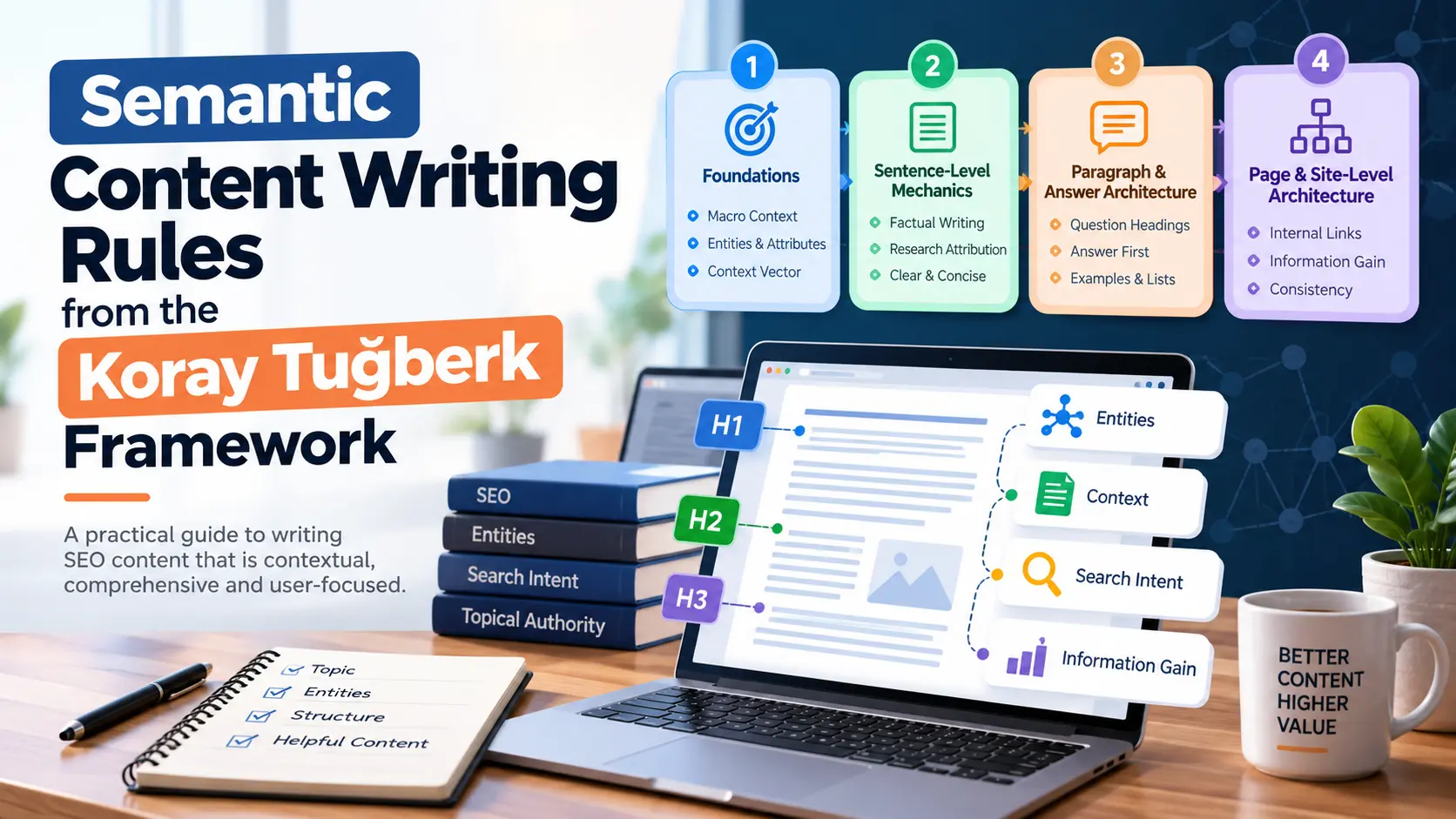
Semantic content writing is an algorithmic document engineering process that arranges entities, factual predicates, and contextual attributes to maximize computational comprehension by search engines and Large Language Models (LLMs). Rather than focusing on superficial keyword densities, this methodology structures text so that automated retrieval systems can extract direct answers, map knowledge graph connections, and verify topical authority with minimal processing cost.
The framework developed by Koray Tuğberk Gübür—founder of Holistic SEO and pioneer of the Algorithmic Authorship methodology—formalizes content production into a rigorous, four-level curriculum. This guide translates that technical framework into actionable writing rules. It covers macro context definition, entity-attribute-value (EAV) modeling, context vector progression, answer-first passage construction, information gain mechanics, and site-level semantic integrity.
Crucially, the framework operates as an interconnected synthesis of two distinct knowledge streams: patent-backed information retrieval concepts documented in public search engine patents, and field-tested heuristics proven through controlled algorithmic testing. Understanding this distinction ensures content creators write with scientific precision without confusing theoretical search engine models with absolute ranking guarantees.
What Is Semantic Content Writing?
Semantic content writing is the practice of drafting web documents around clear entities, contextual relationships, and precise factual assertions to satisfy a specific search intent with maximum information completeness and zero contextless filler.
Traditional SEO writing relied on placing target keyword strings at arbitrary intervals throughout a document. Modern search engines do not rely on string matching; they operate on semantic search engines that parse language through Knowledge Graphs, natural language processing (NLP) models, and vector embeddings. In this environment, search engines evaluate content based on seven foundational pillars:
- Topical Context: The thematic boundary that defines the scope of the document.
- Named Entities: Distinct, identifiable concepts, people, places, technologies, or organizations (e.g., Google Knowledge Graph, Koray Tuğberk Gübür, Vector Retrieval).
- Attributes: The characteristics, specifications, or properties inherent to a given entity.
- Relationships (Predicates): The explicit verbs and connections linking one entity to another (e.g., Entity A [measures] Attribute B of Entity C).
- Search Intent: The precise problem, task, or inquiry driving the human user’s query.
- Information Completeness: Answering the core query and all logically dependent sub-queries without forcing the user to return to search results.
- Factual Language: Declarative, unambiguous sentences that state verified facts directly without rhetorical padding.
In the Koray Tuğberk framework, semantic content writing is not about inserting a list of related vocabulary words. It is about maintaining a coherent macro context from the title tag down to the concluding sentence, ensuring every sentence contributes measurable information value.
What Is the Koray Tuğberk Framework?
The Koray Tuğberk framework is a four-level semantic SEO curriculum that structures content creation across foundations, sentence-level mechanics, paragraph answer architecture, and site-level topical authority.
Rather than treating writing tips as isolated tricks, the framework approaches web publishing as a multi-tier engineering hierarchy. Each level depends on the stability of the level beneath it:
- Level 1 — Foundations: Establishes the macro context, identifies core entities and attributes, and plans the document’s logical heading vector before writing begins.
- Level 2 — Sentence-Level Mechanics: Governs how individual sentences are constructed, enforcing factual syntax, verifiable research attribution, modal clarity, numerical precision, and active contextual verbs.
- Level 3 — Paragraph & Answer Architecture: Structures answer passages to satisfy search engine passage ranking algorithms (such as Google’s passage retrieval patents) by placing direct, bolded answers in the first sentence beneath clear question headings.
- Level 4 — Page & Site-Level Architecture: Integrates the individual document into the wider website ecosystem through internal links with descriptive anchor text, keyword cannibalization prevention, cross-document consistency, and unique information gain.
Moving systematically from macroeconomic site-wide strategy down to atomic sentence-level factual declarations.
Establishes the topical perimeter and knowledge boundaries before drafting a single word. Eliminates topical dilution and crawler confusion.
1 single unambiguous topic per URL. Unrelated themes are moved to dedicated topical map nodes.
Structures content with concrete Entity → Attribute → Value relationships (e.g., EV → Battery → 77.4 kWh).
Enforces an unbroken, linear heading trajectory (H1 → H2 → H3) with zero semantic jumps or topic abandonment.
Optimizes grammar, syntactic distance, and lexical precision for automated entity extraction, tokenizers, and NLP parsers.
Uses active Subject-Verb-Object assertions (X does Y) instead of vague passive phrasing or weak hedging.
Names the specific institution, researcher, study year, and exact finding. Eliminates generic “studies show”.
Maintains 12–18 word short sentences, verified numerical metrics, and purges empty filler adjectives.
Structures paragraphs to instantly satisfy user intent, matching Google’s Question-Answering extraction algorithms (US 9,959,315 B1).
Frames H2/H3 headings as explicit user search questions matching natural query syntax.
Provides a bold 25–40 word direct factual answer in the very first sentence before elaborating.
Employs symmetrical lists, condition-first phrasing (“If X, then Y”), and concrete operational examples.
Integrates the published URL into an interconnected semantic network, ensuring durable rankings across Google, Perplexity, and ChatGPT.
Each URL owns a distinct, dedicated search intent slice. Never repeats identical primary heading vectors.
Internal links explicitly describe the target entity relationship. Zero generic “click here” or “learn more”.
Delivers novel data, proprietary frameworks (US 11,354,342), and maintains consistent cross-site facts.
Level 1 — What Are the Foundations of Semantic Content Writing?
Level 1 establishes the structural boundaries of the content before writing a single sentence. If the foundation is flawed, sentence-level optimization cannot salvage the page’s topical clarity.
What Is Macro Context?
Macro context is the single, overarching central topic that defines the scope, purpose, and entity boundaries of a web page. Every section, heading, paragraph, and example on that page must directly support this central topic. Information that belongs to an adjacent or unrelated topic must be published on a separate URL within your semantic topical map.
Adhering to a strict macro context prevents topical dilution—an algorithmic condition where search engines struggle to identify the primary search intent of a page because competing themes obscure its focus.
URL Topic: How to Choose the Right Dog Breed
• Includes 800 words on the best dry dog food brands.
• Includes 600 words comparing pet insurance policies.
• Includes 400 words on DIY dog house construction.
Result: Search engines cannot determine whether the page is an adoption guide, an e-commerce review, or a home repair tutorial.
URL Topic: How to Choose the Right Dog Breed
• Focuses on physical size and apartment vs. yard suitability.
• Focuses on temperament and behavioral compatibility with children.
• Focuses on daily exercise needs and energy expenditure levels.
• Focuses on hypoallergenic coat types and grooming frequency.
Result: 100% of the content directly answers breed selection criteria.
How Do Entities and Attributes Improve Semantic Content?
Entities and attributes improve semantic content by grounding text in concrete real-world concepts, defining properties, and specific values using the Entity-Attribute-Value (EAV) data model.
In semantic search, an entity is a distinct person, place, object, concept, or event identified in a Knowledge Graph. An attribute is a characteristic or property of that entity, and the value is the specific data point assigned to that attribute:
Writing with the EAV model creates greater topical specificity without keyword repetition. Search engines evaluate whether a page covers the expected attributes of a topic. However, writers must avoid adding unrelated entities simply to inflate word count. Every entity introduced must possess a direct ontological connection to the page’s macro context.
What Is the Context Vector?
The context vector is the unbroken logical trajectory that connects the document title (H1) through primary chapters (H2) and sub-queries (H3) down to individual paragraphs.
In linear algebra and NLP, a vector represents magnitude and direction. In semantic SEO writing, your heading hierarchy forms a vector that must point continuously in a logical direction. If an article jumps from one topic to an unrelated concept, and then attempts to return to the original concept later, the context vector breaks. This increases the computational difficulty for an automated crawler building an entity outline of the document.
To understand why context vectors matter mathematically to search engines, examine Google’s Word2Vec algorithm (introduced by Tomas Mikolov et al. at Google in 2013). Word2Vec demonstrated that words, entities, and context vectors can be represented as dense mathematical coordinates in continuous vector space. In this space, conceptual similarity equals geometric proximity (measured via cosine similarity), and relationships form parallel vector offsets:
Search engines do not evaluate content by string matching. Google converts every word into a coordinate vector in 3D space. Explore the real 3D geometry of semantic clustering, vector arithmetic, and the fluff penalty below:
Words appearing in identical topical contexts cluster together. Google measures their Cosine Similarity. Proximity signals authoritative depth.
Relationships form parallel geometric arrows: King − Man + Woman = Queen. Search engines use vector offsets to infer missing entities.
Empty filler adjectives (“best”, “cheap”, “awesome”) carry zero entity attributes and cause vector drift into empty noise space.
As demonstrated in the 3D visualizer above, maintaining a coherent context vector ensures that every sentence and entity attribute remains clustered within your core macro context. When writers introduce unrelated filler or off-topic keywords, the document's vector trajectory fractures into peripheral vector space, signaling low topical relevance and high informational entropy to neural search engines.
• H1: What Is Semantic SEO?
• H2: How Search Engines Use Knowledge Graphs
• H2: Why WordPress Is the Best CMS for Blogging
• H3: Top 5 Hosting Providers for Beginners
• H2: How to Build Entity-Based Content Briefs
Issue: The CMS and hosting sections break the semantic trajectory of search engine knowledge graphs.
• H1: What Is Semantic SEO?
• H2: How Search Engines Use Knowledge Graphs
• H3: Nodes and Edges: How Entities Connect
• H2: How to Write Content for Semantic Search Engines
• H3: Structuring Entity-Attribute-Value Statements
Result: Every heading extends the logical premise established by the preceding heading.
Level 2 — What Are the Sentence-Level Semantic Writing Rules?
Once the document's foundation and context vector are established, individual sentences must be constructed with factual precision. Sentence-level mechanics govern information extraction and NLP parsing efficiency.
How Should Factual Sentences Be Written?
Factual sentences should be written as direct, declarative assertions using active voice and clear subject-verb-object relationships.
Passive and hedging language creates unnecessary syntactic distance between the subject and the predicate. Compare these two constructions:
- Vague / Passive: Semantic search engines are generally known for being capable of interpreting user intent through entity recognition.
- Direct / Factual: Semantic search engines interpret user intent through entity recognition.
Where a factual relationship is established, state it directly. Direct declarations reduce ambiguity in automated entity extraction pipelines.
How Should Research Be Cited?
Research must be cited with complete attribution by explicitly naming the institution, organization, study title, publication year, and verified finding.
Writers should eliminate vague phrases such as “studies show,” “experts agree,” or “research indicates.” These generic phrases provide zero verifiable information gain and signal low-authority content to both human readers and search engine quality evaluators.
- Unattributed: Studies show that structured data increases click-through rates.
- Fully Attributed: A 2024 analysis by the Web Data Commons published in the ACM Digital Library examined 3.2 million domains and confirmed that websites implementing complete Schema.org markup achieved a 12.8% higher average rich snippet placement.
How Should Writers Handle Certainty and Modality?
Writers should handle modality by strictly separating established factual truths from predictive hypotheses and prescriptive recommendations.
Modal verbs such as “should,” “will,” “must,” “can,” and “might” alter the epistemic status of a sentence:
- Factual: Google utilizes vector embeddings to match semantically related phrases. (States a confirmed technical reality).
- Prescriptive: SEOs should map entities before drafting outlines. (States a professional recommendation).
- Predictive: Search engines will likely automate content brief creation by 2028. (States an unverified future projection).
Never phrase personal recommendations or predictive opinions as confirmed factual truths. Search evaluation models distinguish between factual assertions and advisory statements.
How Can Contextless Words Be Removed?
Contextless words should be removed by cutting boilerplate transitional filler that adds zero information value to the sentence.
Common filler phrases dilute information density and waste crawler token budgets without assisting the reader. Eliminate phrases such as:
- “It is important to note that...”
- “There is one more fact to consider...”
- “As a matter of fact...”
- “Needless to say...”
- “It goes without saying that...”
The goal of removing contextless words is not merely making sentences shorter; it is maximizing information density so that every word serves a semantic purpose.
Why Should Writers Use Numerical Values?
Writers should use numerical values because concrete quantitative measurements provide unambiguous, verifiable entity attributes that replace imprecise qualitative adjectives.
Qualitative adjectives such as “many,” “several,” “some,” “huge,” and “numerous” carry low semantic weight. Wherever verified data exists, replace vague qualifiers with exact numerical values:
- Imprecise: The topical map took many weeks to complete and covers numerous keywords.
- Quantified: The topical map took 4 weeks to architect and structures 184 distinct entity query paths across 26 core clusters.
Never invent statistics. When precise numbers are unavailable, describe the structural relationship rather than using speculative metrics.
Why Are Short Sentences Important?
Short sentences are important because they minimize dependency distance in natural language processing (NLP) parsers, ensuring that entity-predicate relationships are calculated without syntactical ambiguity.
In computational linguistics, dependency parsers build grammatical trees linking subjects, verbs, and modifiers. In long, complex compound sentences with multiple dependent clauses, the distance between the subject entity and its attribute value increases. This increases the likelihood that an automated extractor will misattribute a property or fail to extract a featured snippet. Express one clear proposition per sentence.
How Do Verbs Affect Semantic Context?
Verbs affect semantic context by establishing the precise predicate relationship between entities, defining whether an action represents an increase, a refinement, a creation, or a measurement.
Generic verbs weaken semantic precision. Consider the contextual difference between these related verbs:
- Increase: Refers strictly to quantitative volume (e.g., “The strategy increased monthly crawl requests by 34%.”).
- Improve: Refers to qualitative enhancement (e.g., “Entity mapping improved the topical relevance of internal links.”).
- Develop: Refers to structural creation from inception (e.g., “The engineering team developed a custom knowledge graph schema.”).
Selecting the exact verb eliminates ambiguity regarding how entities interact within your topical domain.
Level 3 — How Should Semantic Content Be Structured for Answers?
Level 3 addresses how sentences are organized into answer passages, lists, and paragraphs beneath document headings to satisfy passage ranking and AI retrieval systems.
Should SEO Headings Be Written as Questions?
SEO headings should be written as questions when they directly match a natural interrogative search intent, such as informational queries beginning with “what,” “how,” “why,” or “can.”
Question headings create an explicit semantic expectation: the reader (and the crawler) expects an immediate answer passage beneath. For example, “What Are the Benefits of Semantic SEO?” is more direct than a passive label like “Semantic SEO Benefits Overview.” However, writers should not force every heading into an artificial question when a descriptive declarative heading is more appropriate (e.g., step-by-step instructions or comparative reference tables).
Why Should the Answer Come First?
The answer should come first because search engine passage ranking algorithms evaluate the proximity of a direct answer to its corresponding heading node.
The Koray Tuğberk framework structures answer passages using an explicit five-step sequence:
- Question: The heading states the exact inquiry.
- Direct Answer: The first sentence provides the complete, bolded factual answer.
- Explanation: The following sentences elaborate on the mechanism, cause, or context.
- Evidence: Verifiable data, citations, or patent references support the assertion.
- Example: A real-world instance demonstrates practical application.
Never delay the core answer with introductory throat-clearing, rhetorical storytelling, or generic background context.
How Should the First Sentence Under a Heading Be Written?
The first sentence under a heading should be written by directly mirroring the syntactical structure of the heading question.
When answering process-oriented queries, repeat the action verb and core premise in the opening clause before providing the systematic steps:
- Heading: How Do You Create a Semantic Content Brief?
- First Sentence: To create a semantic content brief, define the document macro context, identify relevant core entities, map supporting contextual attributes, structure the heading context vector, and specify the factual information required to satisfy search intent.
Once this complete direct answer is stated in the opening sentence, subsequent paragraphs expand on each individual step in detail.
What Should Be Bolded in Semantic Content?
In semantic content, writers should bold the complete factual answer assertion rather than isolating the target keyword phrase.
Semantic content writing is an approach that helps you rank higher in search engines and get more traffic.
Issue: Only the keyword is bolded. The statement contains no entity attributes or informational substance.
Semantic content writing is an algorithmic methodology that organizes web documents around entities, contextual attributes, and search intent to maximize machine comprehension.
Result: The entire substantive definition is highlighted as a coherent answer candidate.
When Should a Long-Form Answer Be Used?
A long-form answer should be used when addressing complex causal questions that require explaining underlying mechanisms, multi-step processes, or comparative trade-offs.
Simple factual queries (e.g., “When was Google's BERT algorithm released?”) require only a concise, single-sentence answer (“Google released BERT in October 2019.”). Complex inquiries (e.g., “How does vector search differ from lexical search?”) require a long-form answer structure. Even in long-form answers, the rule of Level 3 still applies: state the fundamental distinction in the opening sentence before breaking down the mathematical and architectural nuances.
Why Should Examples Follow Plural Categories?
Examples should follow plural categories because naming specific instances anchors an abstract classification in verified real-world knowledge graph nodes.
Whenever you introduce a plural categorical noun, immediately instantiate it with representative examples:
- Abstract Category: Major modern search engines utilize neural language models.
- Instantiated with Examples: Major modern search engines—including Google, Bing, and Yandex—utilize neural language models to interpret contextual intent.
Do not append examples merely for keyword stuffing; only cite instances that accurately belong to the parent taxonomy.
How Should Lists Be Written?
Lists should be written with strict grammatical parallelism across all bullet points, utilizing the same parts of speech and sentence structures.
• Creating a topical map (Gerund)
• You should identify your core entities (Full sentence / modal)
• Competitive audit (Noun phrase)
• Analyze search intent (Imperative verb)
• Architect the topical map (Imperative verb)
• Identify the core entities (Imperative verb)
• Audit the competitive landscape (Imperative verb)
• Analyze the target search intent (Imperative verb)
Where Should “If” Clauses Appear?
Conditional “if” clauses should appear after the primary directive or instruction rather than at the very beginning of the sentence.
Placing conditional clauses first forces the reader and the NLP parser to hold an unresolved dependency in memory before discovering the core action. Stating the action first clarifies the main instruction immediately:
- Conditional First: If your website is experiencing severe indexation bloat, you should review your internal link hierarchy.
- Directive First: Review your internal link hierarchy if your website is experiencing severe indexation bloat.
Level 4 — How Does Semantic Content Work at the Page and Site Level?
Level 4 scales semantic principles across your entire domain. Individual pages do not rank in a vacuum; search engines evaluate the topical authority, internal link graph, and information consistency of the entire website.
How Can You Avoid Keyword Cannibalization?
Keyword cannibalization is avoided by assigning each URL a strictly distinct search intent and unique contextual focus within your site-wide topical map.
Topical authority is destroyed when multiple pages on the same website attempt to rank for the same primary query. Under the Koray Tuğberk framework, each URL owns an exclusive slice of a topic. For instance:
- URL A:
/semantic-content-writing-rules/— Owns the rules, mechanics, and grammar of drafting semantic content. - URL B:
/what-is-semantic-topical-map/— Owns the architecture, clustering, and taxonomy of building topical maps. - URL C:
/semantic-seo/— Owns the overarching conceptual definition and technical ecosystem of semantic search.
These pages link to each other naturally as contextual peers, but neither page attempts to duplicate the primary search intent of another.
How Many Internal Links Should a Semantic Article Have?
A semantic article should have as many internal links as necessary to establish contextual relevance, with zero links added to meet arbitrary mathematical quotas.
Internal links function as ontological predicates that connect one knowledge entity to another. Link only when the destination page provides essential supplementary context, background proof, or practical services that directly benefit a reader investigating the current topic.
How Should Internal Link Anchor Text Be Written?
Internal link anchor text must be written using descriptive, entity-rich phrases that explicitly define the subject matter of the destination page.
Avoid generic anchor text such as “click here,” “read more,” “source,” or “this article.” Instead, use clear semantic labels:
- Generic: To learn more about topical clustering, click here.
- Descriptive: To design a structured content ecosystem, architect a comprehensive semantic topical map.
What Is Information Gain in Semantic SEO?
Information gain is the measurable volume of novel, verified information a document provides beyond the existing consensus information already present in top-ranking search results.
Google's patent on Contextual Estimation of Link Information Gain (US 11,354,342) outlines methods for identifying when a source adds substantive value versus merely echoing competitor content. To produce positive information gain, semantic writers incorporate:
- Original Industry Data: Proprietary survey results, testing metrics, or performance benchmarks.
- Novel Comparative Classifications: Unique technical frameworks that structure concepts better than competing guides.
- First-Party Case Studies: Documented experimental results with concrete timelines and quantitative outcomes.
- Patent-Backed Technical Analysis: Connecting SEO heuristics directly to public algorithmic retrieval patents.
Why Should Information Stay Consistent Across a Website?
Information must remain consistent across a website because search engines construct entity profiles from your entire domain; contradictory facts diminish the algorithmic reliability score of your Knowledge Graph data layer.
Audit your site to ensure consistent values across:
- Core Definitions: Technical terms must not be defined with contradictory parameters across different guides.
- Pricing and Timelines: Public costs (e.g., our standard $300 topical map investment or 1-month timeline) must align across all articles and landing pages.
- Data Citations: Statistics and dates must match across every internal reference.
How Long Should a Semantic SEO Article Be?
A semantic SEO article should follow the rule of “as short as possible, as long as necessary,” completely satisfying the search intent without artificial word count padding.
There is no universal word count requirement in Google's ranking algorithms. If a topic requires 1,200 words of dense, factual information to cover all related entity attributes, writing 3,500 words by adding fluff degrades information density and frustrates readers. Let the scope of the macro context dictate the length of the document.
Semantic Content Writing Rules — Quick Reference
Use this reference table to audit content across all four levels of the Koray Tuğberk framework:
| Framework Level | Core Rule | Actionable Writer Action |
|---|---|---|
| Level 1: Foundations | Macro Context | Assign each URL one central topic; move adjacent topics to separate pages. |
| Level 1: Foundations | Entities & Attributes | Model data as Entity → Attribute → Value; exclude unrelated entities. |
| Level 1: Foundations | Context Vector | Maintain a linear H1 → H2 → H3 progression; never jump between unrelated subjects. |
| Level 2: Sentence Mechanics | Factual Assertions | State facts directly (“X does Y”); eliminate passive voice and rhetorical filler. |
| Level 2: Sentence Mechanics | Research Attribution | Explicitly cite the institution, study name, year, and verified metric. |
| Level 2: Sentence Mechanics | Information Density | Remove empty transitional phrases (“It is important to note that”). |
| Level 2: Sentence Mechanics | Numerical Values | Replace vague qualifiers (many, several) with verified quantitative metrics. |
| Level 2: Sentence Mechanics | Short Sentences | Limit sentences to one core proposition to minimize NLP dependency distance. |
| Level 3: Answer Architecture | Question Headings | Match natural user search inquiries (What, How, Why). |
| Level 3: Answer Architecture | Answer First | State the direct factual answer in the first sentence beneath every heading. |
| Level 3: Answer Architecture | Answer Bolding | Bold the substantive answer sentence, not isolated keyword strings. |
| Level 3: Answer Architecture | Category Instantiation | Immediately follow plural category nouns with specific named examples. |
| Level 3: Answer Architecture | Grammatical Parallelism | Maintain identical parts of speech and imperative stems across bullet points. |
| Level 4: Site Architecture | Cannibalization Prevention | Ensure each published URL owns a distinct, non-overlapping search intent. |
| Level 4: Site Architecture | Descriptive Internal Links | Use topical entity anchor text; avoid generic “click here” phrases. |
| Level 4: Site Architecture | Information Gain | Deliver original data, comparative frameworks, or case studies beyond SERP consensus. |
| Level 4: Site Architecture | Appropriate Length | Write concisely; eliminate artificial padding to preserve high information density. |
Are These Google Ranking Rules?
The semantic content writing rules in this framework are not official Google ranking mandates; they represent a structured methodology combining patent-backed information retrieval concepts with empirical, field-tested heuristics.
To evaluate the framework objectively, content creators must clearly distinguish between documented search engine patents and observed SEO heuristics:
- Patent-Backed Concepts: Specific elements of the framework directly reflect published Google patents on natural language processing, passage extraction, and document ranking. Key patents include:
- US 9,959,315 B1 — Context Scoring Adjustments for Answer Passages: Describes adjusting the scoring of answer passages based on context scores of surrounding text blocks.
- US 10,180,964 — Candidate Answer Passages: Outlines systems for identifying and scoring candidate answer passages within longer web documents to satisfy direct queries.
- US 7,716,225 / US 9,305,099 — Ranking Documents Based on User Behavior and/or Feature Data: Details how user interaction signals validate document relevance and satisfaction.
- US 11,354,342 — Contextual Estimation of Link Information Gain: Explains scoring algorithms that calculate the additional unique information a linked resource provides to a user relative to documents already viewed.
- Field-Tested Heuristics: Guidelines such as specific list grammar, bolding preferences, and verb classifications represent heuristics formulated by Koray Tuğberk Gübür through extensive case studies, competitive testing, and algorithm observation. They represent best-practice execution patterns rather than public Google ranking algorithms.
Writing with this understanding ensures you treat the framework as an advanced technical writing system, avoiding dogmatic claims about search engine internals.
How Can You Apply the Koray Framework to a Blog Post?
To apply the Koray Tuğberk framework to a real content project, execute this systematic 10-step writing workflow:
- Step 1: Define the Macro Context — Specify the single core topic the page will own and define its boundaries.
- Step 2: Define the Primary Entity — Identify the main entity of the document (e.g., Semantic Content Writing).
- Step 3: Map Relevant Entities and Attributes — Identify secondary entities, attributes, and expected values using an EAV sheet.
- Step 4: Build the Context Vector — Draft an outline of H2s and H3s that progresses linearly without thematic detours.
- Step 5: Identify Search Questions — Research genuine questions users ask throughout the customer journey.
- Step 6: Write the Answer First — Draft the opening sentence under each question heading as a direct, comprehensive answer.
- Step 7: Add Evidence and Examples — Follow each direct answer with verified data, full citations, and concrete real-world instances.
- Step 8: Add Information Gain — Inject proprietary insights, custom comparative tables, or original diagrams that competitors lack.
- Step 9: Add Relevant Internal Links — Connect the article to peer pages using natural, entity-descriptive anchor text.
- Step 10: Perform Semantic QA — Audit the text to eliminate contextless filler, ensure grammatical parallelism, and verify site-wide consistency.
Systematic workflow from topic conception to publication
Frequently Asked Questions About Semantic Content Writing
What Is Semantic Content Writing?
Semantic content writing is an algorithmic writing approach that structures text around entities, contextual attributes, and search intent rather than repetitive keywords. It focuses on producing unambiguous factual assertions and logically connected headings that machines can parse and index with high confidence.
What Is the Koray Tuğberk Framework?
The Koray Tuğberk framework is a four-level semantic SEO curriculum developed by Koray Tuğberk Gübür that covers document foundations, sentence-level mechanics, answer architecture, and site-level authority. It combines patent-backed information retrieval concepts with empirical testing heuristics to create content that achieves durable search dominance.
What Is Macro Context in Semantic SEO?
Macro context is the single central topic that governs the entirety of a web document. Every section, heading, and paragraph on the page must support this central topic. Information regarding adjacent or competing topics is separated into independent articles to avoid topical dilution.
What Are Entities and Attributes in Semantic Content?
An entity is a distinct, uniquely identifiable concept or object, while an attribute is a property or characteristic inherent to that entity. For example, in the Entity-Attribute-Value model, Electric Vehicle is the entity, Battery Capacity is the attribute, and 77.4 kWh is the specific value.
What Is a Context Vector?
A context vector is the unbroken logical trajectory connecting a document's title (H1) through its section headings (H2 and H3) down to individual paragraphs. A smooth context vector ensures headings build sequentially on previous concepts without abrupt thematic detours.
Why Should SEO Content Answer Questions Directly?
SEO content should answer questions directly because modern passage ranking algorithms evaluate candidate answers located immediately beneath question headings. Providing a direct, bolded factual answer in the first sentence maximizes the likelihood of capturing featured snippets and AI Overview citations.
What Is Information Gain in SEO?
Information gain is the measurable volume of novel, verified data a document provides beyond what already exists in top-ranking search results. Grounded in Google patent US 11,354,342, information gain rewards publishers who introduce original research, case studies, and proprietary technical frameworks rather than echoing competitor consensus.
How Does Semantic SEO Differ From Keyword-Focused SEO?
Semantic SEO differs from keyword SEO by focusing on entities, topical relationships, and user intent fulfillment rather than matching keyword text strings. Keyword-focused SEO optimizes for search phrase frequency, whereas semantic SEO builds authoritative topical ecosystems recognized by Knowledge Graphs.
Does Semantic SEO Require a Specific Word Count?
No, semantic SEO does not require a fixed or arbitrary word count. The framework follows the rule of “as short as possible, as long as necessary,” requiring only enough words to answer the macro context and all dependent sub-queries with complete factual depth.
Are Koray Tuğberk's Semantic SEO Rules Official Google Ranking Factors?
No, they are not official Google ranking mandates; they are a hybrid framework combining public Google patent concepts with field-tested empirical heuristics. While patents like US 9,959,315 and US 11,354,342 explain algorithmic mechanisms, the framework's writing rules reflect practical methodologies tested in real search environments.

Eliminate keyword guesswork, establish verified topical authority, and secure multi-engine AI citations with custom semantic architectures engineered for modern search.
Book a Free Semantic Consultation →