
Home › Semantic SEO › AI Overviews Optimization
AI Overviews optimization is the work of making your pages the sources Google cites inside its AI-generated answers. The work starts from normal search eligibility, because Google documents no additional requirements and no special optimizations for AI features. The gains sit in what happens after eligibility. An AI Overview is assembled from answers to several narrower sub-questions, and the pages cited are the ones whose passages answer those sub-questions completely, carry information the answer cannot source elsewhere, and are corroborated across the web. This guide orders the work by evidence strength, separating what Google documents from what large citation datasets show and from the folklore the industry repeats without proof.
What is an AI Overview?
An AI Overview is an AI-generated summary that Google places above the classic list of results, with links to the pages it drew from. A custom Gemini model builds the summary on top of Google’s existing ranking and quality systems. Google shows an Overview only when its systems judge the summary additive to the regular results, so the feature appears on some queries and not on others.
A panel study of 68,879 real searches by 900 US adults in March 2025 found an AI summary on 18% of searches. The share rose to 53% for queries of 10 words or more and to 60% for queries opening with a question word. Commercial trackers report higher figures, between 25% and 48% of US searches, because they sample fixed keyword sets rather than people’s actual searches. Both views agree on the direction. Longer, question-shaped, informational queries are where AI Overviews live, and those are the queries most content programmes are built to win.
How does Google choose which pages an AI Overview cites?
Google cites pages its retrieval systems pull from the regular search index for the query and its sub-questions. Google’s own guide to AI features in Search sets the entry conditions. A page must be indexed and eligible to appear in Search with a snippet, and beyond that there are no additional requirements. Retrieval runs against the same index and core ranking systems as classic Search, so there is no separate AI index to enter and no AI-specific file or markup to submit.
The second mechanism is query fan-out. An AI Overview rarely answers the typed query alone. Google splits the query into sub-questions, runs retrieval for each one, and grounds the generated answer in the passages those searches return. The citation list is therefore wider than the 10 blue links, and it follows the sub-questions rather than the head query. Our RAG SEO guide walks through that retrieval pipeline stage by stage. This page covers what to do about it.
Do you need to rank in the top 10 to be cited in an AI Overview?
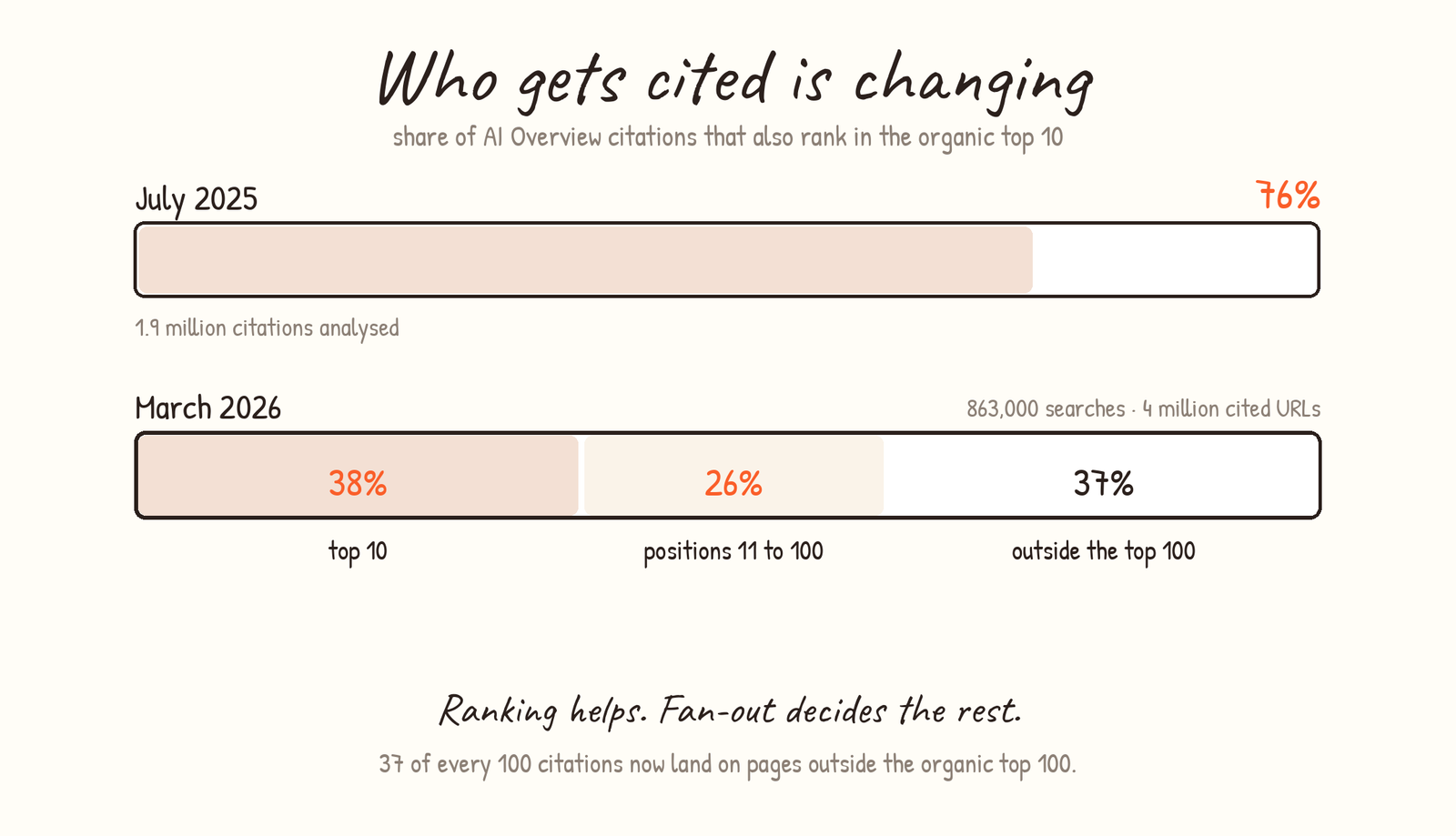
No. Ranking in the top 10 raises your odds of being cited, and it no longer decides the outcome. The relationship between ranking and citation has weakened measurably in under a year, and the older advice built on it is now out of date.
An analysis published in July 2025, covering 1.9 million AI Overview citations, found 76% of cited pages also ranked in the organic top 10 for the same query. A larger analysis published in March 2026, covering 863,000 keyword searches and 4 million cited URLs, found the top 10 share down to 38%. In that dataset 26% of cited pages ranked between positions 11 and 100, and 37% ranked outside the top 100 entirely. The publisher notes that part of the drop reflects better citation counting on its own side, so the size of the change is uncertain. The direction is not.
A second analysis of 167.9 million citations from June to August 2026 points the same way. It found 43% of citations going to pages that also ranked in the top 10 and 57% going to pages outside it, and the page sitting in organic position 1 was cited only 24.9% of the time. A third tracker measuring 9 industries over a longer window reports the overlap rising in its data, with healthcare at 75.3% and restaurants at 19.2%. The honest reading is that industry and method move the number, and no single overlap figure describes every market. What survives every dataset is the practical conclusion. Ranking well still helps, fan-out retrieval means a page that answers a sub-question completely can be cited without ranking for the head query at all, and a programme that only defends top 10 positions is defending a shrinking share of the citation pool.
How do you optimize for AI Overviews?
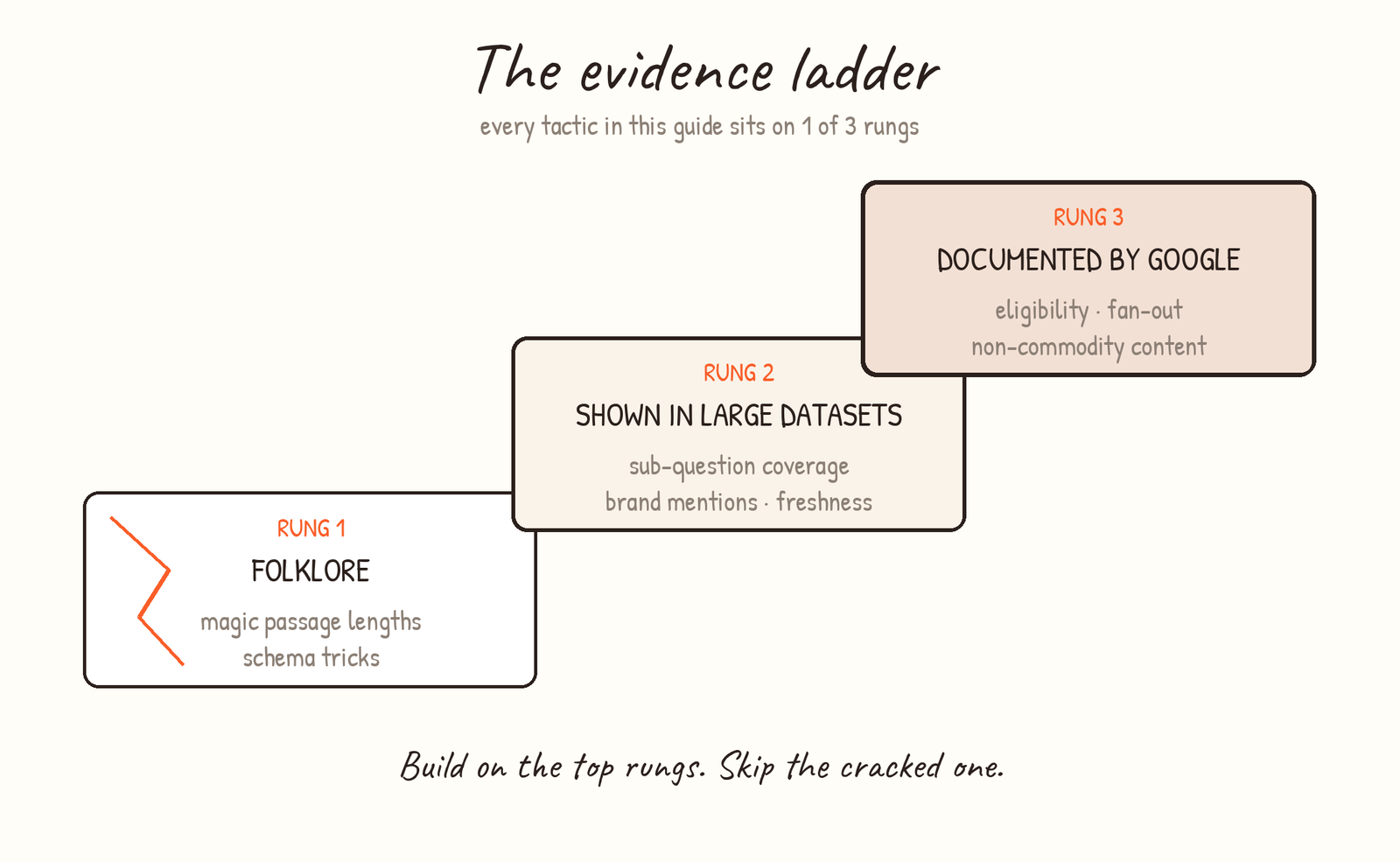
You optimize in evidence order, documented requirements first, measured patterns second, and nothing that rests on folklore. The 6 steps below follow that order. The first step is a gate, because a page that fails it cannot be cited at all. Steps 2 to 6 raise the chance that an eligible page is the one retrieved and quoted.
Step 1. Secure eligibility before anything else
A page enters the citation pool only when it is indexed, snippet-eligible and crawlable. Google’s documented practices for AI features are the classic fundamentals stated plainly. Allow crawling in robots.txt and at the CDN. Keep the main content in readable text rather than locked inside scripts or images. Use internal links so retrieval can find the page from the rest of the site. Keep structured data consistent with the visible text. None of this is new, and that is the point. Most pages missing from AI Overviews fail here, on indexation and accessibility, long before any question of content quality arises.
Step 2. Cover the sub-questions behind the query
Fan-out means the Overview is assembled from several narrower questions, so the page that answers those questions is the page that gets cited. Take each money query your buyers type and work out the sub-questions it splits into. A query about a service splits into questions about method, cost drivers, timelines, risks and proof. Answer each sub-question inside the strongest relevant page you own, under its own heading, in passages that stand on their own. Depth of coverage across a topic is what makes a domain retrievable for the whole fan-out rather than one phrasing of it, and our guide to topical authority covers how that coverage is built and measured. One warning from Google’s own documentation belongs here. Building a separate page for every fan-out variation is scaled content abuse. The coverage belongs inside strong pages, not sprayed across thin ones.
Step 3. Write passages that survive extraction
Each section should open with a direct, self-contained answer that still makes sense when quoted alone. The generated answer lifts passages, not pages, so a passage that depends on the paragraph before it loses its meaning in transit and loses the citation with it. Keep qualifiers attached to the claims they qualify. Put the number and its basis in the same sentence. Use a table where a comparison has to be read row by row, because a table keeps each fact tied to its label. Vendor recipes promise that a magic passage length wins citations, with figures between 40 and 160 words circulating in current guides. No controlled study supports any of those numbers, and Google rejects fixed content requirements outright. Write the complete answer the sub-question needs, at the length the answer requires.
Step 4. Publish information the answer cannot get elsewhere
Google’s own guidance names non-commodity content as the factor that matters most over time. An Overview built from pages that all restate the same facts has no reason to cite yours. First-party data, worked examples with real figures, firsthand test results and genuine pricing ranges give the answer something it cannot source from a competitor. The controlled evidence points the same way. A 2024 academic study of generative engine optimization measured visibility lifts of 41% for added quotations and 33% for added statistics inside test content. That study ran on a research prototype rather than on Google itself, so treat the size of the lifts as directional. The direction matches Google’s stated preference exactly.
Step 5. Build corroboration beyond your own pages
AI Overview visibility tracks how widely the web mentions your brand, not only how many links point at you. A study of 75,000 brands found branded web mentions correlating with AI Overview visibility at 0.664, against 0.218 for backlinks. Correlation is not causation, and the study cannot prove that mentions alone cause citations. The pattern still redirects effort productively. Consistent brand facts across profiles, directories, press and partner pages give retrieval more independent sources that agree about who you are and what you do. That agreement rests on entity clarity, and our entity SEO guide covers the identifiers and profiles that keep a brand’s facts consistent across the web.
Step 6. Keep cited pages current
Citations decay when the cited facts go stale, so the pages earning citations need maintenance rather than replacement. Across a dataset of roughly 17 million citations, cited pages ran about 25.7% fresher than the pages in the organic top 10. Update the figures, dates and claims on any page an Overview cites, and recheck the page after each update renders. A page that keeps its facts current defends a citation it already holds, which is cheaper than winning a new one.
What does not work for AI Overviews?
Most tactics sold specifically for AI Overviews fail against Google’s documentation or against the citation data. The 5 below are the ones buyers ask about most.
Special schema. Google requires no special structured data for AI features and names none that earns citations. Accurate schema still clarifies your entities for classic Search. It is hygiene, not a citation lever.
An llms.txt file aimed at Google. Google does not use llms.txt in Search, and request logs across 137,210 domains showed AI bots almost never fetching the file at all. Our llms.txt evidence review works through the log data in full.
Fan-out page farms. A page per sub-question, generated at volume, is the scaled content abuse pattern Google’s spam policy names. It risks the domain rather than feeding it citations.
Buying a place in the answer. No paid route into an AI Overview exists. Advertising inside and around AI features is labelled as advertising and runs through separate systems.
Exact-match passage recipes. Word-count formulas for answer blocks come from vendor blog posts, not from controlled tests or from Google. A passage wins by answering completely, not by hitting a length.
How do you measure AI Overview visibility?
You measure presence in Search Console, citation share with a fixed query set, and value by the conversions the cited pages still earn. No single surface shows all 3, and any report claiming otherwise is selling false precision.
Search Console carries a Generative AI performance report covering Google’s AI features. It shows which pages and queries earn impressions inside AI Overviews and AI Mode. That is presence data. It tells you where you appear, not how often you are cited against competitors on the same query.
Citation share needs a fixed set of buyer queries checked on a schedule, recording whether an Overview appears, whether your domain is cited, and which competitor holds the citation when you do not. Third-party trackers automate that sampling against their own keyword sets, which is why their percentages describe their samples rather than your market. Treat their numbers as directional and your own query set as the record.
The click reading needs honesty. An Overview answers the query on the results page, so informational click-through falls on Overview queries whether you are cited or not. The cited page keeps the visible presence inside the answer and tends to keep the higher-intent visits that follow. Judge the programme on cited presence plus assisted conversions, not on the raw traffic the query returned before AI Overviews existed.
When does AI Overviews work need outside help?
Outside help pays when the citation on a revenue query belongs to a competitor and nobody inside the business owns the fix. The warning signs are concrete. A competitor is cited in the Overview for the service you sell. Informational traffic is falling quarter on quarter with no named owner. The site has the eligibility problems of step 1 buried in indexation debt. The work itself is unglamorous, an eligibility audit, a fan-out coverage rebuild and a measurement habit, and it compounds when it is done once and done properly.
Is your site eligible to be cited?
The free site audit checks the indexation, entity and AI readiness layer first, with the evidence quoted for every finding.
A full programme wraps this work into topical coverage, entity corroboration and content built to be quoted. Our AI SEO services page sets out that scope. Whether the work sits inside your team or outside it, the order in this guide holds. Eligibility first, sub-question coverage second, corroboration third, and measurement from the first week rather than the first crisis.
Frequently asked questions
Is AI Overviews optimization different from SEO?
It builds on SEO rather than replacing it. Eligibility, indexation, internal linking and page quality are classic SEO, and Google documents no additional requirements for AI features. The extra work sits on top, covering the sub-questions a query fans out into, writing passages that survive extraction, and earning corroboration across the web. The same discipline applied across every answer engine, not only Google, is answer engine optimization.
Can you pay to appear in an AI Overview?
No. There is no paid placement inside an AI Overview. The citations are chosen by retrieval from the search index. Advertising appears inside and around AI features through separate, labelled systems, and buying it does not influence which pages the answer cites.
Does schema markup help you get cited in AI Overviews?
Not by itself. Google states that no special structured data is required for AI features and that structured data should match the visible content. Accurate schema supports classic Search and clarifies your entities. No dataset shows schema alone earning a citation that the page’s content and corroboration did not already support.
Why is a competitor cited in the AI Overview instead of my page?
Usually because their page answers a sub-question more completely, or because the web corroborates them more widely. Since the March 2026 data, a top 10 ranking on its own explains a minority of citations. Audit the fan-out first. List the sub-questions behind the query, check which page answers each one best, and compare brand mentions across the web before assuming the problem is your ranking.
How long does it take to appear in AI Overviews?
There is no switch and no guaranteed timeline. A page becomes eligible the moment it is indexed and snippet-eligible, and citations follow the coverage and corroboration work over the following weeks. Citation sets also churn quickly, with studies measuring most cited links in AI answers changing from one day to the next, so a citation won is a citation to defend with current facts rather than a permanent placement.
Does being cited in an AI Overview protect your traffic?
Partly, and the honest answer matters more than the comforting one. The Overview absorbs clicks that the query used to send to the results list, and that loss lands on cited and uncited pages alike. The cited page keeps the presence inside the answer itself, which is where the remaining attention sits, and keeps the brand in front of the buyer at the moment the shortlist forms. The alternative to being cited is not the old traffic. It is absence from the answer entirely.

Written by Hanzala Khan
Hanzala Khan has over 5 years of specialized experience in entity-based search optimization, Knowledge Graph engineering, and topical authority architectures. He specializes in designing custom semantic topical maps, advanced Schema.org data layers, and algorithmic authorship frameworks that help enterprise brands achieve durable search dominance and AI citation authority across Google, Perplexity, and ChatGPT.