
Home › Semantic SEO › RAG SEO
RAG SEO is the practice of making your pages easy for an AI system to retrieve and cite when it builds an answer from live sources. RAG stands for retrieval-augmented generation. It is the mechanism AI search products use to fetch web pages at answer time instead of replying only from training data. The optimization target is one step inside that mechanism. Your page must be found by the retrieval step before the model can quote it, summarise it or link to it.
What is retrieval-augmented generation?
Retrieval-augmented generation is a technique that lets a language model search external documents before it answers, then write its answer from what it found. Patrick Lewis and co-authors described it in a 2020 research paper written for knowledge-intensive NLP tasks. The design combines 2 kinds of memory. Parametric memory is the knowledge stored inside the model weights during training. Non-parametric memory is an external document collection the model can query at answer time. The original system queried a dense vector index of Wikipedia through a neural retriever.
The distinction decides what a website owner can influence. Parametric memory is fixed at training time. No edit to your site changes what a model already memorised, and no citation points back to you. Non-parametric memory is live. A page published last week can enter the document collection, get retrieved for a question asked today, and receive the citation. RAG SEO works entirely on the non-parametric side.
How does RAG work in AI search?
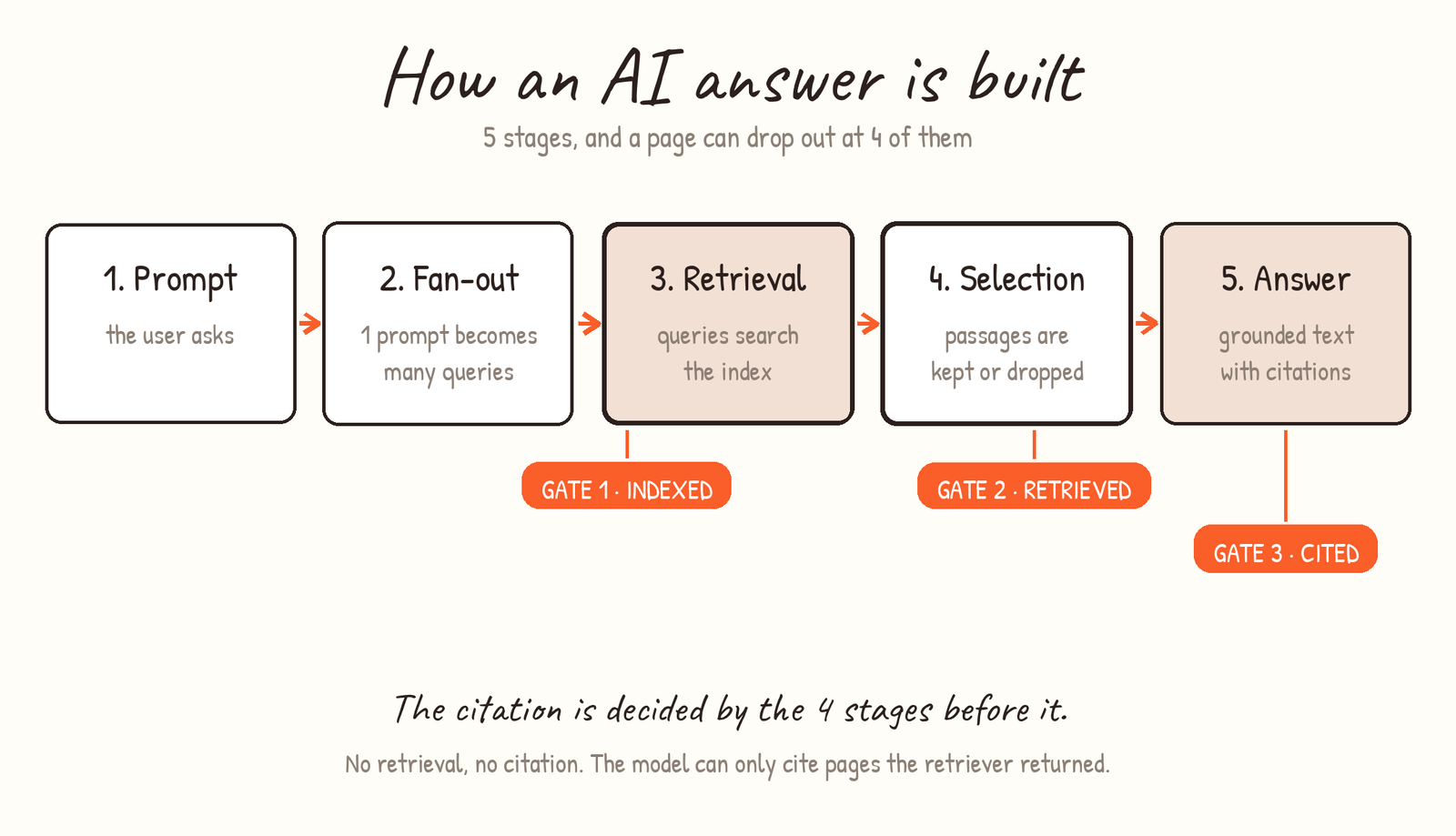
A RAG answer is built in 5 stages, and a page can drop out at 4 of them. The implementations differ between products, and no vendor publishes its full pipeline. The stages below are the shared pattern, with Google’s documented version named where Google has described its own system in its guide to optimizing for generative AI features.
- Query understanding and fan-out. The system reads the prompt and usually expands it into a set of related queries. Google calls this query fan-out. Its own example starts with a question about fixing a lawn full of weeds and fans out into queries about herbicides, chemical-free removal and prevention.
- Retrieval. The queries run against an index and return candidate pages. Google states that its generative AI features retrieve pages from the same Search index that powers the organic results, using its core ranking systems. There is no separate AI index to submit to.
- Selection. The system reviews the specific information inside the retrieved pages and keeps the passages that answer the question. A page is retrieved as a document and used as passages.
- Grounding. The model writes the answer conditioned on the selected passages. Google uses the word grounding for this step. The answer is supposed to rest on the retrieved evidence instead of the model’s memory.
- Citation. The answer shows links to the pages that support it. The citation is the only stage a website owner can see, and it is decided by the 4 stages before it.
One limit matters before any tactic. Retrieval does not run on every prompt. Models answer many questions from parametric memory alone, especially stable facts they absorbed in training. When no retrieval runs, no page can be retrieved and no citation exists to win. RAG SEO only applies to the share of prompts where the system decides to search.
Is RAG SEO different from SEO, GEO and AEO?
RAG is a mechanism, and SEO, GEO and AEO are practices aimed at systems that use it. The 4 terms sit at different levels, and most confusion in this topic comes from treating them as rivals.
- RAG names the architecture. It describes what the AI system does internally when it retrieves documents and generates an answer from them.
- SEO names the foundational practice. Crawlability, indexation, topical coverage and page quality decide whether a page is in the index the retrieval step searches.
- GEO and AEO name practices aimed at the answer itself. They focus on being named and cited inside AI responses across products. Our GEO vs SEO comparison and our answer engine optimization playbook cover those 2 practices in full.
Google’s position collapses most of the debate. Its guide states that generative AI features on Google Search are rooted in its core Search ranking and quality systems, and that SEO best practices continue to apply. For Google, RAG SEO is not a new discipline with new rules. It is ordinary SEO read through one extra question. Once this page is indexed and ranked, can the retrieval step also use it as evidence?
Why does the retrieval step decide who gets cited?
A citation is granted at the end of the pipeline, but it is earned at the retrieval step, because the model can only cite pages the retriever returned. Think of the pipeline as 3 gates. Each gate has a different owner inside an SEO programme.
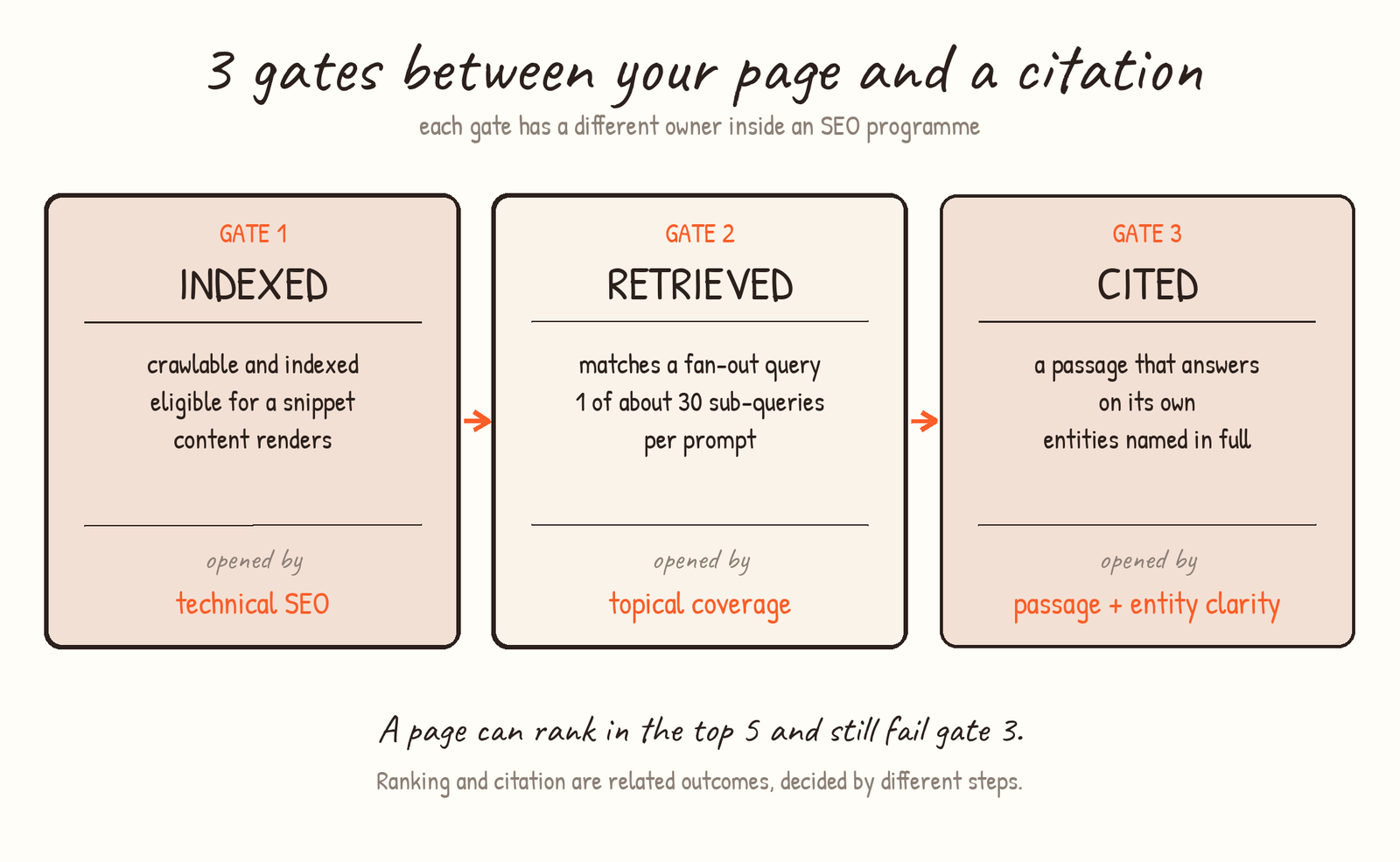
- Gate 1 is indexation. Google states the requirement directly. A page must be indexed and eligible to be shown in Search with a snippet before it can appear in generative AI features. Technical SEO owns this gate.
- Gate 2 is retrieval. The page must match at least 1 query in the fan-out set. Fan-out multiplies the competition. One 2026 prompt study measured an average of 30.1 related queries generated per prompt, so a page competes against the sub-questions, not only against the wording the user typed. Topical coverage owns this gate.
- Gate 3 is citation. The retrieved page must contain a passage the system can use and attribute. An analysis of 863,000 search results found that 38% of AI Overview citations rank in the organic top 10. Retrieval draws heavily on ranked pages, and the remaining share shows that a passage can earn a citation without a top 10 ranking when it answers a fan-out query better than the ranked pages do. Passage clarity and entity clarity own this gate.
The 3 gates explain a pattern many site owners misread. A page can rank in the top 5 and never appear in AI answers when its answer is buried inside unfocused text. A page can also sit outside the top 10 and get cited when 1 section answers a fan-out sub-question directly. Ranking and citation are related outcomes decided by different steps.
What makes a page retrievable?
A retrievable page is indexed, covers the question family around its topic, and states its answers in passages that stand on their own. 6 attributes decide most retrieval outcomes.
1. It passes the eligibility gate
The page is crawlable, indexed and snippet-eligible. A noindex directive, a blocked crawler or a page that renders its main content only after client-side scripts run can each remove the page from the candidate set before relevance is ever judged. Eligibility is checked first and forgiven never.
2. It covers the fan-out, not only the head query
Retrieval runs the fan-out queries, not the user’s exact words. A page that answers the head query and its nearest sub-questions gives the retriever more chances to match. This is the retrieval-side argument for topical coverage. One page with complete coverage of a topic’s question family is retrievable for dozens of prompts. This is not an argument for a page per variation. Google warns that creating separate pages for every fan-out variation to manipulate AI responses violates its scaled content abuse policy. Coverage belongs inside strong pages.
3. Its passages answer without their surroundings
Retrieval systems use passages, so each section of the page should make sense when it is lifted out alone. A section that opens with its answer, names its entities in full and avoids pronouns that point at earlier sections survives extraction. A section that begins mid-argument does not. This is a writing discipline, not a formatting trick, and the next section covers the difference.
4. Its entities are unambiguous
A retriever matching meaning needs to know which thing a passage is about. Pages that name entities in full, keep 1 name per entity and connect the entity to its attributes give the matching step clean material. Pages that alternate between a brand name, an abbreviation and a pronoun force the system to guess. Our entity SEO guide covers the attribute structure behind this in detail.
5. Its facts are specific and owned
The Princeton GEO study presented at KDD 2024 tested which page changes lift AI visibility. Adding statistics raised it by up to 33%, adding quotations by up to 41% and citing sources by up to 28%, while keyword stuffing reduced it. Specific numbers, named examples and sourced claims give the grounding step material it can attribute to 1 page. Generic summaries give it material that belongs to everyone and therefore to no one.
6. It is current where the topic moves
Retrieval exists partly to fix staleness. For topics where facts change, such as prices, regulations and software versions, the retriever favours pages whose content matches the current state of the topic. A page that was accurate at publication and wrong 18 months later loses retrieval contests it used to win, and the loss is silent. Nothing in the organic ranking announces it.
What does Google say you do not need for RAG?
For Google Search, the platform itself rejects 4 popular RAG tactics, and the rejection is documented in its own guide. The scope matters. This guidance describes Google’s AI Overviews and AI Mode. Other products document less, so the same claims cannot be settled for them either way.
- Chunking. Google states there is no requirement to break content into tiny pieces for AI, that its systems understand multiple topics on 1 page, and that there is no ideal page length. Guides that prescribe a universal chunk size or a fixed passage length in words are selling a recipe no platform has published. Write sections that stand on their own because readers and extraction both benefit. Do not dice a page into fragments to satisfy a number.
- Special AI files. Google states that it does not use llms.txt or other special machine-readable files for Search, including its generative AI features. Our llms.txt evidence review measured the same pattern in request logs across the wider web. A file can exist for other tools without being a Google ranking input.
- Rewriting for AI. Google states that AI systems understand synonyms and general meaning, so content does not need to be rewritten in a special AI style or padded with long-tail variations.
- Special structured data. Google states that no special schema markup is required for generative AI search. Structured data keeps its ordinary value for rich results and entity clarity. It is not an AI admission ticket.
The pattern across the 4 rejections is consistent. Each rejected tactic is a surface change applied to a page. Each accepted factor is a property of the page itself, such as eligibility, coverage, clarity and unique information.
How do you measure RAG SEO?
You measure RAG SEO by citation presence on a fixed prompt set and by the AI performance reports the platforms provide, because no platform gives site owners a retrieval log. 3 measurements are available today.
- The Generative AI performance report in Search Console. Google provides this report for its generative AI features. It shows how content performs where AI answers appear, and it is the only first-party measurement for Google.
- A fixed prompt set, run on a schedule. Choose the prompts your buyers actually ask, run them monthly in the AI products that matter to you, and record which pages are cited for each prompt. Our measurement method for topical programmes uses the same fixed-set discipline. The set must stay fixed, or the trend line means nothing.
- AI referral traffic. Visitors arriving from AI products convert at a higher rate than ordinary organic visitors in multiple published analyses, so even small citation gains show up in referral data before they move rankings.
The honest limit is the missing log. You cannot see the fan-out queries a system ran for your topic, the candidate set your page competed in, or the passage that lost. Every RAG SEO measurement is an outcome measurement. Anyone who reports retrieval-stage data for your site is estimating it.
Can your pages pass the retrieval step?
The free site audit checks the indexation, structure and entity signals the retrieval step reads.
Which mistakes block retrieval?
The mistakes that block retrieval are the ones that fail a gate while looking like optimization from the outside. 4 recur across audits.
- Building a page for every fan-out query. The scaled content pattern Google names in its spam policy. It also splits coverage across thin pages, so no single page is the strongest candidate for any sub-question.
- Blocking the wrong crawler. A robots.txt rule written to stop AI training crawlers can also stop the search and retrieval crawlers of the same company when the rules are copied without reading them. Each crawler has a separate job, and the file has to be read line by line before it is trusted.
- Publishing commodity summaries. A page that restates what the top 10 already say gives the grounding step no reason to cite it over them. Google’s own term for the alternative is non-commodity content, meaning content built on first-hand knowledge the other sources do not have.
- Writing chunks instead of answers. Sections chopped to a target length, stripped of context and stuffed with the query wording read badly to people and extract badly to machines. The passage that wins retrieval is the one that answers its question completely inside its own boundaries.
RAG SEO is therefore not a new layer to buy. It is the retrieval reading of the work this site already teaches. Indexation and technical clarity open the first gate, topical coverage opens the second, and passage and entity clarity open the third. Our AI SEO service applies the same 3-gate reading to client sites, starting with an audit of where pages currently drop out.
Frequently asked questions
What does RAG stand for?
RAG stands for retrieval-augmented generation. The term comes from a 2020 paper by Patrick Lewis and co-authors. It describes a system that retrieves documents from an external collection and generates its answer from those documents instead of relying only on knowledge stored during training.
Is RAG SEO a ranking factor?
No. RAG SEO is not a ranking factor, and RAG is not a ranking system. RAG is the retrieval and generation mechanism behind AI answers. The ranking systems that feed Google’s version of it are the core Search ranking systems. A page influences the outcome through indexation, relevance and clarity, not through a RAG score.
Does RAG use a separate AI index?
Google’s generative AI features do not use a separate AI index. Google states that its systems retrieve pages from the Search index using core ranking systems. Other AI products maintain their own crawls and indexes, and each documents its crawlers separately.
Do I need to chunk my content for AI retrieval?
No platform requires chunking, and Google explicitly says the opposite. Its guide states that there is no requirement to break content into tiny pieces and no ideal page length. Sections should be complete and self-contained because that helps readers and extraction. Length targets sold as retrieval recipes have no published source.
How is RAG SEO different from GEO?
RAG names the mechanism, and GEO names a practice aimed at it. GEO work tries to increase how often a brand is cited inside AI answers. RAG SEO focuses one step earlier, on whether the page can be retrieved at all. A GEO programme that ignores retrieval is optimizing the last stage of a pipeline its pages may never enter.
Can I see which queries retrieved my pages?
No. No AI search product gives site owners a retrieval log. Google offers the Generative AI performance report in Search Console for outcomes in its AI features. For other products, the available method is a fixed prompt set run on a schedule, with citations recorded by hand or by a monitoring tool.

Written by Hanzala Khan
Hanzala Khan has over 5 years of specialized experience in entity-based search optimization, Knowledge Graph engineering, and topical authority architectures. He specializes in designing custom semantic topical maps, advanced Schema.org data layers, and algorithmic authorship frameworks that help enterprise brands achieve durable search dominance and AI citation authority across Google, Perplexity, and ChatGPT.
2 Responses