
Home › Semantic SEO › Semantic SEO vs Traditional SEO
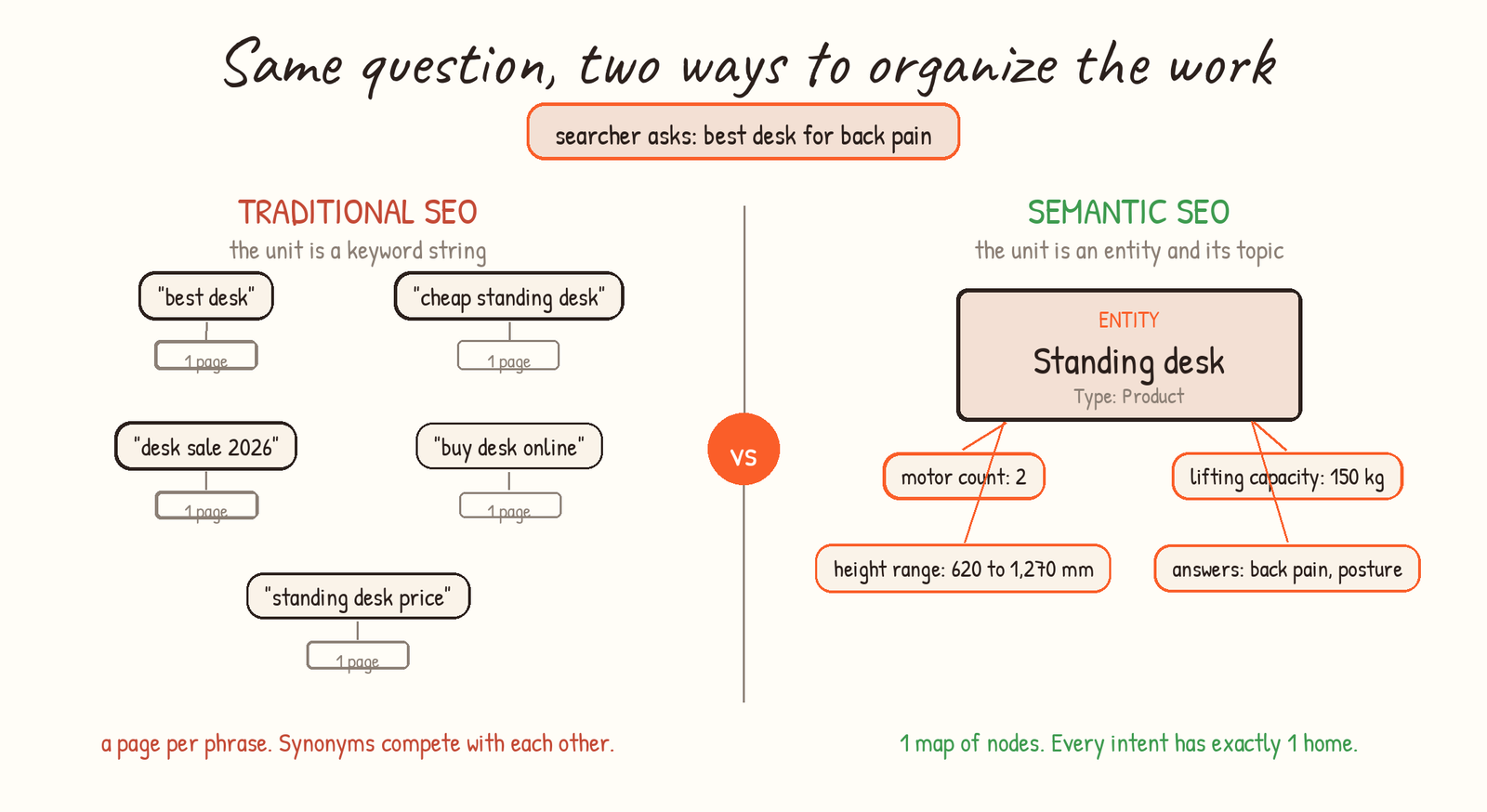
Semantic SEO and traditional SEO differ in the unit they optimize. Traditional SEO optimizes a page for a keyword string. Semantic SEO optimizes a site for an entity and its topic. Every other difference in research, writing, linking and measurement follows from that 1 decision, and most comparison pages stop at the slogan level without showing what changes in the daily work.
This guide works through the differences dimension by dimension. It also covers what never changed, because the technical floor of traditional SEO still carries every semantic programme, and it ends with the cases where traditional SEO is genuinely enough and the 5 steps for moving a traditional site onto a semantic architecture. The full method behind the semantic side is set out in our semantic SEO guide.
What is traditional SEO?
Traditional SEO is the practice of optimizing individual pages for individual keyword strings. A keyword research tool produces a list of phrases with search volumes. Each valuable phrase gets a page. The page carries the phrase in its title, its headings and its body at a workable density, earns links with the phrase as anchor text, and is judged by the position it holds for that phrase.
The model was rational for the search engine it grew up with. Early Google matched the letters of a query against the letters on pages and returned a list, with links as votes. If matching strings is the game, then a page per string, a string per page, is the correct formation. The weaknesses were visible even then. Synonyms needed duplicate pages. Near-identical pages competed with each other. A page could satisfy every rule and still say nothing, because the rules measured the string and never the meaning.
What is semantic SEO?
Semantic SEO is the practice of organizing a website around entities, their attributes and their relationships, so that search engines understand what the site is about and how completely it covers its topic. Research starts from the topic’s knowledge graph instead of a keyword list. Pages are planned as nodes in a topical map before any of them is written. Each page states facts about its central entity as complete entity-attribute-value triples. Internal links connect the pages along the relationships between their entities. Success is measured as coverage and visibility across the topic’s whole query set, not as positions for a handful of chosen strings.
The method was formalized by Koray Tuğberk Gübür as part of Holistic SEO. Its premise is that search engines now store the web as knowledge about things, so the winning move is to publish knowledge about things in the same structure the engines store it.
Why did SEO split into traditional and semantic?
SEO split because Google changed what it reads, in 4 documented steps. In May 2012 the Knowledge Graph launched under the line things, not strings, and Google began storing entities with identities and relationships instead of only indexing words. In 2013 Hummingbird rebuilt the query parser around conversational intent, so the meaning of a full question started to outweigh its individual words. In 2015 RankBrain became the first deep learning system inside Search, translating queries into vectors and matching them against pages by proximity of meaning, including for queries nobody had typed before. In October 2019 BERT gave Google bidirectional reading of word context, and in 2021 MUM extended that reading across languages and formats.
Each step moved ranking weight from the string on the page toward the thing the page is about. Traditional SEO kept optimizing the part that was shrinking. Semantic SEO is the practice rebuilt around the part that grew. How engines process meaning at page level today is the subject of our semantic search guide.
What is the difference between semantic SEO and traditional SEO?
The difference between semantic SEO and traditional SEO runs through 8 dimensions of the work. The table states them compactly. The sections after it work through the 4 dimensions where the difference changes what a team actually does on Monday morning.
Mentioned in the table below:
| Dimension | Traditional SEO | Semantic SEO |
|---|---|---|
| Unit of optimization | A keyword string and 1 page | An entity and its whole topic |
| Research output | A keyword list with volumes | A topical map of entities, attributes and questions |
| Page planning | 1 page per valuable phrase | 1 page per node the topic requires |
| Writing brief | Keyword, density, word count | Entities, attributes with values, heading structure, fan-out |
| Internal linking | Anchor text and link equity flow | Contextual bridges between related entities |
| Measurement | Positions for chosen keywords | Coverage and visibility across the topic’s query set |
| Update behaviour | Fragile, positions reset per string | Durable, facts about things stay ranked |
| AI search fit | Pages match strings in answers rarely | Pages supply citable facts about entities |
How does the research differ?
Traditional research asks which phrases are worth pages. It exports keyword lists, sorts by volume and difficulty, and promotes the phrases a site can plausibly win. The output is a list, and the list has no structure. Nothing in it records that 2 phrases are the same question in different words, or that a third phrase is an attribute of the entity the first 2 are about.
Semantic research asks what the topic contains. It maps the central entity, its attributes, the questions each attribute opens, and the neighbouring entities those questions touch. Search volume still gets checked, but it sizes nodes instead of creating them. A question with low volume and no other home in the graph still becomes a node, because the graph has a hole without it. A phrase with high volume and the same intent as an existing node becomes a section of that node, never a second page. The output is a map, and the map is the strategy document every later decision reads from.
How does page planning differ?
Traditional planning produces a content calendar of unrelated commissions. This month a page for phrase A, next month a page for phrase B, each briefed from the keyword list, each published into whatever corner of the site has room. Cannibalization is managed reactively, after 2 pages are already competing.
Semantic planning produces a publication order. The topical map fixes the core section and the outer section, the bridges between them, and the sequence that lets each new page land next to the pages it relates to. Cannibalization is designed out before it can happen, because every intent in the graph has exactly 1 node assigned to it. What a topical map contains and how 1 is built is covered in our topical map guide.
How does the writing differ?
Traditional writing briefs a keyword. The writer is told the phrase, a density, a word count and a set of related terms to include. The predictable output is a page that circles its phrase, repeats it in costume, and states few checkable facts, because facts were never requested.
Semantic writing briefs an entity. The brief names the central entity, the attributes the page must state with values, the heading structure in context order, and the sub-queries from the query fan-out the page must answer. The writer’s job changes from weaving a phrase to stating a record. Pages written this way read differently in a way readers notice before algorithms do. Every paragraph adds a fact, a value or a relationship, and nothing is repeated to fill a count, because the brief contains no count to fill.
How does measurement differ?
Traditional measurement watches positions. A rank tracker checks the chosen keywords on a schedule, and the programme is judged by how many sit in the top 3 or top 10. The blind spot is structural. The tracker only sees the phrases somebody chose, so a site can win its report while losing the topic, dropping long-tail queries it never knew it held.
Semantic measurement watches coverage. The questions are whether the map’s nodes are published, whether the site is visible across the topic’s whole query set in Search Console, whether new pages inside the topic rank faster than pages outside it, and whether AI engines cite the site on the topic. Position data still matters, read at cluster level instead of keyword level. The underlying asset being measured is topical authority, and our topical authority guide defines how it accumulates and what signs show it is forming.
What stays the same in both approaches?
More than the slogans admit. Crawlability and indexation decide whether any page can rank at all, under either method. Site speed, clean architecture and working internal navigation are traditional engineering, and a semantic programme built on a broken technical floor fails exactly the way a traditional one does. Links still corroborate a source and still move discovery, even if semantic work treats them as evidence instead of as the strategy itself. And Google’s own documentation of how search works still lists content containing the words of the query among its basic relevance signals. Keywords did not stop mattering. They stopped being the unit the work is organized around.
Anyone selling semantic SEO as a replacement for technical SEO is selling a site that will underperform a well-built traditional one. The honest model is a stack. Traditional mechanics are the floor. Semantic architecture is what gets built on it.
How do the 2 approaches differ in AI search?
Traditional pages enter AI answers rarely, because answer engines do not retrieve strings. They resolve the entities in a question, fan the question out into sub-queries, and assemble the answer from pages that state facts about those entities. A page built to repeat a phrase gives the engine nothing to extract. A page built as a record of an entity gives it citable facts with values attached.
That is why the same content investment now pays twice under semantic SEO and once under traditional SEO. The semantic page competes in the classic results and in the answer layer above them. How the answer layer differs from classic ranking as a system is the subject of our GEO vs SEO comparison.
When is traditional SEO enough?
Traditional SEO is enough in 3 situations. A very small local business with 1 service and 1 town has a topic so narrow that a keyword list and a map are nearly the same document, and the traditional version is cheaper to produce. A short-lived campaign page, built for a launch window of weeks, has no time to accumulate the historical data semantic work compounds, so direct keyword targeting is the rational spend. And a site in pure maintenance, holding positions in a stable niche with no growth target, can run on technical upkeep and link corroboration for a long time.
Outside those cases the traditional model taxes growth. Every new phrase is a new page decision, every synonym is a cannibalization risk, and the content library grows wider without growing deeper. The moment a site wants to own a topic rather than rent positions in it, the unit has to change.
Still working from a keyword list?
The free site audit shows which entities your current pages actually cover and where the graph has holes. It is step 1 of the migration, done for you.
How do you move from traditional SEO to semantic SEO?
You move in 5 steps, and the existing site is the raw material rather than a write-off.
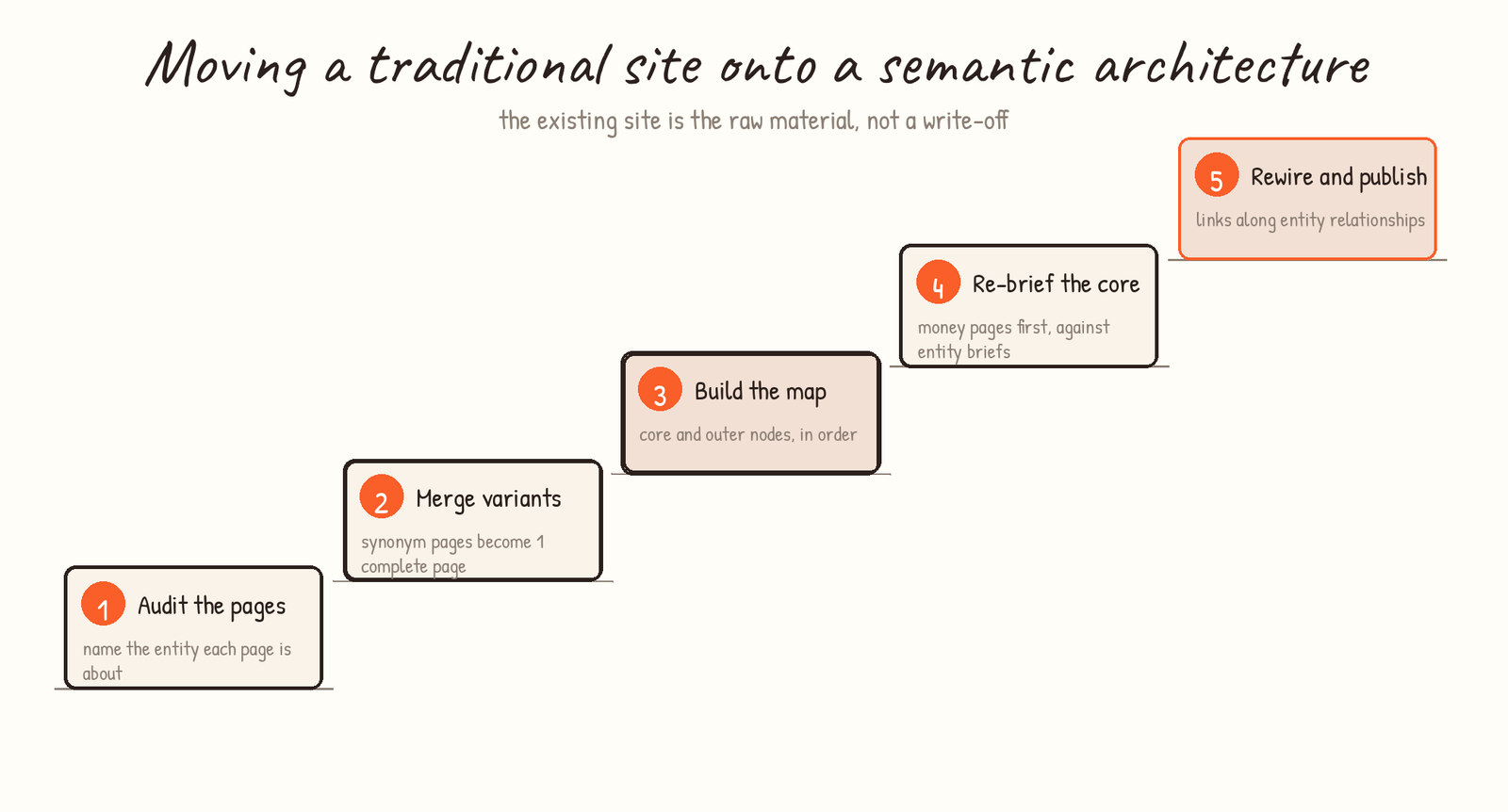
- Audit the existing pages into entities. List every live page, name the entity it is actually about, and record the attributes it states. Most traditional sites discover they have 4 pages about 1 entity and 0 pages about the entities that matter most.
- Merge the variant pages. Pages that target synonyms of 1 intent become 1 page that answers the intent completely. Redirect the duplicates into it and keep the strongest URL.
- Build the topical map. Fix the source context and the central entity, then map the core and outer sections the merged site should hold. The audit from step 1 shows which nodes already exist and which are holes.
- Re-brief the core section first. Rewrite the money pages against entity briefs before producing anything new. The core carries the commercial weight, and it is usually the thinnest content on a traditional site.
- Rewire the internal links and publish down the map. Connect the pages along entity relationships, then produce the missing outer nodes in the map’s order, measuring coverage rather than positions from that point on.
None of the steps requires a new domain, a new brand or a bonfire of the old content. It requires re-reading the old content as a partial graph and completing it.
Frequently asked questions
Is semantic SEO replacing traditional SEO?
Semantic SEO is replacing traditional SEO as the organizing method, not as a set of mechanics. Crawlability, indexation, site architecture and links remain traditional engineering, and semantic programmes fail without them. What changed is the unit the strategy is built around. Programmes are planned as entities and topics now, and executed with the traditional toolkit underneath.
Do keywords still matter in semantic SEO?
Yes, Searchers still type keyword strings, and Google still uses the words in a query as a basic relevance signal. The difference is the job keywords do. In semantic SEO a keyword is evidence about how searchers phrase a question, used when sizing and wording a node. It is not the page’s target, and no page is built to repeat it at a set density.
Is semantic SEO harder than traditional SEO?
Semantic SEO is harder at the start and easier at scale. The research phase is heavier, because mapping a topic’s entities and attributes takes longer than exporting a keyword list. After the map exists, every later decision gets cheaper. Briefs write themselves from the map, cannibalization is prevented by design, and new pages have an assigned place instead of needing a fresh strategy argument each time.
Can a website use both approaches at once?
Yes, and most working sites do. The common pattern is a semantic architecture for the topics the business wants to own, with traditional keyword work on the long tail of one-off pages, campaign pages and local pages where a topic is too small to map. The rule is that the 2 approaches never compete for the same intent. Each query area gets 1 organizing method.
How long does semantic SEO take to outperform traditional SEO?
On an existing site, the first gains usually show inside 90 to 180 days, once the merged core pages and the first new nodes are indexed and internally linked. The compounding advantage takes 6 to 12 months, because it runs on coverage plus historical data rather than on any single page. Traditional work can win individual phrases faster in the first weeks. It does not build the asset that makes later phrases cheap.
Is traditional SEO dead?
No, Traditional SEO is incomplete, which is a different claim. Its mechanics still run the floor of every ranking site, and in narrow local topics and short campaigns it remains the right-sized tool. What died is the belief that a keyword list is a content strategy. On any topic large enough to have structure, organizing by strings now loses to organizing by entities, measurably and repeatedly.
Practical test of which approach a site is running takes 1 minute. Open its content plan. If the plan is a list of phrases, the site is traditional whatever its agency calls it. If the plan is a map of entities with pages assigned to nodes, it is semantic. If your plan is still a list and your market has outgrown it, the first deliverable is the map, and it starts from an audit of the pages you already have.

Written by Hanzala Khan
Hanzala Khan has over 5 years of specialized experience in entity-based search optimization, Knowledge Graph engineering, and topical authority architectures. He specializes in designing custom semantic topical maps, advanced Schema.org data layers, and algorithmic authorship frameworks that help enterprise brands achieve durable search dominance and AI citation authority across Google, Perplexity, and ChatGPT.