
Home › Semantic SEO › Topical Authority
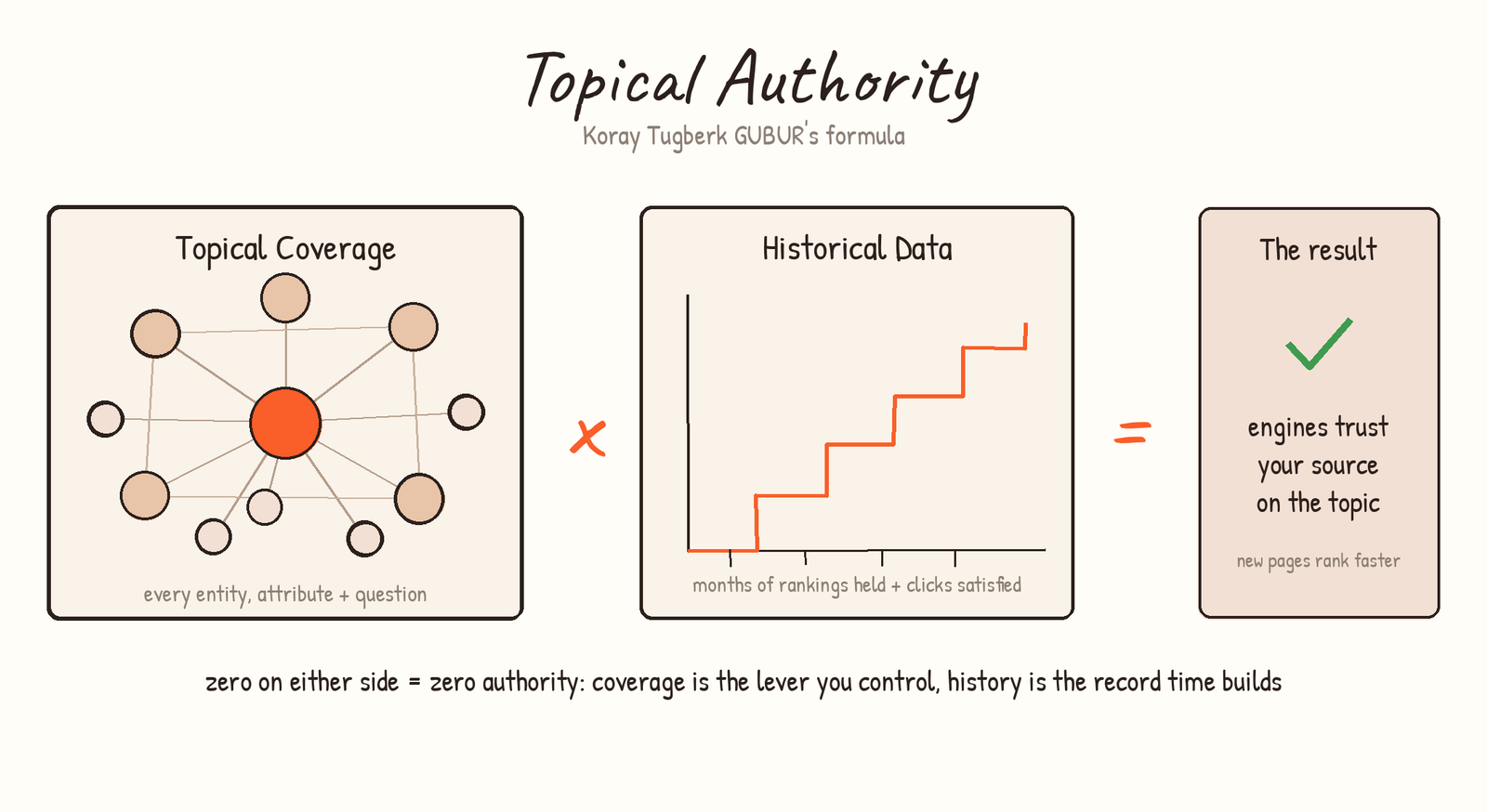
Topical authority is the degree to which a search engine treats a website as a trusted source on one topic. It is not a score any tool can show you. It is the accumulated result of two things: how completely the site covers its topic, and how long it has sustained that coverage. In semantic SEO, the concept is stated as a formula by Koray Tuğberk Gübür, the researcher who formalized it: topical authority equals topical coverage multiplied by historical data.
This guide defines each part of that formula, sets out what topical authority is made of, answers honestly whether Google measures it, and shows how it differs from the link-based authority scores most SEOs still quote.
What is topical authority in SEO?
Topical authority in SEO is a site’s demonstrated expertise on one defined topic, shown by complete and connected coverage of that topic’s entities, attributes and questions. A site has topical authority on a topic when its pages answer the full set of questions that topic contains, in the order and depth a searcher needs them, and when those pages link to each other by meaning.
Three properties separate topical authority from ordinary content volume. First, it is topic-bound: a site holds it on one topic at a time, never on everything it publishes. A retailer can hold topical authority on standing desks and none on office chairs, on the same domain. Second, it is relative: authority is judged against the other sources covering the same topic, so completing the topic’s coverage matters more than publishing more pages than a competitor. Third, it is earned at site level but spent at page level: once a source is trusted on a topic, a new page inside that topic starts with an advantage a new page on an unrelated topic does not get.
What is the formula for topical authority?
The formula for topical authority is topical coverage multiplied by historical data. Koray Tuğberk Gübür published it in February 2021 in a case study of four websites built with semantic content networks, where the sites gained rankings with technical SEO, page speed work and link building deliberately left out of the method.
The multiplication is the point of the formula. A site that covers a topic completely but started last month has coverage and almost no historical data, so its authority is still small. A site that has published on a topic for ten years but covers only a fraction of it has historical data and weak coverage, and its authority is capped by the missing fraction. Either side approaching zero pulls the product toward zero. Of the two sides, only coverage can be built deliberately and quickly. Historical data accumulates at its own speed, which is why the planning instrument, the topical map, comes first: you build the coverage you control, and time converts it into authority.
What does topical coverage mean?
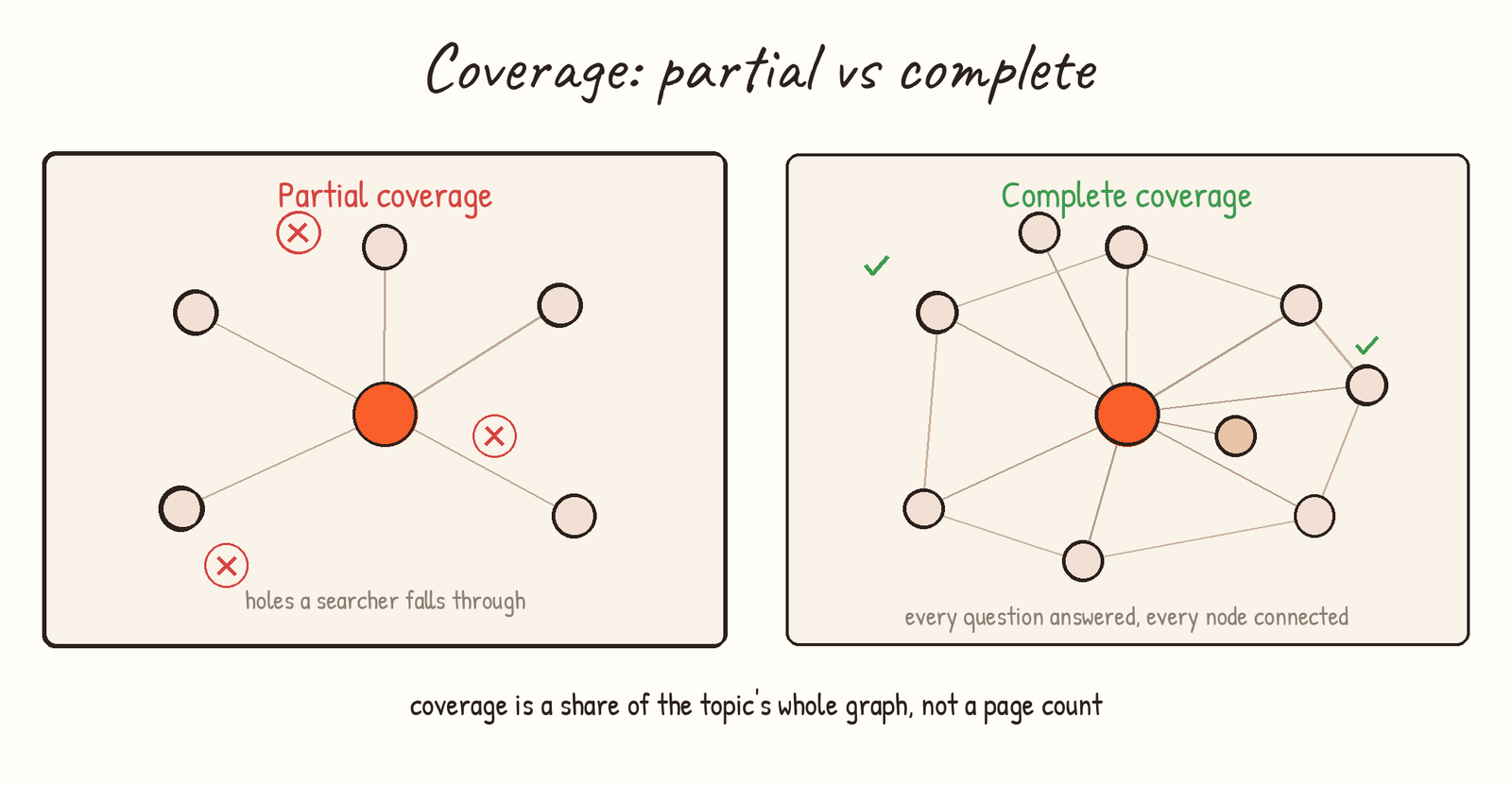
Topical coverage means the share of a topic’s knowledge graph that a site actually covers: its entities, each entity’s attributes, and the questions searchers ask about them. A topic is not a keyword list. It is a connected graph in which one central entity carries attributes, each attribute opens its own questions, and each question connects to neighbouring entities. Coverage is complete when the graph has no holes a searcher can fall through.
Coverage is organized in two sections. The core section covers the central entity and its main attributes: the pages closest to the site’s commercial purpose. The outer section covers the minor attributes, the comparisons, the background and the follow-up questions: the pages that prove the source understands the topic beyond what it sells. A site that publishes only its core section looks like a shop with opinions. A site that publishes only its outer section looks like a magazine with no subject. Authority forms when both sections exist and connect.
Coverage is not a page count. Fifty pages that repeat one attribute of one entity cover less of the graph than fifteen pages that each cover a distinct part of it. This is also why entity stuffing fails: naming an entity on a page is not covering it. Covering it means stating its attributes with values and answering the questions those attributes raise. What a topical map is, as the document that plans this coverage before anything is written, is defined in our topical map guide.
What is historical data in SEO?
Historical data in SEO is the record a search engine holds of how a site has performed on a topic over time: what it published, what ranked, what searchers clicked, whether those clicks were satisfied, and how the content was maintained. In Koray’s framework, historical data is not simply age. A domain registered in 2015 that published nothing on a topic until 2026 has no historical data on that topic. Historical data is topic-specific, exactly like coverage.
Four behaviours build it. Sustained publishing inside the topic, at a steady cadence rather than in bursts. Rankings held over time, which show the engine the coverage was not an accident. Satisfied search sessions: clicks that do not bounce back to the results page tell the engine the page answered the query. Maintenance: pages updated when the topic changes, so the record shows a source that keeps its coverage accurate.
Historical data is also the side of the formula that can turn negative. A site that covered a topic badly, or covered it and let the pages decay, holds a record of that too. Rebuilding authority on a topic with poor historical data takes longer than building it on a fresh topic, because the new coverage has to outweigh the old record, not just fill the graph.
Does Google measure topical authority?
Google does not publish a topical authority score, and no general ranking factor carries that name. The only system Google has ever named in this area is its news topic authority system, described in May 2023, which helps surface expert sources for news queries in areas such as health, politics and finance. That system weighs signals Google listed itself: a source’s notability on a topic, original reporting that other sources cite, and the source’s reputation.
For the wider web, Google describes its ranking as mostly page-level, with site-wide signals on top. Topical authority is the SEO field’s name for what those site-wide signals add up to on one topic. The strongest public evidence that Google measures site focus directly came in the 2024 leak of its internal search documentation, which contained site-level attributes including one that quantifies how focused a site is on a single topic, one that measures how far an individual page deviates from the site’s central theme, and site-level topic embeddings that represent the site’s subject as a whole. Leaked documentation is not a ranking manual, and no attribute in it is a dial a site can read. What it confirms is narrower and still useful: Google’s systems represent a site’s topic and its focus mathematically, which is the machinery a concept like topical authority requires. How search engines process meaning at page level is the subject of our semantic search guide.
What are the components of topical authority?
Topical authority is built from six components, and each one is a decision made before or during publishing, not a metric checked afterwards.
- Source context. The reason the site exists and the audience it serves. It fixes what the site may credibly claim authority on, and it is the border that keeps coverage from drifting.
- Central entity. The one entity the topic is about, present across every section. Coverage of a topic with no central entity is a pile of articles, not a graph.
- Core section. The central entity’s main attributes as pages: the definitions, the services, the products, the money pages.
- Outer section. The minor attributes, comparisons, background and follow-up questions as pages: the coverage that proves depth beyond the commercial core.
- Semantic content network. The published pages connected by contextual internal links, so the coverage reads as one traversable body of knowledge rather than isolated posts. The bridges between sections carry the authority from the outer pages to the core pages.
- Historical data. The accumulated record described above: sustained, satisfied, maintained performance on the topic over time.
Our topical map example shows components one to five as a finished artefact: a 30-node map for one retailer, with its source context, its central entity, its core and outer sections and its named bridges, each node ruled in or out on the record.
How is topical authority different from domain authority?
Topical authority and domain authority measure different things, come from different sources, and predict different outcomes. Domain authority is the name given to third-party scores that estimate a domain’s link strength. Google does not use them, does not publish them, and has said so for years. They are useful for comparing link profiles and useless for judging whether a site covers its topic.
| Dimension | Topical authority | Domain authority scores |
|---|---|---|
| What it measures | Completeness and history of coverage on one topic | Estimated strength of a domain’s backlink profile |
| Who produces it | Search engines, internally, per topic | Third-party SEO tools, per domain |
| Can you look it up? | No public score exists | Yes, in the tool that sells it |
| What builds it | Coverage of entities and attributes, internal connections, sustained performance | Links from other domains |
| Topic-specific? | Yes, one topic at a time | No, one number for the whole domain |
| What it predicts | Whether the source is trusted across a topic’s whole query set | Rough ranking competitiveness from links alone |
The practical difference shows up in competitive results. A specialist site with a modest link profile and complete coverage of a narrow topic routinely outranks a generalist site with a far stronger link profile on that topic’s queries, because the generalist’s links point at a domain that never covered the subject. Links still matter: they help discovery and they corroborate a source. They do not substitute for the coverage itself, which is the part of the formula a site controls.
Why does topical authority matter for AI search?
Topical authority matters for AI search because answer engines cite sources, and they cite the sources that cover the entity in the question most completely. When ChatGPT, Perplexity or Google AI Overviews answer a question, they fan it out into sub-queries and assemble the answer from pages across the topic’s graph. A source that covers only the head question has one page eligible for citation. A source with topical authority has a page eligible for nearly every sub-query in the fan-out.
This changes what coverage is worth. Under classic ranking, an outer-section page earned its keep by passing authority to the core through internal links. Under AI search, that same page can be cited directly, by name, in the answer a searcher reads instead of the results page. The authority the engine has accumulated about your source decides whether your pages enter the candidate set at all. Our answer engine optimization playbook works through the page-level craft of being cited; topical authority is the site-level condition underneath it.
How long does topical authority take to build?
Topical authority takes months to build and 6 to 12 months to compound. The coverage side can be produced on a schedule: a focused map for a narrow topic may hold 15 to 30 nodes, a market map may hold hundreds, and a team can publish either in a quarter. The historical data side runs on the engine’s clock. Rankings must be earned, held, clicked and kept accurate long enough to form a record, and practitioners report that a narrow niche can show clear authority effects within about 6 months of complete, connected coverage, with the compounding across a full topic taking 6 to 12 months.
Two shortcuts do not exist. Publishing the entire map in one week does not compress the history: the record needs sustained performance, not a launch spike. Buying links does not substitute for the missing coverage: links pointing at a graph with holes corroborate a source that still has not covered its topic. The only acceleration available is order: publish in the sequence the map specifies, connect each page as it lands, and keep the cadence steady, so every month of history is recorded against complete coverage rather than against fragments.
What are the signs a website has topical authority?
A website shows topical authority through effects you can observe without any score. New pages inside the topic rank faster and higher than the same site’s pages outside it, because the engine already trusts the source on that subject. The site holds rankings across the topic’s whole query set, including the long informational queries in the outer section, not only its commercial head terms. Its pages are cited in AI answers on the topic. And its rankings on the topic survive core updates that move less focused competitors, because the update re-evaluates quality signals the site’s coverage and history already satisfy.
The negative signs are equally specific. A site whose every new post needs months and links to move, on a topic it has published on for years, holds coverage without connection or history without maintenance. A site that ranks for its brand terms and nothing else in its topic has a graph with only a centre. Both are coverage problems before they are link problems.
Frequently asked questions
Is topical authority a Google ranking factor?
Not as a named factor or a published score. Google has named only a news topic authority system, for news queries in specific areas. For the wider web, topical authority is the SEO field’s term for the combined effect of site-level signals about focus, coverage and track record, and leaked internal documentation confirms Google computes site-focus attributes. Treat any tool that shows you a topical authority number as showing you its own estimate, not Google’s measurement.
Can a new website have topical authority?
A new website can build the coverage side immediately and cannot have the historical side yet. Its authority grows as the record forms: sustained rankings, satisfied clicks and maintained pages inside one topic. This is why new sites should choose a narrower topic than established competitors. A complete graph on a narrow topic, held for six months, produces more authority than a partial graph on a broad topic held for the same period.
How many pages does a website need for topical authority?
There is no fixed number, because the requirement is completeness relative to the topic’s graph, not a count. A narrow topic may be fully covered by 15 to 30 connected pages. A full market may need several hundred nodes. The correct test is whether a searcher can start at any question in the topic and reach every related answer without leaving the site, not whether the site has published an impressive number of posts.
Do backlinks build topical authority?
Backlinks support topical authority and cannot create it. A link from a relevant source corroborates the site and helps its pages get discovered and crawled. But the formula’s two factors are coverage and historical data, and a link changes neither the completeness of the graph nor the record behind it. Sites with strong link profiles and thin coverage lose topic queries to specialists with weaker links and complete coverage, which is the clearest evidence that links alone do not confer it.
Is topical authority the same as E-E-A-T?
No. E-E-A-T is a framework from Google’s search quality rater guidelines for judging the trustworthiness of individual pages and their authors: experience, expertise, authoritativeness and trust. Topical authority is a site-level condition about coverage and history on one topic. They overlap at expertise: complete, accurate coverage of a topic is one of the strongest demonstrations of it. A page can satisfy every E-E-A-T signal and still sit on a site with no topical authority, if the rest of the topic was never covered.
Can a website lose topical authority?
Yes, through both sides of the formula. Coverage decays when the topic moves and the site does not: new entities and attributes appear, competitors complete parts of the graph the site left open, and its share of the topic shrinks. Historical data turns when rankings and satisfied sessions are replaced by neglect, or when the site drifts into unrelated topics and dilutes the focus its record was built on. Authority is maintained the same way it is built: keep the graph complete, keep the pages accurate, keep publishing inside the topic.
Topical authority is not a campaign. It is the state a site reaches when its coverage of one topic is complete and its record on that topic is long. If you want that state measured against your own market, the instrument is the topical map: it shows the graph, the holes in it, and the order to close them in. Our semantic topical map service builds that map for your central entity, and the first step is an audit of the coverage you already hold.

Written by Hanzala Khan
Hanzala Khan has over 5 years of specialized experience in entity-based search optimization, Knowledge Graph engineering, and topical authority architectures. He specializes in designing custom semantic topical maps, advanced Schema.org data layers, and algorithmic authorship frameworks that help enterprise brands achieve durable search dominance and AI citation authority across Google, Perplexity, and ChatGPT.
2 Responses