
Home › Semantic SEO › AEO Playbook
Key takeaways
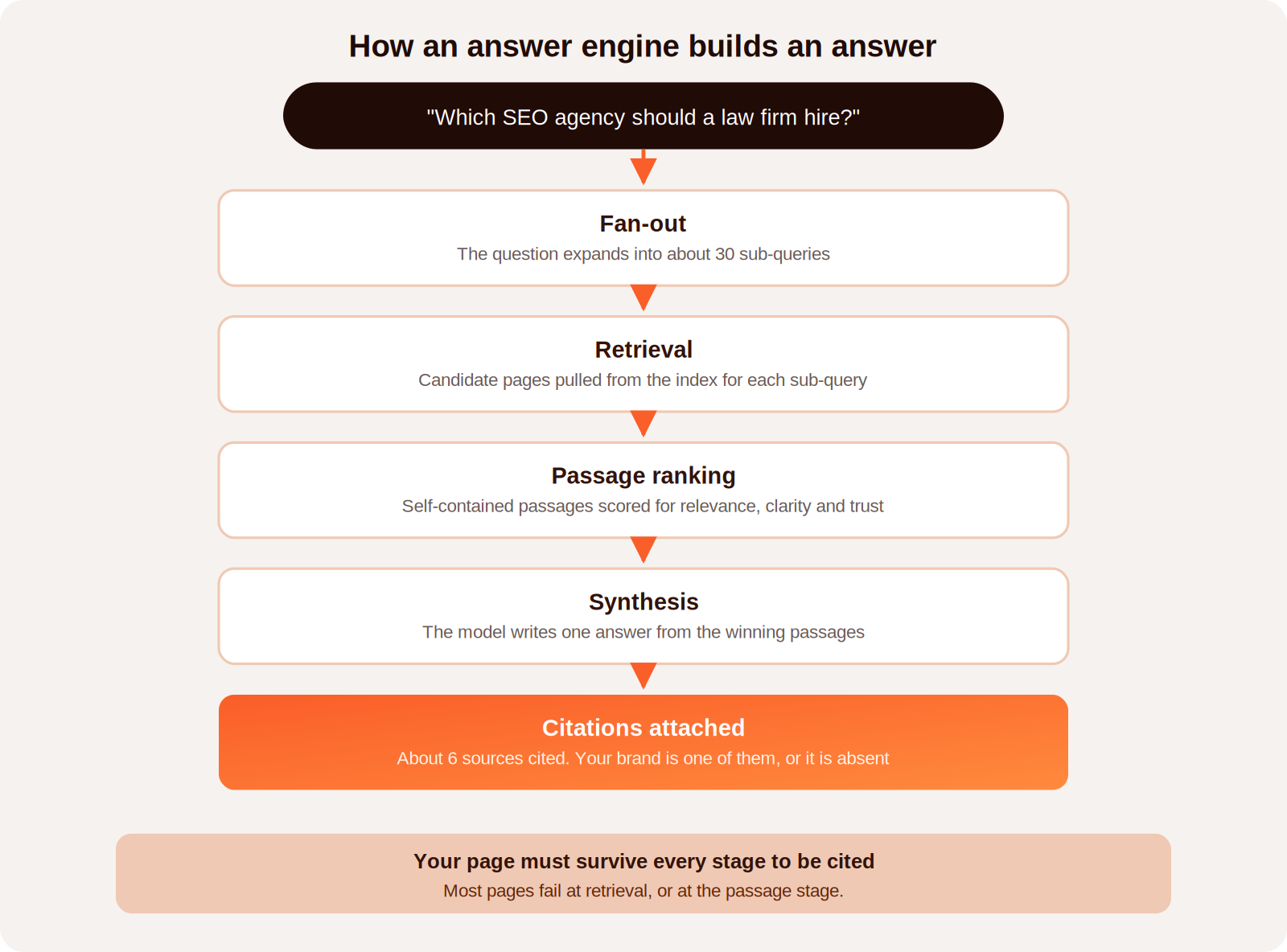
- An answer engine runs a pipeline, not a ranking: it expands the question into a fan-out of sub-queries, retrieves candidate pages, scores passages, and writes one answer with about six citations. Your page has to survive every stage.
- The arithmetic is brutal. One question fans out into roughly 30 sub-queries, yet the finished answer carries an average of 5.87 citations (GeoAura and Foglift panel, November 2026). Most retrieved pages are read and discarded.
- The term is old, the surface is new. AEO started with featured snippets and voice assistants, and US search demand for it is now climbing fast: the term averaged 2,400 US searches a month over the past year and hit 4,400 in September 2026, its highest month on record.
- Branded web mentions correlate with AI Overview visibility at 0.664 in Ahrefs’ study of 75,000 brands. Backlinks correlate at 0.218. What the web says about you matters more than what links to you.
- Citations churn. About 65 percent of cited sources change from one day to the next, so AEO is a measurement loop with a fixed prompt panel, not a checklist you finish.
What is answer engine optimization?
Answer engine optimization is the discipline of earning citations and brand mentions inside answers generated by AI systems: ChatGPT, Perplexity, Claude, Gemini, Microsoft Copilot, and Google’s AI Overviews and AI Mode. An answer engine is any system that responds to a question with a written answer instead of a list of links. AEO is the work of being the material that answer is built from.
The term predates ChatGPT. SEOs used it from the mid-2010s for featured snippets, People Also Ask boxes and voice assistants, all of which extract one passage and present it as the answer. What changed is the extractor: a snippet lifted your paragraph verbatim, while a generative engine reads dozens of passages, rewrites them, and cites a few sources. The passage discipline survived. The scale and the measurement problem did not.
Generative engine optimization (GEO) is the academic name, from the KDD 2024 paper that first measured the work. LLM SEO and AI SEO circulate in agency decks. But “answer engine optimization” is the phrase business owners type, and its volume is rising faster than any rival term in the cluster. A playbook should be written under the name its readers use.
How does an answer engine build an answer?
Every practical AEO decision follows from how the answer is assembled. There are five stages, and a page can fail at any of them.
Stage 1: The question arrives in natural language: Buyers no longer type “semantic seo agency pricing”. They ask “which semantic SEO agency should a 40-person law firm hire, and what does it cost?” The question carries constraints, context and intent that a keyword never held. Content planned around keywords is planned around a query format your buyers have stopped using.
Stage 2: The engine fans the question out: Google documents this directly: its AI features may use a query fan-out technique, issuing multiple related searches across subtopics before answering. Foglift’s five-engine panel (65,558 answers measured to 3 November 2026) puts the average at 30.1 sub-queries per question. Each sub-query is a separate retrieval event, and your content can win some and lose others independently.
Stage 3: Retrieval pulls candidate pages: For each sub-query, the engine fetches pages from its index. This is the stage semantic search governs: retrieval matches meaning, entities and relationships, not literal strings, so a page about the right concept in different words can be retrieved, and a page stuffed with the exact phrase can be skipped. Google’s requirement is mechanical: to appear as a supporting link in AI Overviews or AI Mode, a page must be indexed and eligible to show with a snippet. No indexation, no citation, whatever the content says.
Stage 4: Passages are scored and extracted: Retrieved pages are split into chunks, and the chunks are scored against the sub-query they were fetched for. The passages that survive are self-contained: they state a fact, name the entity it belongs to, and still make sense with no surrounding context. A brilliant page whose answer is spread across four paragraphs and a table footnote loses to a plain page that says the thing in two sentences.
Stage 5: The answer is synthesized and sources are cited. The model writes one answer from the extracted passages and attaches citations. The panel average is 5.87 citations per answer, but the engines differ sharply: Perplexity cites about 9.20 sources per answer, AI Overviews 7.54, Gemini 4.82, ChatGPT 3.30 and Claude 2.47 (GeoAura and Foglift, November 2026).
There is also a sixth, invisible route that skips the pipeline entirely: the model answers from what it already knows. Ahrefs analyzed 66.6 million ChatGPT responses in October 2026 and found only 14.4 percent triggered a web search at all. For the other 85.6 percent, no page work can win the citation, because there is no retrieval. What the model names in those answers is what it absorbed about brands from the web at large. For ChatGPT especially, the mentions step in the playbook below is most of the game.
How do featured snippets and People Also Ask connect to AEO?
If AEO feels familiar, it should. The passage discipline was built for featured snippets, and the two systems now share one source pool, but they are no longer the same pool. Ahrefs analyzed 863,000 keyword results and found that only 38 percent of pages cited in AI Overviews also rank in Google’s top 10, down from about 76 percent in July 2025. Ranking well still helps you get retrieved. It no longer predicts being cited.
People Also Ask has quietly completed the transition. AlsoAsked tracked 19.2 million English-language PAA questions through 2026 and found that 97 percent of the answers shown in the first week of September 2026 were AI-generated, up from 12.6 percent in July 2025. The box that used to quote one page now synthesizes like every other answer engine. The practical reading: the question sets inside PAA are still the best public map of what buyers ask, but winning them now takes the full pipeline, not a snippet-shaped paragraph.
How is AEO different from GEO and SEO?
This post is a playbook, not a comparison, so here is the distinction in one table and one paragraph. We published the full breakdown in our GEO vs SEO comparison for readers who want the long version.
| Discipline | The win | The unit | The working surface |
|---|---|---|---|
| SEO | A ranked position in a list of links | The page | Google and Bing results |
| GEO | Being a trusted source across AI systems | The brand and its whole web footprint | All generative engines, including model knowledge |
| AEO | A cited passage inside one generated answer | The self-contained passage | The answer itself: AI Overviews, ChatGPT, Perplexity, Claude, Gemini |
The useful way to hold the three: SEO gets you retrieved, GEO is the umbrella strategy for being chosen, and AEO is the page-level craft of being quotable. The playbook below is AEO in that strict sense, plus the entity and mention work it depends on, because a perfect passage on an unknown brand’s site still loses.
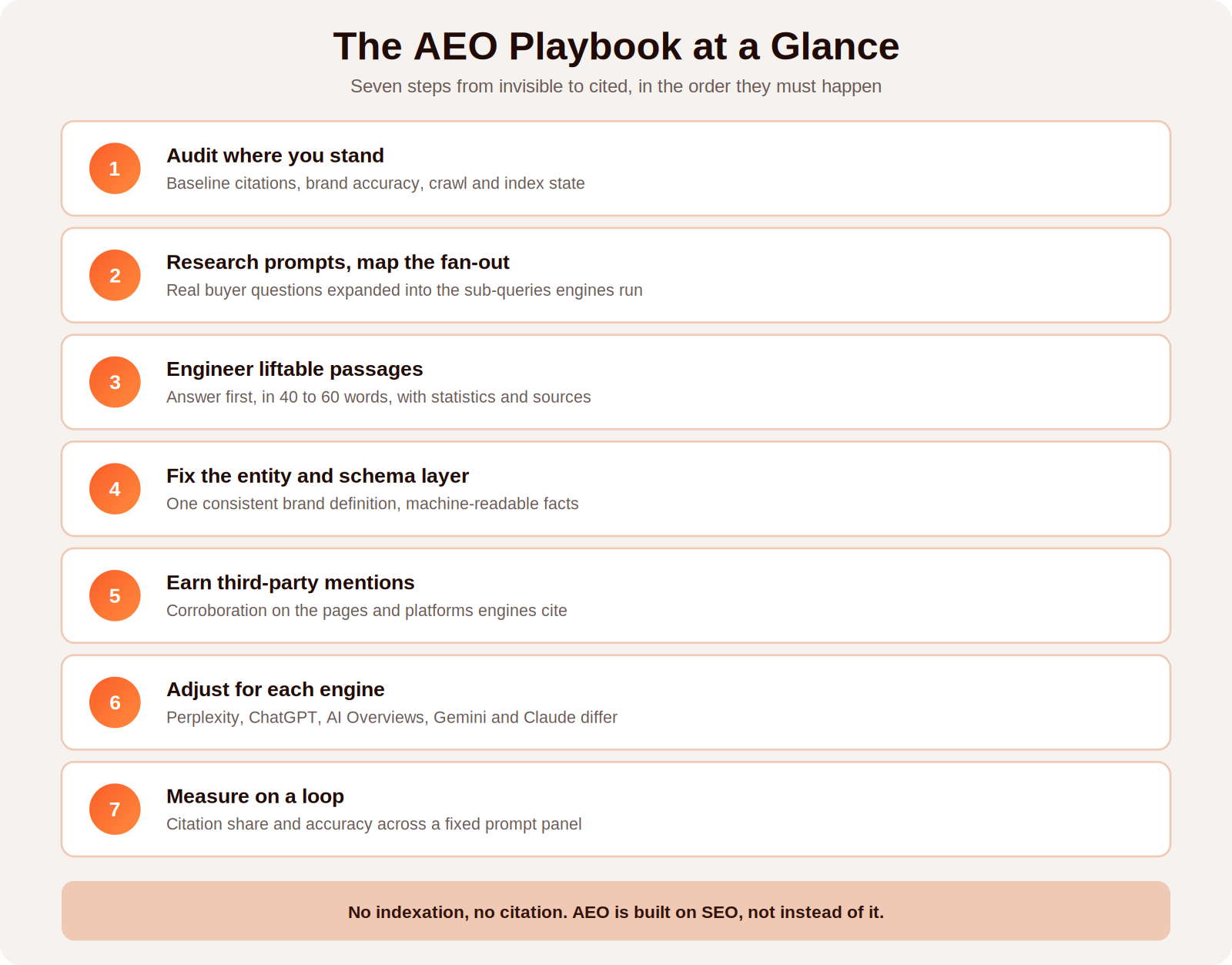
The AEO playbook
Seven steps, in order. The first three are diagnosis and planning, and skipping them is why most AEO efforts produce rewritten pages and no citations. This is the sequence we run inside our AI SEO services engagements, published here in full.
Step 1: How do you audit where you stand in AI answers today?
Before editing anything, record the baseline. Build a starter panel of 20 to 30 questions your buyers actually ask, run each one in ChatGPT, Perplexity, Google AI Overviews, Gemini and Claude, and save the full answers with dates. Log three things per answer: whether your brand is named, whether your pages are cited, and whether what the answer says about you is true. Without it, later movement cannot be proved, because citations churn too fast for memory.
In the same pass, audit the machine state of the site: which pages are crawled and indexed, whether AI crawlers are blocked anywhere in robots.txt or a CDN rule, and whether your money pages are eligible to show with a snippet. A blanket crawler block left over from 2023 is still the single most common reason established brands are absent from answers. Our free semantic SEO site audit covers the website side of this baseline in minutes; the prompt panel you run yourself.
Step 2: How do you research prompts and map the fan-out?
Keyword lists describe how people searched in 2019. Your raw material now is questions: from sales calls, support tickets, Search Console queries, People Also Ask trees, Reddit and industry forums, and the follow-ups your own customers ask after the first answer. Group them by intent (definition, process, cost, comparison, problem) and by the product or service they attach to.
Then expand each seed question into the sub-queries an engine would generate from it. This expansion discipline is query augmentation: varying the entity, the constraint, the comparison and the context until the set covers the fan-out. Finally, map every question and sub-question to the page and passage that should answer it, and mark the gaps where no page exists. That coverage plan is what a topical map is in the answer era, and it is the difference between a content calendar and a citation strategy.
Step 3: How do you engineer passages that survive being lifted?
This is the craft step, and the only one with controlled experimental evidence behind it. The Princeton GEO study (Aggarwal et al., KDD 2024) tested content changes on a 10,000-query benchmark and measured the shift in a source’s share of the generated answer: adding quotations from credible sources lifted visibility by up to 41 percent, adding statistics by up to 33 percent, improving fluency by up to 29 percent, and citing sources by up to 28 percent. Keyword stuffing reduced visibility. Read those percentages honestly: they come from a benchmark on simulated engines, they measure share of answer text rather than citation probability, and they only apply to pages the engine already retrieved. Directional, not promised.
Translated into page work, the rules are concrete. Put the answer in the first one or two sentences of every section, in a passage of roughly 40 to 60 words that names its subject in full and stands alone. Write headings as the questions buyers ask. Give every claim a number, a date or a named source where one exists. Use lists and real HTML tables for comparisons and processes, because each row is a discrete, liftable fact. And do the engineering at brief level, not in the editor afterwards: our semantic content briefs specify the answer block, the entities, the statistics and the citations each section must contain before a word is written.
Step 4: How do you fix the entity and schema layer?
Engines do not only read your pages. They resolve your brand as an entity and check what the rest of the web says it is. So define the entity once, canonically: one brand name, one one-sentence description, one category label, the same facts about services, people and locations, and then apply that definition identically on your site, your profiles, your directory listings and your press boilerplate. This is the point where AEO stops being a writing exercise and becomes semantic SEO: entities, attributes and relationships, stated consistently enough that a machine can merge every mention into one confident picture.
Structured data supports that picture, and its 2026 status needs stating plainly, because most AEO guides are out of date. Organization markup with sameAs links, Article markup with a named author and honest dates, Person markup for your experts, and BreadcrumbList all help engines disambiguate who you are and what a page is. FAQPage markup is still valid schema.org, but Google restricted FAQ rich results to government and health sites in 2023 and stopped showing them entirely on 7 May 2026, removing the documentation that June. HowTo rich results were retired in September 2023. Add FAQ markup for machine readability if the page genuinely contains the questions and answers, but do not buy it as a visibility tactic. And no schema type is required for AI Overviews: Google says so explicitly. Markup clarifies. It does not substitute for the answer being on the page.
The failure mode this step prevents is worse than invisibility. When your facts conflict across the web, engines do not average them politely. They repeat one version, sometimes the wrong one, with total confidence, which is how brands end up fighting poisoned SERPs where an outdated price, a closed location or a service you never offered is stated as fact in answer after answer. Entity consistency is reputation defense, not housekeeping.
Step 5: How do you earn corroboration the engine can check?
An engine trusts a claim more when independent sources repeat it. The strongest large-scale evidence for this is the Ahrefs study of 75,000 brands (May 2025): branded web mentions correlated with AI Overview visibility at 0.664, branded anchor text at 0.527, while the number of backlinks correlated at just 0.218. Correlation is not causation, and Ahrefs says so itself. But the pattern matches the mechanism: models name brands they have seen described, consistently, in places other than the brand’s own site.
Work the sources engines actually cite. Read the answers from your Step 1 panel, list the pages cited for your buyers’ questions, and sort them by type: comparison and listicle pages, review platforms, industry publications, community threads, directories, YouTube. Then earn presence in those exact places: expert commentary and original data for publications, complete profiles on the platforms, honest participation in the threads. This is also the only route into model-knowledge answers, where no retrieval happens at all. A brand the web describes everywhere is a brand the model can name from memory.
Step 6: Why does each engine need its own adjustments?
A playbook tuned for one engine is a fraction of a program. Writesonic ran 161,286 prompts across ChatGPT, Gemini, Perplexity and AI Overviews in July 2026 and found that 72 to 73 percent of cited domains appeared on only one engine, and just 3.8 percent appeared on all four. The engines retrieve from different indexes, cite at different rates, and weight brand knowledge differently.
So adjust at the margins, per engine. Perplexity cites the most sources per answer (about 9.20) and retrieves live, so fresh, well-structured pages with clear sourcing get picked up there fastest; it is the best early indicator that passage work is landing. AI Overviews draw on Google’s index and snippet eligibility, so your Google technical state is the gate. ChatGPT cites the fewest sources per answer (about 3.30) and, per the Ahrefs response analysis, usually answers without searching at all, so brand familiarity and presence in the comparison content it trusts carry the most weight there. Gemini and Claude sit between: Gemini inherits Google’s ecosystem, Claude cites sparingly (about 2.47 per answer) and favors authoritative reference material.
Step 7: How do you measure AEO on a loop?
AEO measurement fails in most companies because someone types five prompts into ChatGPT once, screenshots the result, and calls it a report. Answers vary by session, phrasing, model version and day. Citation-stability research published in 2026 found about 65 percent of cited sources change from one day to the next (arXiv:2604.07585), and Ahrefs’ 20-day tracking found most dropped citations return within the window. A single run is noise. The framework below is built to see through it.
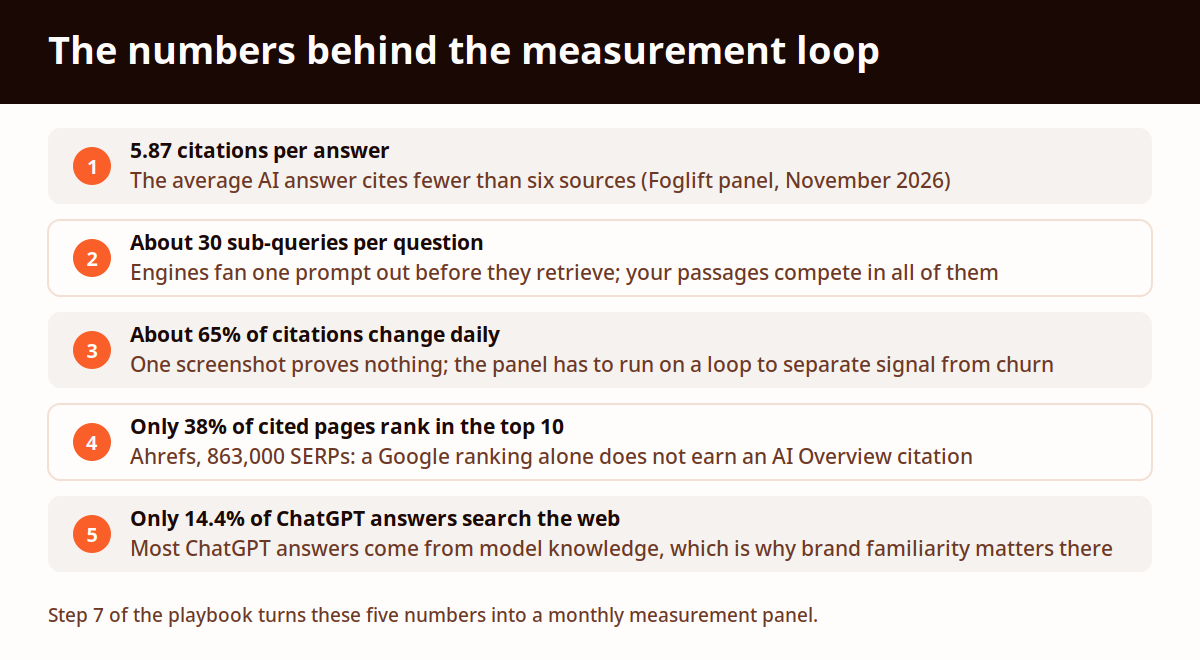
The panel. Fix a set of 30 to 50 buyer prompts, covering definitions, comparisons, costs and problems in your market, plus a small branded set. Freeze the wording. Run the panel on a schedule (weekly is workable, monthly is the minimum) across ChatGPT, Perplexity, AI Overviews, Gemini and Claude, and run each prompt more than once, because same-day repetitions of the same question agree only partially.
The metrics. Track five numbers per engine. Mention rate: the share of answers that name your brand at all. Citation share: your cited pages as a share of all citations given for the panel, which is the closest AEO equivalent of share of voice. Share of answer: how much of the answer text your material accounts for when you are cited. Accuracy rate: whether the answer describes your brand, prices and services correctly, which matters more than most teams expect, since one study of four generative engines found only 51.5 percent of generated sentences were fully supported by their citations (Liu, Zhang and Liang, 2023). And AI referral traffic: sessions from chatgpt.com, perplexity.ai and similar sources in analytics, segmented honestly.
The honesty check. Keep the scale in view. ChatGPT referral traffic equals about 0.62 percent of Google’s organic traffic (Pember Research, November 2026, reporting Marie Haynes’ analysis of more than 145 million sessions). And Kevin Indig’s 632 correlation tests (Growth Memo, October 2026) found no reliable link between AI visibility metrics and downstream business metrics yet. AEO is worth doing because buyers form shortlists inside answers and because the discipline compounds with SEO, not because AI referrals are about to replace search. Any report that hides the 0.62 percent is selling something. Measure the loop, fix the biggest gap the panel shows (usually absent prompts first, then competitor-cited prompts, then inaccurate descriptions), and rerun.
This playbook runs on a topical map: the prompt research in Step 2 becomes coverage decisions, and the passages in Step 3 are briefed page by page. If your site does not have that map yet, our semantic topical map service builds it.
What mistakes keep brands out of AI answers?
1. Blocking the crawlers, then wondering. A robots.txt or firewall rule that blocks OAI-SearchBot, PerplexityBot or ClaudeBot removes you from those engines’ answers entirely. Blocking training crawlers is a legitimate separate choice. Blocking search crawlers by accident is self-sabotage.
2. Burying the answer. Introductions and scene-setting before the first fact. The extractor takes the passage that answers, and it is rarely yours if yours starts on paragraph five.
3. One page for every question. A mega-page that loosely addresses twelve questions gives the engine twelve mediocre passages. One page or one tight section per question cluster produces passages that can win.
4. Keyword stuffing, still. The Princeton benchmark measured it as a negative, and engines trained on fluent text treat repetition as a quality smell. Write the fact once, clearly.
5. Buying FAQ schema as a tactic. Google retired FAQ rich results in May 2026 and HowTo results in 2023. Vendors still selling either as an AEO shortcut are selling a retired feature.
6. Inconsistent brand facts. Three descriptions, two founding dates and a moved office that was never updated. The engine picks one version and states it as fact, and correcting an answer is slower than correcting a listing.
7. Measuring once and declaring victory or defeat. With about two thirds of cited sources turning over daily, any single screenshot proves nothing in either direction. No panel, no baseline, no conclusion.
Frequently asked questions
What is answer engine optimization in simple terms?
It is making your content easy for an AI system to find, lift and credit when it answers a question. Practically: be indexed, answer real questions in self-contained passages near the top of the page, back claims with numbers and sources, keep your brand’s facts consistent across the web, and track whether answers name and cite you.
Is AEO the same as GEO?
They overlap heavily and most teams should treat them as one program. The clean distinction: GEO is the umbrella strategy for being chosen as a source by generative systems, including what models know about your brand. AEO is the page-level craft inside it, structuring content so a clean answer can be extracted and cited. Our GEO vs SEO comparison covers how both sit on top of classic SEO.
Does ranking on Google guarantee citations in AI answers?
No. Ahrefs found only 38 percent of pages cited in AI Overviews also rank in Google’s top 10, and the share has been falling. Rankings help you pass the retrieval stage. Citations are decided later, at the passage stage, and by whether the engine trusts and recognizes your brand.
Does FAQ schema help with AEO in 2026?
Not as a visibility feature. Google stopped showing FAQ rich results for all sites on 7 May 2026, and no engine documents a citation boost from FAQPage markup. A genuine FAQ section still helps, because question-and-answer passages are highly extractable as visible content. The markup is optional clarity. The visible answers are the asset.
How long does AEO take to show results?
Engines that retrieve live, Perplexity and AI Overviews, can cite a new or fixed page within days to weeks. Brand-level change is slower, because it depends on third-party mentions accumulating and on model knowledge updating. Judge progress on a fixed prompt panel over six to twelve weeks, not on daily checks, because citation churn makes short windows meaningless.
How much does AEO cost?
Most of the playbook is editing and structuring work on pages you already have, plus mention-building and measurement time. If your SEO foundation is sound, AEO is an added layer on the same program, not a second program with a second budget. If the foundation is broken (indexation problems, thin coverage, contradictory facts), that repair comes first and is where the early money goes.
The bottom line
AEO is not a new channel and it is not a trick. It is the discipline of being the source an answer is built from, in a system that expands every question thirty ways, keeps about six citations, and reshuffles them daily. The brands winning it are not doing anything exotic. They are indexed, they answer real questions in passages built to be lifted, their facts agree everywhere, other sites describe them consistently, and they measure the loop instead of the screenshot.
Start with the baseline. Run the free semantic SEO site audit to check the machine state of your site, then run your buyers’ questions through the engines and see who gets cited instead of you. If the answers name your competitors, our AI SEO services run this exact playbook end to end, from the topical map to the measurement panel. Or talk to us first and we will tell you honestly which step you are actually stuck on.

Written by Hanzala Khan
Hanzala Khan has over 5 years of specialized experience in entity-based search optimization, Knowledge Graph engineering, and topical authority architectures. He specializes in designing custom semantic topical maps, advanced Schema.org data layers, and algorithmic authorship frameworks that help enterprise brands achieve durable search dominance and AI citation authority across Google, Perplexity, and ChatGPT.
One Response