
The terms differ by who coined them, not by the work involved.
Home › Semantic SEO › GEO vs SEO
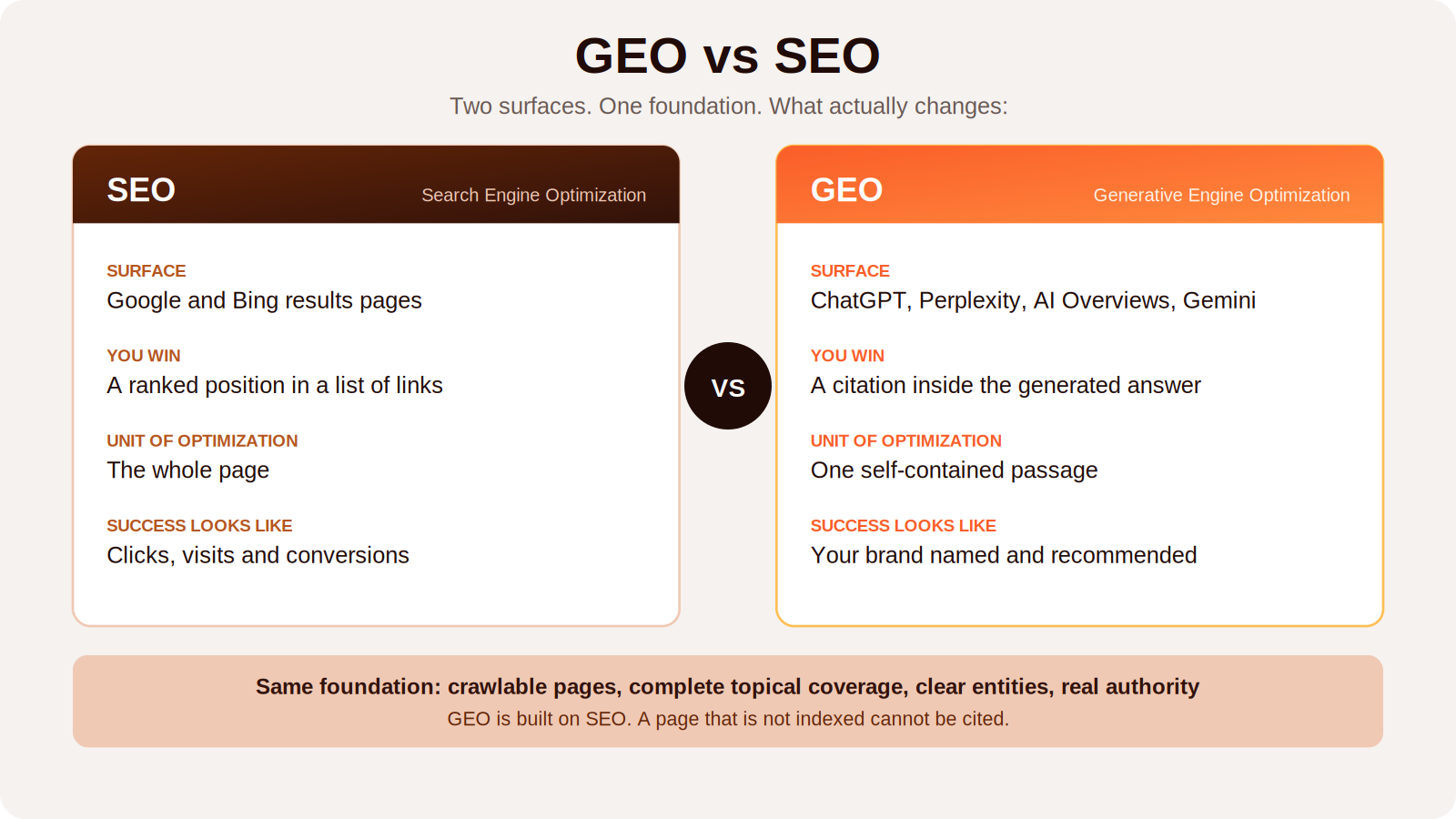
SEO gets your pages ranked in search results. GEO (generative engine optimization) gets your brand cited inside answers written by AI systems such as ChatGPT, Perplexity, Claude, Gemini and Google AI Overviews. GEO does not replace SEO, because AI engines retrieve their sources from the same crawled, indexed web that SEO builds. What changes is the unit of competition: a ranking position becomes a cited passage, a keyword becomes a fan-out of sub-questions, and a click becomes a mention that may never produce a visit. The foundations stay shared. The execution layer on top is new, and it is measurable.
Key takeaways
- SEO competes page against page for a position in a list of links. GEO competes brand against brand for one of roughly six citation slots inside a single generated answer.
- AI engines can only cite pages that are crawled and indexed. Google states that a page must be indexed and eligible to appear with a snippet before it can show as a supporting link in AI Overviews or AI Mode. SEO decides which pages the AI reads. GEO decides whether your passage gets quoted.
- The strongest measured signal for AI visibility is not backlinks. In an Ahrefs study of 75,000 brands, branded web mentions correlated with AI Overview visibility at 0.664, while backlinks correlated at 0.218.
- Citations are unstable. Only about 35 percent of sources cited by AI engines stay the same from one day to the next, so GEO is a monitoring discipline, not a one-time fix.
- The practical answer is one program, not two: a technically sound site, a topical map built from real questions, passage-level content, consistent entity data, and prompt-level citation tracking.
What is SEO?
SEO (search engine optimization) is the practice of making web pages rank in the organic results of search engines such as Google and Bing, so that searchers click through to your site. It rests on three working parts: technical SEO, which keeps pages crawlable, indexable and fast; content, which must match the intent behind a query and cover its topic completely; and authority signals, mainly backlinks and brand signals, which tell the engine your page can be trusted over competing pages.
The output of SEO is a position. Positions convert to impressions, impressions convert to clicks, and clicks convert to customers. Every part of that chain is visible in Google Search Console, which is why SEO measurement is mature: rankings, impressions, click-through rate and conversions can all be tracked to the page and the query.
What is GEO?
GEO (generative engine optimization) is the practice of making your content and your brand easy for AI answer engines to retrieve, understand and cite when they generate a response. The term comes from the research paper “GEO: Generative Engine Optimization” by Pranjal Aggarwal and colleagues from Princeton University, Georgia Tech, IIT Delhi and the Allen Institute for AI, first published in November 2023 and presented at KDD 2024. The same discipline is also sold as answer engine optimization (AEO), LLM SEO and AI SEO. The names differ. The work is the same: be the source the answer is built from.
A generative engine does not return ten links. It reads a set of retrieved sources, synthesizes one answer, and cites a handful of them. GEO is the work of getting your pages into that retrieved set, getting your passages quoted in the synthesis, and getting your brand described accurately when the engine talks about your market. The buyer may never click. The mention itself is the asset, because the shortlist the AI gives is increasingly the shortlist the buyer works from.
What are the key differences between GEO and SEO?
| Factor | SEO | GEO |
|---|---|---|
| Primary surface | Google and Bing results pages | ChatGPT, Perplexity, Claude, Gemini, Google AI Overviews and AI Mode |
| What you win | A ranked position in a list of links | A citation, a quote or a brand mention inside a generated answer |
| Unit of optimization | The page | The passage: a self-contained block of text that still makes sense when lifted out alone |
| The query | A keyword or short phrase typed by the user | A long, conversational question that the engine expands into a fan-out of sub-queries |
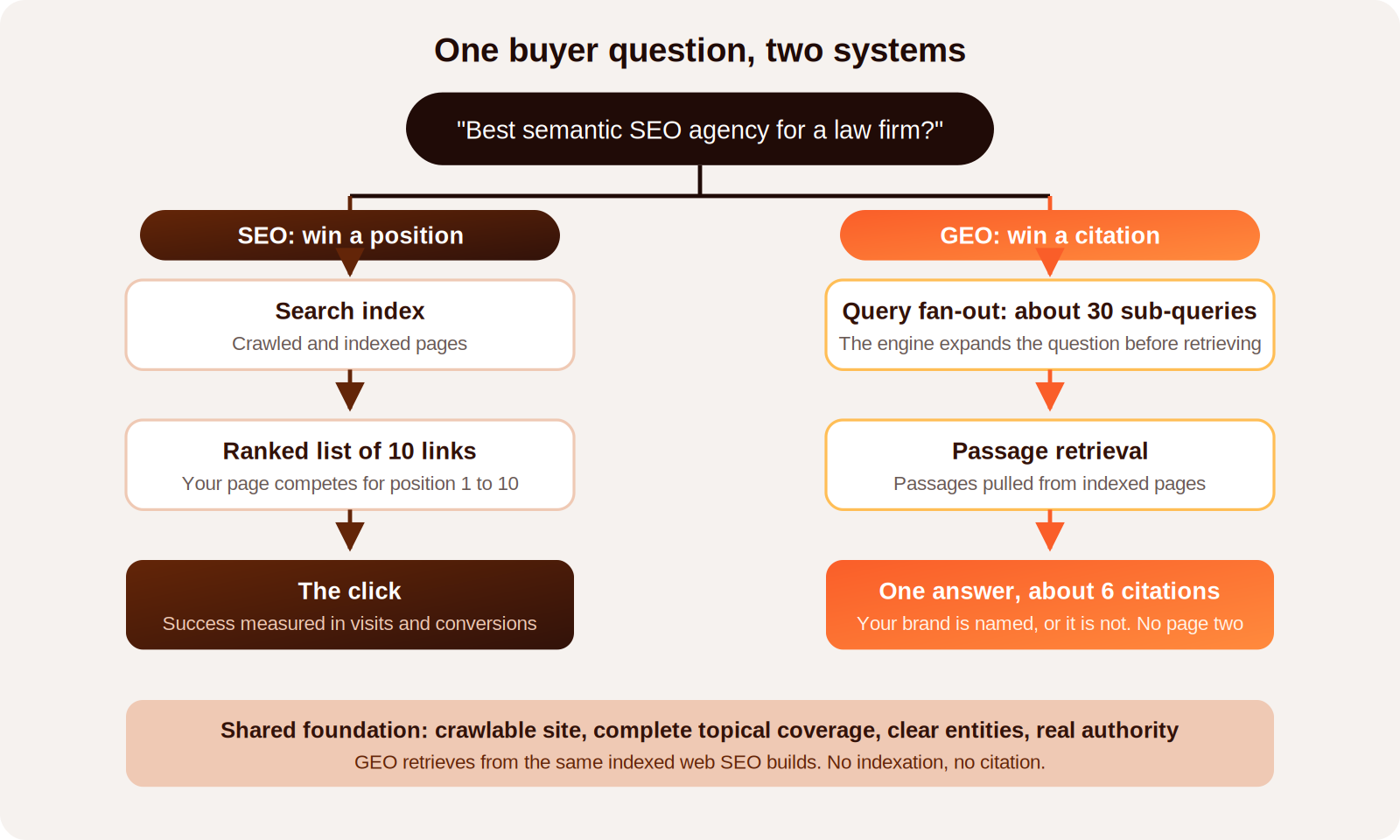
| How many winners | Ten organic positions per page, plus page two | About six citation slots per answer on average, and often only one to three brands named |
| Core signals | Relevance, content quality, backlinks, page experience | Retrievability, quotable facts, entity clarity, branded mentions across the web, source consensus |
| Role of links | Backlinks are a primary authority signal | Backlinks help you get retrieved, but branded mentions correlate more strongly with being cited |
| Measurement | Rankings, impressions, clicks and conversions in Search Console | Citation share across a fixed prompt set, brand mention rate, AI referral traffic |
| Stability | Rankings move slowly and can be held for months | Roughly 65 percent of cited sources change from one day to the next |
| What failure looks like | Ranking on page two | Not being named at all. There is no page two in an answer |
| Dependency | Works on its own | Cannot work without SEO: uncrawled, unindexed pages are invisible to answer engines |
What stays the same in GEO and SEO?
Most GEO advice that tells you to abandon SEO is selling you a layer with no base under it. These five foundations serve both disciplines at once, and weakness in any of them caps your results in both.
1. Crawlability and indexation. An answer engine retrieves from an index, the same as a search engine. If GPTBot, ClaudeBot, PerplexityBot or Googlebot cannot fetch your page, or the page is not indexed, it cannot be cited. Google is explicit about its own AI features: a page must be indexed and eligible to appear with a snippet to be used as a supporting link in AI Overviews or AI Mode. Technical health is not an SEO-only concern. It is the entry ticket to both games.
2. Complete, intent-matched content. Search engines rank pages that satisfy the intent behind a query, and answer engines retrieve passages that answer a question directly. Both reward the same thing: full coverage of a topic, organized the way a searcher thinks about it. This is the core of semantic search: engines interpret meaning and entity relationships, not keyword strings, and they have done so since long before AI answers existed.
3. Entities and structured data. A brand that is described consistently, with the same name, services, locations and facts on its site, its profiles and its listings, is easier for both a search engine and a language model to understand and to describe correctly. Schema markup, clean heading structure and unambiguous entity definitions help Google build its knowledge graph entries and help AI engines resolve who you are and what you do.
4. Authority and trust. Pages from sites with real expertise, real authorship and real-world reputation rank better and get cited more. The Princeton GEO study and every citation analysis since point the same way: engines prefer sources that other credible sources also rely on.
5. Topical depth over scattered pages. A site that covers a subject completely, with a coherent structure of pillar pages and supporting content, is easier to rank and easier to retrieve from than a site with one thin page per keyword. That structure is semantic SEO in practice, and it transfers directly: the topical coverage that earns rankings is the same coverage that gives an answer engine material to cite for every sub-question in a fan-out.
What actually changes in GEO?
What is the unit of optimization in GEO vs SEO?
A ranking is earned by a whole page. A citation is lifted from a single passage. Answer engines split pages into chunks, embed them, and retrieve the chunks that best match the question being answered. A page can rank third on Google and contribute nothing to the AI answer, because the specific paragraph that answers the question is buried, vague or dependent on surrounding context to make sense.
The practical consequence: every important claim on a GEO-ready page is written as a self-contained passage that states its answer in the first sentence, names its entities in full, and still makes sense when quoted alone. Pages written this way also tend to win featured snippets and People Also Ask placements, which is why good passage engineering pays in both systems.
What is query fan-out, and why does it change content planning?
A searcher types one short query. An AI engine does something different: it expands the question into many sub-queries, retrieves sources for each of them, and merges the results into one answer. This expansion is called query fan-out. According to the AI Search Visibility Report published by GeoAura and Foglift in November 2026, a single user question fans out into roughly 30 related searches on average, yet the finished answer carries only about 5.87 citation slots. Thirty doors in, six chairs.
This changes content planning completely. Ranking for the head query is no longer the whole job. Your content has to be retrievable for the sub-questions the engine generates: the comparisons, constraints, prices, alternatives and follow-ups a buyer would ask next. Planning content around fan-outs is an extension of query augmentation, and it is why we build semantic topical maps from real question sets instead of keyword lists. The map has to cover the fan-out, or the engine retrieves a competitor for that sub-question and cites them instead.
Why does GEO measure mentions instead of clicks?
In SEO, visibility and traffic rise together. In GEO they come apart. About 68 percent of US Google searches now end without any click at all (SparkToro and Similarweb, 2026), and when an AI Overview is present the share is higher still. A brand can be named in thousands of AI answers and see only a trickle of visits, while a competitor with more traffic is never mentioned at all.
This does not make mentions worthless. It makes them a different asset: the recommendation itself. Buyers shortlist from what the answer says. Seer Interactive has measured AI-referred visitors converting at 4.4 to 9 times the rate of traditional organic visitors, because the AI has already done the persuading before the click happens.
Do backlinks or brand mentions matter more for GEO?
Backlinks remain the backbone of retrieval: engines mostly retrieve from pages that search indexes already trust. But the strongest correlate of being cited is not links. In the Ahrefs study of 75,000 brands, the correlation between branded web mentions and AI Overview visibility was 0.664. For backlinks it was 0.218. YouTube mentions, Wikipedia presence and consistent brand references across the open web all tracked visibility more closely than link counts did.
The GEO implication is that digital PR, expert commentary, comparison pages, review platforms and directory presence are no longer supporting acts for SEO. They are primary inputs to whether an answer engine knows your brand exists and what to say about it.
How stable are AI citations compared to Google rankings?
A page that reaches position three can hold it for a quarter. A citation can vanish tomorrow. Citation tracking through 2026 consistently finds that only about 35 percent of the sources an engine cites for the same prompt stay the same from one day to the next. Model updates, index refreshes and the probabilistic nature of generation all reshuffle the answer.
So GEO cannot be a project with an end date. It is a monitoring loop: a fixed panel of buyer prompts, checked on a schedule across ChatGPT, Perplexity, AI Overviews, Gemini and Claude, with content adjusted where citations are lost. Anyone who sells you a one-time GEO fix is selling you a snapshot.
How do you measure GEO without an official dashboard?
SEO has Search Console. GEO has no official dashboard, so it is measured with prompt panels, citation-share tracking and AI referral segments in analytics. Keep the scale honest: Pember Research, analyzing more than 145 million sessions (reported by Search Engine Journal in October 2026), found ChatGPT referral traffic equals about 0.62 percent of Google’s organic traffic. GEO matters because of where those buyers are in their decision, not because AI referrals replace search volume. They do not, and any agency claiming otherwise has not read its own analytics.
There is also a per-engine reality most comparisons skip. The engines do not cite equally: Perplexity averages about 9.2 citations per answer, AI Overviews 7.54, Gemini 4.82, ChatGPT 3.30 and Claude 2.47 (GeoAura and Foglift, November 2026). And the sources barely overlap: a Writesonic analysis of 161,286 prompts found only 3.8 percent of cited domains appear in all four major engines. A GEO program tuned only for ChatGPT is a quarter of a program.
What does the GEO research say actually works?
The original GEO paper tested content changes on real generative engines and measured the visibility shift. The tactics that worked are specific, and they are not the tactics most GEO checklists lead with:
- Add quotations from credible sources: up to 41 percent visibility improvement. Engines quote pages that themselves quote expertise.
- Add statistics: up to 33 percent. Specific numbers with sources are the most liftable units in any passage.
- Improve fluency and clarity: up to 29 percent. Plain, direct sentences beat clever ones when a model is extracting.
- Cite your sources: up to 28 percent. Outbound references signal that a passage belongs to the credible set.
- Keyword stuffing: reduced visibility. The oldest SEO shortcut is an active negative in generative engines.
Two honest caveats. The Princeton experiments were run in 2023 and 2024 on earlier models, so treat the percentages as directional, not as guarantees for 2026 engines. And no single tactic survives contact with a weak foundation: a quotable passage on an uncrawlable page with no topical support around it still loses to a complete site.
What are the most common GEO myths?
Myth 1: GEO replaces SEO. False, mechanically. Answer engines retrieve from crawled, indexed pages. Google’s own guidance for its AI features requires indexation and snippet eligibility, and its AI optimization guidance treats GEO and AEO as extensions of SEO, not successors. Remove the SEO and the GEO has no source material.
Myth 2: You need an llms.txt file to be cited. Not supported by data. An Ahrefs analysis of 137,210 domains found that 97 percent of llms.txt files received zero requests from AI bots in May 2026, and Google has stated the file is neither required nor rewarded for AI search visibility. An llms.txt is cheap hygiene and a useful map for AI crawlers. It is not a citation strategy, and no serious program should be sold on it.
Myth 3: Ranking number one means you will be cited. Not reliably. Engines retrieve per sub-question in the fan-out, weigh brand mentions from across the web, and synthesize from multiple sources. Plenty of top-ranking pages are never quoted because their answer passage is weak, and plenty of cited sources rank nowhere for the head term. Rankings help. They do not transfer automatically.
Myth 4: GEO is a one-time project. The citation churn data kills this one. With about 65 percent of cited sources changing daily, last month’s visibility is not this month’s. GEO is an operating loop of monitoring and adjustment, closer to reputation management than to a site migration.
How do you run one program for both GEO and SEO?
You do not need two teams, two budgets or two content strategies. You need one program with a shared foundation and a GEO layer on top. This is the sequence we run for AI SEO and GEO services clients:
Step 1: Audit both surfaces. Start with the technical and topical state of the site: crawlability, indexation, internal structure, content coverage. Then audit the AI surface: run your buyer prompts through ChatGPT, Perplexity, AI Overviews, Gemini and Claude and record who is cited and what is said about your brand. Our free semantic SEO site audit covers the website side of this in minutes.
Step 2: Build the topical map from questions and fan-outs. List the questions your buyers actually ask, expand each into its likely fan-out of sub-questions, and map every one to a page or a passage. This is what a topical map is in the AI era: not a keyword spreadsheet, but a coverage plan for everything an engine might retrieve.
Step 3: Write briefs that engineer passages, not just pages. Every brief specifies the entities, the facts, the statistics, the quotations and the self-contained answer blocks each page must contain. A page built from semantic content briefs is built to rank as a whole and to be quoted in pieces.
Step 4: Fix the entity layer. One canonical description of the brand, its services and its people, applied consistently across the site, schema markup, business profiles, directories and third-party mentions. Engines assemble their picture of you from everywhere. Contradictions, outdated facts and missing profiles are GEO defects, and they are exactly how brands end up misdescribed or, in the worst cases, caught in poisoned SERPs where wrong information is repeated with confidence.
Step 5: Monitor prompts, not just rankings. Track a fixed panel of buyer prompts weekly across the five engines. Log citation share, mention rate and how your brand is described. Feed losses back into Step 2. This loop is the difference between a GEO program and a GEO blog post.
GEO or SEO: which do you prioritize first?
| Your situation | Prioritize | Why |
|---|---|---|
| Site has technical problems, thin content or poor rankings | SEO first | GEO retrieves from the indexed web. Fix the base or nothing downstream works |
| You rank well but AI answers recommend competitors | GEO layer now | Your foundation is fine. The gap is passages, entity clarity and brand mentions |
| Buyers research heavily before buying (B2B, professional services, considered purchases) | Both, integrated | Shortlists are being built inside AI answers. Missing the answer means missing the deal |
| Local business dependent on maps and “near me” searches | Local SEO first, GEO second | The Business Profile and reviews feed both systems, in that order |
| Brand new site with no authority | SEO, with GEO-ready habits | Write passages properly from day one, but expect citations only as authority grows |
Frequently asked questions
Is GEO replacing SEO?
No. GEO depends on SEO at the mechanical level: AI engines cite pages that are crawled and indexed, and Google requires a page to be indexed and snippet-eligible before it can appear as a supporting link in AI Overviews or AI Mode. GEO adds a new surface and a new execution layer. It does not remove the foundation.
What is the main difference between GEO and SEO?
SEO wins a ranked position for a page in a list of links, and success is measured in clicks. GEO wins a citation or brand mention inside a generated answer, and success is measured in citation share across buyer prompts, whether or not a click follows. The unit of optimization also changes, from the page to the self-contained passage.
Is GEO the same as AEO and AI SEO?
In practice, yes. GEO (generative engine optimization), AEO (answer engine optimization), LLM SEO and AI SEO describe the same discipline: making content retrievable, quotable and citable by AI answer engines. The terms differ by who coined them, not by the work involved. Our AEO playbook works through the page-level craft step by step. Our AI SEO services page covers the full scope under one program.
Do backlinks matter for GEO?
Yes, but differently. Backlinks help pages get retrieved, because answer engines lean on trusted indexes. However, branded web mentions correlate far more strongly with AI visibility than backlinks do: 0.664 versus 0.218 in the Ahrefs study of 75,000 brands. For GEO, being talked about accurately across the web matters at least as much as being linked to.
How is GEO measured?
With a fixed panel of buyer prompts run on a schedule across ChatGPT, Perplexity, Google AI Overviews, Gemini and Claude. Track how often your brand is mentioned, how often your pages are cited, your share of citations against competitors, and AI referral traffic in analytics. There is no official GEO dashboard equivalent to Search Console yet.
How much does GEO cost compared to SEO?
GEO is not a separate budget line in a well-run program. It is an additional layer on the same content and authority work: passage engineering in briefs, entity consistency work, mention-building and prompt monitoring. If your SEO foundation is sound, the GEO layer is an increment, not a second program. If an agency quotes GEO as a complete replacement for your SEO spend, that is a sales position, not a technical one.
The bottom line
GEO vs SEO is the wrong framing. It is SEO, then GEO, in that order, in one program. The foundations, crawlability, topical coverage, entity clarity and authority, are identical, and roughly three quarters of the work is shared. The remaining quarter is genuinely new: passage-level writing, fan-out coverage, brand mention building and citation monitoring. Sites that built real topical authority for SEO are holding most of the cards for GEO already. Sites that chased shortcuts in SEO will find the shortcuts work even worse here.
If you want to know where your site stands on both surfaces, run the free semantic SEO site audit first. Then, if AI answers are naming your competitors instead of you, talk to us about closing the gap.

Written by Hanzala Khan
Hanzala Khan has over 5 years of specialized experience in entity-based search optimization, Knowledge Graph engineering, and topical authority architectures. He specializes in designing custom semantic topical maps, advanced Schema.org data layers, and algorithmic authorship frameworks that help enterprise brands achieve durable search dominance and AI citation authority across Google, Perplexity, and ChatGPT.
One Response