
Home › Semantic SEO › ChatGPT SEO
ChatGPT SEO is the work of getting your brand named, and your pages cited, inside ChatGPT answers. ChatGPT has no results page and no positions to climb, so the goal is inclusion in the answer itself. 2 separate paths decide that inclusion. The first is the model’s training memory, which supplies the brand names it volunteers without searching. The second is live search, which rewrites the question, retrieves pages through search providers led by Bing, and cites a small selection of them. The memory path moves slowly and rewards how consistently the web describes your brand. The search path can be worked on now, and it starts with 3 crawler settings and a Bing indexation problem most sites have never checked.
What is ChatGPT SEO?
ChatGPT SEO is optimization for a single generated answer rather than for a ranked list. A buyer asks ChatGPT for a recommendation or an explanation, and the model answers in prose. Your brand is either one of the names in that prose, backed by a citation, or it is absent from the conversation entirely. There is no position 4 to improve from and no click curve to model.
The scale of the surface makes the work worth doing carefully. ChatGPT is the most used AI assistant in most Western markets, and its answers shape shortlists before a buyer ever opens a search engine. The click value is smaller than the presence value. Referral traffic from ChatGPT has been measured at about 0.62% of the volume Google organic sends, so a programme judged on ChatGPT clicks alone will always look weak. The return sits in being named at the moment a buyer forms the shortlist, and in the branded searches and direct visits that follow from it.
One measurement from February 2026 frames everything in this guide. In a clickstream study of real usage, ChatGPT ran a web search on only 34.5% of queries. The remaining answers came from what the model already knew. Any ChatGPT programme that works only on the search path is ignoring roughly 2 of every 3 answers.
How does ChatGPT decide what to cite?
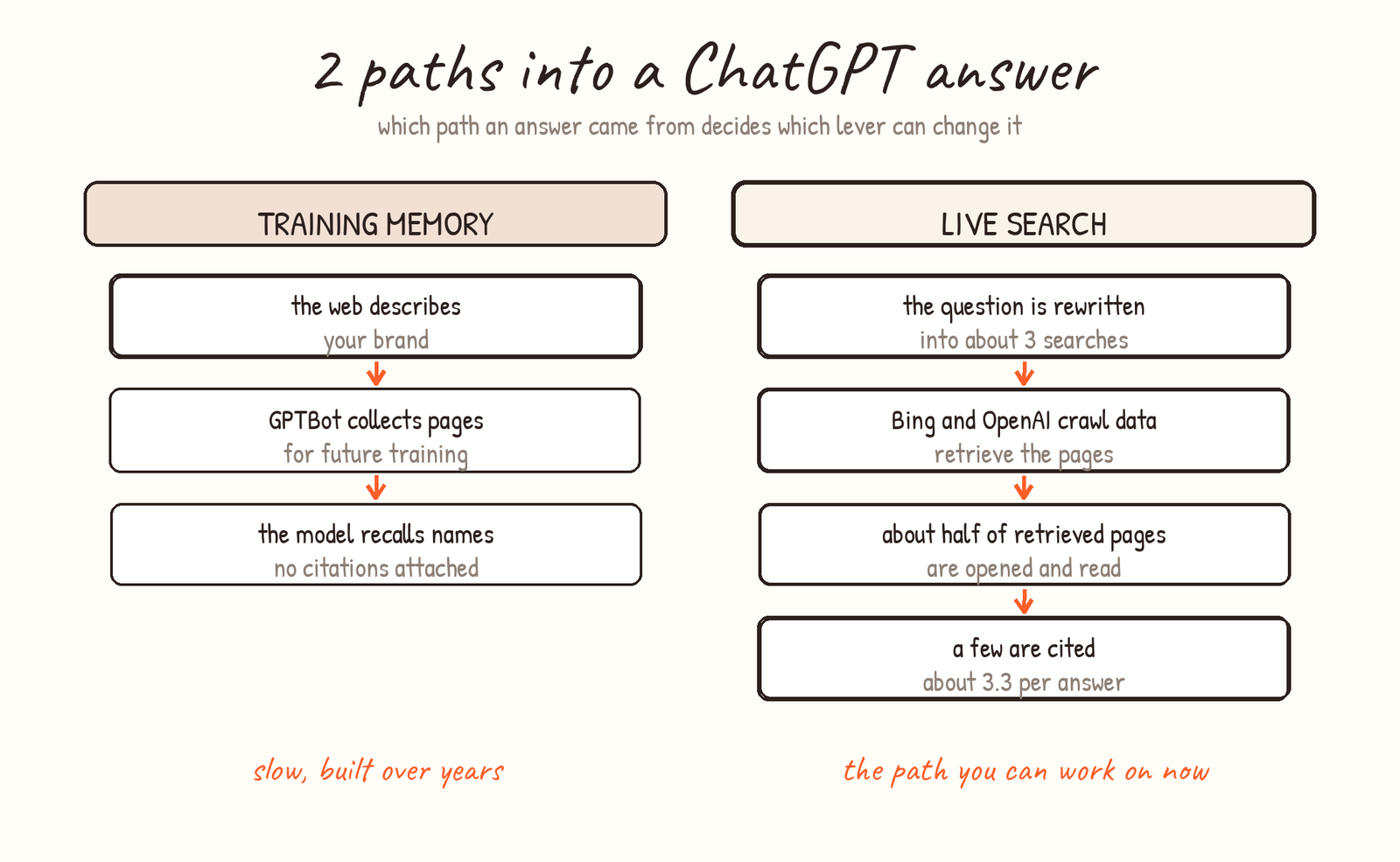
ChatGPT names brands from training memory and cites pages from live retrieval, and the 2 paths obey different rules. Understanding which path an answer came from tells you which lever, if any, can change it.
On the memory path, the model answers from patterns absorbed during training. It volunteers the brands it saw described most consistently across the web, and it attaches no citations, because nothing was retrieved. There is no submission, no setting and no quick correction for this path. What the web publishes about your brand this year is what a future model will recall, which makes the memory path a publishing discipline rather than a technical fix.
On the search path, the model first rewrites the question into 1 or more targeted searches of its own. A research scan that captured 618 of those searches found about 3 searches per answer, with 11% of the rewritten queries carrying a year, and frequent searches written in English even when the original question was not. Those searches run against search providers and OpenAI’s own crawl data, the results come back as titles, URLs and snippets, and the model then opens a selection of pages before writing. Our RAG SEO guide explains that retrieve-then-generate pattern in full. The selection is strict. An analysis of 1.4 million prompts found ChatGPT cited only about 50% of the URLs it retrieved, and a preprint study of its citation behaviour found every cited page was one its search had retrieved, with retrieval explaining about 32% of the variation between pages and page properties explaining about 2.8%. Getting retrieved is the gate. Everything else is a tiebreaker.
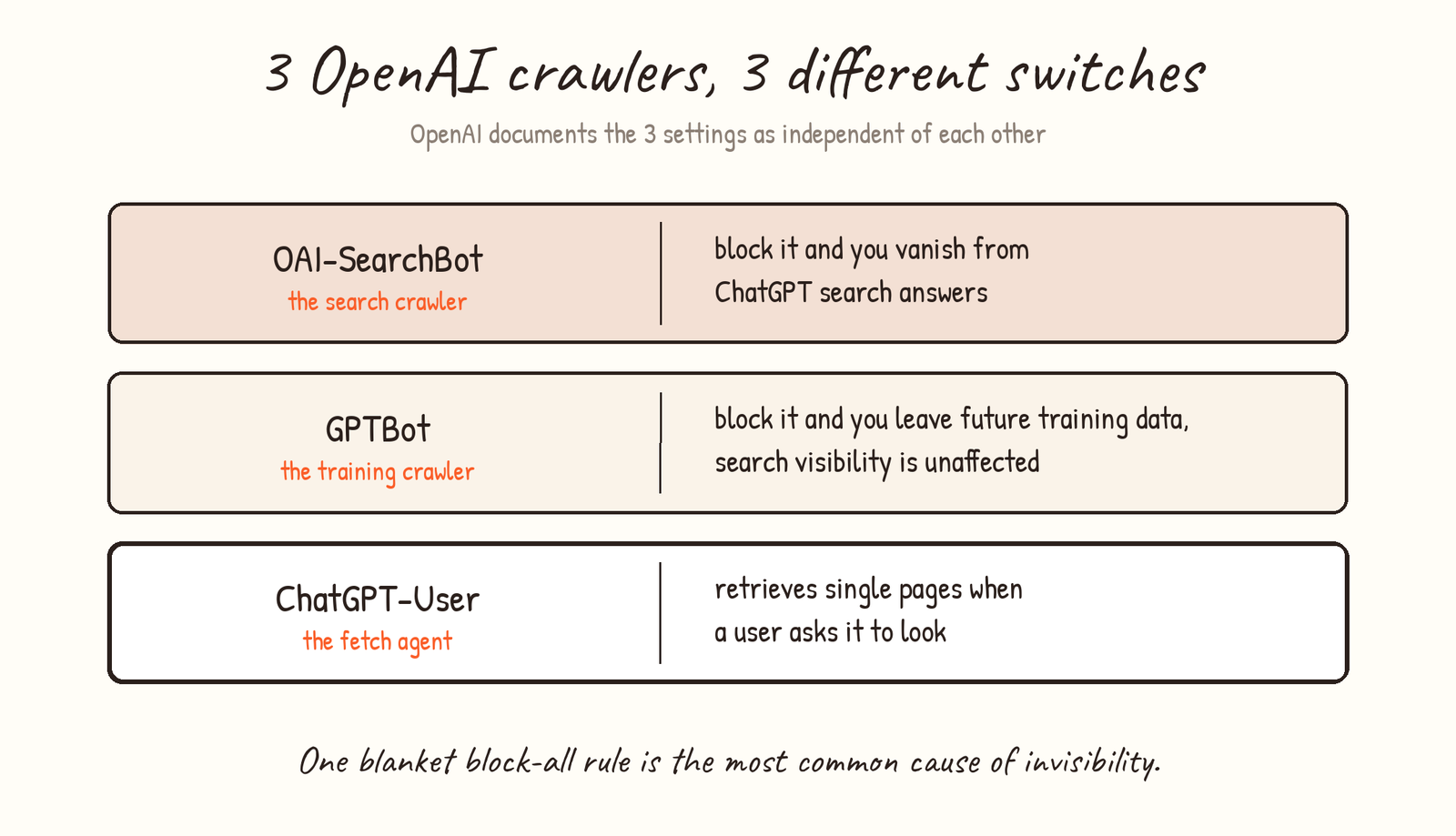
3 OpenAI crawlers govern whether your pages can enter that pipeline at all, and each one does a different job. OAI-SearchBot is the search crawler, and it decides whether your site can be shown in ChatGPT search answers. OpenAI states the consequence directly. A site opted out of OAI-SearchBot will not be shown in ChatGPT search answers, though it can still appear as a navigational link. GPTBot collects content that may be used to train future models. Blocking it opts you out of training data and does nothing to your search visibility, in either direction. ChatGPT-User fetches individual pages when a user asks ChatGPT to look at something specific. OpenAI documents the 3 settings as independent of each other, and robots.txt changes take about 24 hours to take effect. Most sites that are invisible in ChatGPT search are invisible because a single blanket rule blocked all 3 agents at once.
Why does Bing decide so much of your ChatGPT visibility?
Because the search path retrieves through Bing’s index, a page Bing cannot see is a page ChatGPT mostly cannot cite. OpenAI names Microsoft among the search providers behind ChatGPT search and does not name Google. Independent measurement supports the weight of that relationship. A 2025 analysis found 87% of ChatGPT search citations matched Bing’s top organic results, and a smaller February 2026 study measured the same 87% overlap with Bing against 56% for Google.
Treat those figures with care. They come from limited query sets, overlap is not identity, and retrieval is the gate rather than the whole decision. The practical conclusion survives the caution. 2 decades of SEO ignored Bing, so most sites carry unexamined Bing problems, missing indexation, stale sitemaps, crawl traps that Google tolerates and Bing does not. Claiming Bing Webmaster Tools, confirming your money pages are indexed there and pushing updates through IndexNow is the cheapest visibility work in this entire guide, because almost none of your competitors have done it.
How do you do ChatGPT SEO?
You work the search path in gate order, then feed the memory path with consistent publishing, and you measure both as rates over repeated runs. The 6 steps below follow that order.
Step 1. Set the 3 crawler switches deliberately
Allow OAI-SearchBot, and decide GPTBot as a separate, conscious choice. Search your robots.txt and your CDN rules for OpenAI agents today. If a block-all rule names OAI-SearchBot, your site cannot be cited in ChatGPT search answers no matter how strong the content is, and removing that block is the single highest-value edit in this guide. GPTBot is a genuine judgement call. Allowing it feeds future training data, which feeds the memory path that names brands. Blocking it protects content from training use and forfeits that slow benefit. Either choice is defensible. An accidental choice, inherited from a template, is not.
Step 2. Fix your Bing presence before writing anything
Confirm your important pages are indexed in Bing, submit the sitemap in Bing Webmaster Tools, and enable IndexNow for updates. Retrieval cannot cite what the index does not hold. Check the money pages individually rather than trusting the homepage, because partial indexation is the common pattern. A page missing from Bing while ranking on Google is the clearest possible explanation for a brand that Google rewards and ChatGPT ignores.
Step 3. Match the questions ChatGPT actually searches
Write pages whose titles carry the wording of the real question, and open with the answer. ChatGPT does not search the buyer’s exact words. It rewrites the prompt into narrower queries, sometimes year-stamped, sometimes in another language, and it retrieves against those. The 1.4 million prompt analysis found that a page title matching the prompt’s wording predicts citation better than most page features. Cover the follow-up questions a careful buyer asks next, on the same strong page, because the rewritten searches hunt for those follow-ups. Open each section with a self-contained answer that survives being quoted alone. One audit of cited posts found 72.4% carried a short self-contained explanation directly under the heading. That is a correlation from a single audit, not a formula, and the guides selling an exact character count for it are selling folklore. Complete answers in the question’s own words are the defensible version of the same advice.
Step 4. Get named on the pages ChatGPT already trusts
For brand and category questions, ChatGPT builds its answer mostly from third-party sources, so being named there matters more than your own pages. An analysis of 23,387 citations for branded queries found only 23% came from the brand’s own content. The rest came from comparison lists, directories, review sites, forums and publishers. Find the pages ChatGPT cites for your category’s questions and work on being named in them accurately, with your facts stated the way you state them yourself. The model also searches for known brands directly by domain, which rewards a brand it can recognise as one consistent entity. Our entity SEO guide covers the identifiers and profiles that keep that recognition intact.
Step 5. Feed the memory path with consistent facts
Publish and maintain one consistent account of what your brand is, everywhere, and accept that this path pays back over years. The model recalls the brands its training data described coherently. Contradictory descriptions, shifting names, dead profiles and stale directories all blur that recall. Keep your own site, your profiles and your third-party listings telling the same story with the same name, the same services and the same facts. There is no shortcut on this path, and any service promising one is promising something it cannot deliver.
Step 6. Keep facts checkable and current
ChatGPT verifies specifics before it commits to them, so prices, dates and credentials on your pages must be exact and visibly current. The captured search behaviour shows the model running narrow follow-up searches against candidate sites to confirm details. A page whose figures conflict with a directory listing or with another page on your own site gives the model a reason to cite the competitor instead. Show dates on time-sensitive content and update the pages that earn citations rather than replacing them.
How does Perplexity choose what to cite?
Perplexity runs retrieval on every standard answer, through its own index, and cites more sources more visibly than ChatGPT does. It deserves its own section because its mechanics differ from ChatGPT’s in ways that change the work. Perplexity is an answer engine first, so there is no equivalent of the memory path in a standard answer. Every answer is built from pages retrieved for that question by Perplexity’s own crawler, PerplexityBot, working over Perplexity’s own index rather than Bing’s.
The citation behaviour is more generous and more transparent. In the same multi-engine dataset used earlier in this guide, Perplexity cited an average of 9.20 sources per answer against ChatGPT’s 3.30, and it displays its source list alongside the answer as a matter of design. Recency carries unusual weight, with fresh pages favoured strongly in its retrieval, and community sources such as forum threads appear often for opinion and recommendation questions.
Most of the ChatGPT work transfers directly. Retrievability, self-contained answers in the question’s wording, third-party presence and consistent entity facts all raise Perplexity citations as well. 3 things change. First, the index gate is PerplexityBot and Perplexity’s own crawl, so Bing fixes do not help here and PerplexityBot needs its own allow decision in robots.txt. Second, freshness work pays back faster, because stale pages lose citations sooner. Third, the absence of a memory path means a new brand can earn Perplexity citations on merit within weeks, while ChatGPT’s unprompted brand recall still takes far longer to build. A programme that reports the 2 engines as one AI visibility number hides exactly the differences that decide where to spend the next month of work. For the Google equivalent of this discipline, our AI Overviews optimization guide covers the surface where the index and the rules are Google’s.
What does not work for ChatGPT SEO?
The tactics that fail here fail for a structural reason, not a lack of effort. The 4 below are the ones buyers ask about most.
Blanket AI bot blocks kept by accident. A robots.txt template that blocks every AI agent in one line blocks the search crawler along with the training crawler. Sites routinely discover they opted out of ChatGPT search without ever deciding to.
Treating GPTBot as the search switch. Allowing GPTBot does not earn a single citation, and blocking it does not cost one. Confusing the 2 crawlers produces confident decisions about the wrong system.
Prompt tricks. Content written to manipulate the model with hidden instructions or flattery targets the wrong layer. Citations are decided by retrieval and selection before the model writes a word of prose.
A Google ranking as the whole strategy. Google results overlapped ChatGPT citations at 56% in the February 2026 study. A Google programme with no Bing work and no third-party naming work leaves most of the ChatGPT surface untouched.
How do you measure ChatGPT visibility?
You measure naming and citation rates across a fixed prompt set, referral arrivals through the utm tag OpenAI applies, and Bing indexation health. No ChatGPT equivalent of Search Console exists, so the measurement discipline has to be built rather than opened.
Run a fixed set of buyer prompts, the questions your customers actually ask, on a schedule, and record whether your brand is named, whether your pages are cited, and which competitor appears when you do not. Answers vary from run to run, so judge rates across weeks and never from a single answer. A brand named in 7 of 10 runs is in a different position from a brand named in 2, and that difference is the metric.
Referral measurement is exact where it exists. OpenAI documents that ChatGPT referral links carry utm_source=chatgpt.com, so analytics can isolate the visits ChatGPT sends and the pages receiving them. Expect the volume to be small against Google. The 0.62% comparison earlier in this guide is the honest scale. Judge the programme on named presence and on the branded demand that follows it, with referrals as supporting evidence rather than the headline.
When does ChatGPT work need outside help?
Outside help pays when a competitor is the name ChatGPT gives your buyers and nobody inside the business owns the retrieval layer. The warning signs are concrete. Your brand is absent from answers in your own category. Your robots.txt blocks crawlers nobody remembers choosing. Your Bing indexation has never been opened, let alone audited. The work itself is an eligibility repair, a Bing rebuild, a third-party naming programme and a measurement habit, and it compounds when it is set up once and run properly.
Can ChatGPT even see your site?
The free site audit checks the crawler, indexation and entity layer first, with the evidence quoted for every finding.
A full programme runs this work alongside the Google AI surfaces and the topical coverage underneath them. Our AI SEO services page sets out that scope. Whether the work sits inside your team or outside it, the order in this guide holds. Open the gate, fix the index, earn the naming, and measure rates rather than moments.
Frequently asked questions
Is ChatGPT SEO different from SEO?
It shares SEO’s foundations and then diverges at the index and the answer format. Indexation, crawlability, internal linking and clear passages matter on both surfaces. The differences are concrete. Retrieval runs through Bing rather than Google, 3 OpenAI crawlers carry their own settings, there is no Search Console equivalent, and success is a naming rate inside generated answers rather than a position on a page. The discipline applied across every answer engine at once is answer engine optimization.
Does blocking GPTBot remove my site from ChatGPT search?
No. GPTBot collects training data. OAI-SearchBot is the crawler that decides whether your site can be shown in ChatGPT search answers. Blocking GPTBot leaves your search visibility untouched and opts you out of future training data. Blocking OAI-SearchBot removes you from search answers while leaving navigational links possible. OpenAI documents the 2 settings as independent.
Do I need to rank on Google to be cited by ChatGPT?
No, and the overlap is weaker than most guides imply. ChatGPT search retrieves through Bing and OpenAI’s own crawl data, not through Google. A February 2026 study measured a 56% overlap between Google results and ChatGPT citations, against 87% for Bing. A page can rank well on Google and be invisible to ChatGPT if Bing has not indexed it, and the reverse also happens.
How long does it take to get cited by ChatGPT?
The search path can move within weeks, and the memory path takes far longer. Fixing a crawler block takes effect in about 24 hours by OpenAI’s own documentation, and Bing indexation repairs show up as soon as retrieval next runs against your pages. Being named from training memory is built from years of consistent publishing and cannot be scheduled. Any timeline promising quick unprompted brand recall is not being honest about which path it is describing.
Can you pay for ChatGPT to recommend your brand?
No paid placement decides which brands a standard ChatGPT answer names or cites. Advertising products around ChatGPT exist separately and are labelled. The names in an organic answer come from training memory and live retrieval. Money spent on this surface goes into indexation, content and third-party presence, the same inputs the unpaid system reads.
Why does ChatGPT recommend a competitor instead of my brand?
Usually because the competitor is retrievable and named in the sources the model trusts, and your brand fails one of those 2 tests. Work through the gates in order. Check whether OAI-SearchBot can reach you, whether Bing has your money pages indexed, whether the pages ChatGPT cites for your category name your competitor and omit you, and whether your own facts agree everywhere the model might check them. The answer is almost always sitting in 1 of those 4 places.

Written by Hanzala Khan
Hanzala Khan has over 5 years of specialized experience in entity-based search optimization, Knowledge Graph engineering, and topical authority architectures. He specializes in designing custom semantic topical maps, advanced Schema.org data layers, and algorithmic authorship frameworks that help enterprise brands achieve durable search dominance and AI citation authority across Google, Perplexity, and ChatGPT.
One Response