
Google Poisoned SERPs: How to Detect Ranking Data Issues

Google poisoned SERPs occur when an automated rank-tracking request returns unexpected, irrelevant, or incomplete search results that do not accurately represent what human users see. When a tracking tool ingests these anomalous result sets without secondary validation, it can report phantom ranking drops, trigger unnecessary content rewrites, and erode client trust.
Are Your SEO Rankings Telling the Full Story?
Unexpected ranking changes deserve forensic investigation before you execute reactive optimizations. Review your rank-tracking baseline, technical crawling logs, and Search Console performance to pinpoint whether a drop is genuine or a data anomaly.
📜 Table of Contents
- 01. What Are Google Poisoned SERPs?
- 02. How Poisoned SERPs Affect Rank-Tracking Tools
- 03. Why Automated Search Requests Return Anomalies
- 04. Normal SERP Volatility vs. A Poisoned SERP
- 05. 7-Step Diagnostic Framework to Validate SERPs
- 06. How to Protect SEO Reporting Quality
- 07. Agency Impact: Client Trust & Forecasting
- 08. Protocol: What to Do When Rankings Drop
- 09. Is Google Deliberately Targeting SEO Tools?
- 10. The Role of Semantic Relevance in Validation
- 11. Final Thoughts & Next Steps
- 12. Frequently Asked Questions
What Are Google Poisoned SERPs?
Google poisoned SERPs are search engine results pages collected by automated tracking platforms that contain unexpected, irrelevant, or incomplete search results that do not accurately represent what typical human searchers see. When an automated scraper requests a search results page, the search engine may serve an alternate, degraded, or localized DOM layout rather than the standard commercial organic listings.
In conventional rank tracking, a collection error is obvious: the automated scraper receives an HTTP 429 “Too Many Requests” status code, a Cloudflare challenge, or a Google CAPTCHA screen. In those scenarios, the tool knows the collection failed and tags the query as uncollected. A poisoned SERP is fundamentally more deceptive because the HTTP response returns an HTTP 200 “OK” code with a fully rendered HTML page containing genuine-looking organic snippets and clickable URLs.
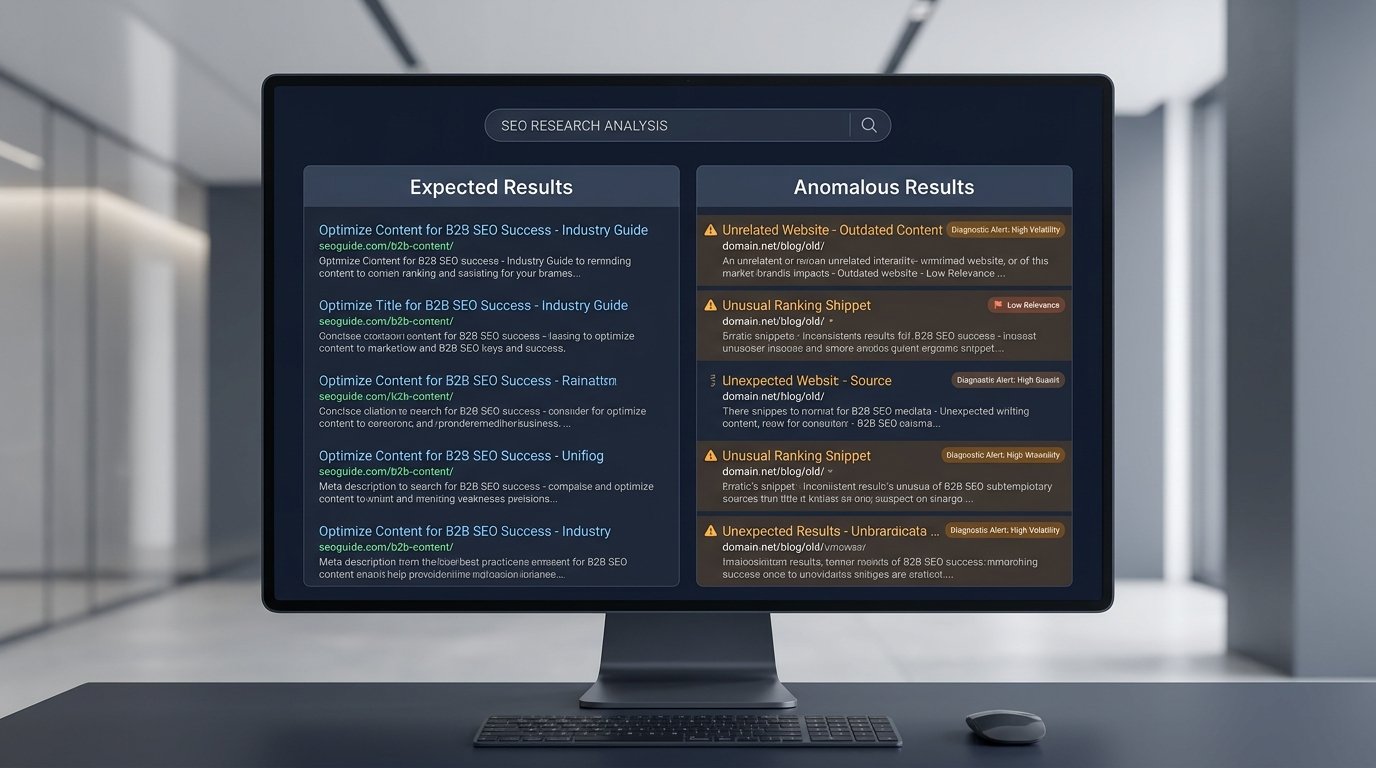
However, the contents within that page are topically fractured. Established authority domains for the target query vanish entirely, replaced by unrelated forums, foreign-language subdomains, or completely irrelevant informational queries matching only an isolated keyword substring. If a rank tracker parses that HTML without semantic validation, its database records a catastrophic ranking drop for legitimate websites.
On October 27, 2026, Semrush officially acknowledged observed anomalies where automated search requests returned inconsistent result sets, announcing enhanced internal verification algorithms to filter out corrupted captures. Independent SEO tracking firms including DemandSphere and Advanced Web Ranking have similarly documented instances of automated search queries returning divergent results compared to clean, localized human sessions.
How Do Google Poisoned SERPs Affect Rank-Tracking Tools?
Google poisoned SERPs affect rank-tracking tools by injecting corrupted position values into their historical databases, causing tracking dashboards to report false-positive ranking drops. Because automated monitoring systems compare current captures directly against the previous day’s baseline, an unverified anomalous crawl immediately triggers alert notifications, downward visibility trends, and client dashboard spikes.
To understand how this vulnerability propagates, consider the six operational stages of an automated rank-tracking platform:
- Query Dispatch: The rank tracker dispatches an automated search request configured with specific geographic coordinates, device parameters (desktop or mobile), and language headers.
- Response Retrieval: The search engine processes the request through a proxy network and returns an HTML payload.
- DOM Extraction: Automated parsers traverse the HTML document Object Model (DOM) to identify organic result blocks, recording the position, URL, title tag, and featured snippet.
- Database Persistence: The extracted positions are recorded into historical time-series tables.
- Baseline Delta Calculation: Algorithms calculate the position difference between the latest capture and the historical baseline.
- Report Generation: Automated dashboards, agency email alerts, and weekly performance summaries update to reflect the newly recorded positions.
Imagine a legal practice holding position #3 for “commercial litigation attorney Manchester” for fourteen consecutive months. During an automated overnight collection, the scraper receives a poisoned SERP dominated by dictionary definitions of “litigation” and international law student message boards. The tool parses the page, cannot locate the client’s URL in the top 100, and records a position drop from #3 to 0. The next morning, the agency account manager receives a high-severity alert indicating an 80% loss in commercial keyword visibility, despite the client’s website remaining firmly pinned at #3 for live, human searchers in Manchester.
Query Dispatch
Scraper queries Google via localized proxy network and defined user-agent.
SERP Retrieval
Search engine returns HTML payload with HTTP 200 OK status code.
Validation Gate
Semantic evaluation checks entity relevance and historical domain overlap.
Delta Analysis
Positions verified against Search Console before alerting or reporting.
Results match query entity graph and show expected competitor overlap. Data is committed to primary reporting database.
Corrupted capture isolated. Automatic re-crawl triggered with clean residential IP before updating client dashboards.
Why Are Google SERPs Becoming Unreliable for Rank Tracking?
Google search results are becoming less predictable for automated rank tracking due to the combination of aggressive anti-scraping defense mechanisms, dynamic rendering states, and search engine infrastructure shifts. While rank tracking was historically a straightforward process of downloading static HTML, contemporary Google search architecture relies on continuous behavioral evaluation, personalized intent clustering, and complex layout experiments.
1. Bot Mitigation and Headless Browser Fingerprinting
Search engines invest heavily in protecting their infrastructure from unmetered automated data scraping, AI training harvesters, and malicious crawlers. Modern anti-bot systems analyze TLS fingerprints (JA3/JA4), TCP/IP stack signatures, canvas rendering artifacts, and IP pool reputations. When automated scraper requests trigger heuristic thresholds without failing completely, anti-scraping systems may route them through degraded edge servers that return generic fallback SERPs.
2. Location, Language, and Proxy Network Degradation
Rank trackers rely on third-party proxy networks to simulate searches from thousands of cities worldwide. If a proxy exit node suffers IP reputation degradation or misconfigures its geolocation headers, Google may serve search results corresponding to the proxy’s physical data center rather than the simulated target market, causing local service rankings to evaporate from the report.
3. AI Overviews and Dynamic Generative Search Features
Google’s rollout of AI Overviews, generative search snapshots, and modular multi-intent cards creates asynchronous layout shifts. Depending on whether an automated tool executes JavaScript or parses raw server-side HTML, the extracted DOM tree can diverge substantially from what a real user views on a modern mobile browser.
4. Inherent Methodology Discrepancies Across Providers
Every rank-tracking platform utilizes distinct scraping intervals, browser headers, and parsing rules. A keyword flagged as lost in one provider may show stable rankings in another simply because their proxy infrastructure interacted with different Google data centers. Discrepancies between tools reflect differences in measurement infrastructure rather than deliberate manipulation of specific websites.
What Is the Difference Between Normal SERP Volatility and a Poisoned SERP?
The difference between normal SERP volatility and a poisoned SERP lies in the nature of the change: normal volatility represents genuine search engine algorithm adjustments or competitor movements, whereas a poisoned SERP represents an artificial measurement distortion where the collected data fails to reflect real-world search intent.
To prevent misdiagnosing data errors as search penalties, SEO analysts should evaluate suspicious ranking movements against the six diagnostic criteria detailed below:
| Diagnostic Signal | Normal Search Volatility | Potentially Poisoned / Anomalous SERP |
|---|---|---|
| Topical Relevance | Returned pages remain directly aligned with the core search intent and entity subject. | Results display severe topical divergence; pages match only an isolated keyword token. |
| Competitor Overlap | Established industry competitors trade positions (e.g., #2 and #4 swap rankings). | Most or all established competitors disappear simultaneously, replaced by non-commercial domains. |
| Re-crawl Repeatability | Re-running the query under the same conditions yields consistent or very similar positions. | An immediate manual re-crawl under clean residential settings restores the normal baseline. |
| Search Console Trends | Google Search Console impressions and clicks mirror the ranking decline across the timeframe. | Search Console organic impressions and clicks remain completely stable despite the reported drop. |
| Domain Scope | Ranking drops typically cluster around specific URLs, categories, or technical issues. | Disparate keywords across unrelated practice areas drop together on a single batch collection. |
| Appropriate Action | Conduct a technical SEO audit, inspect content depth, and analyze competitor updates. | Quarantine the capture, re-verify with independent sources, and avoid premature on-page changes. |
How to Detect Google Poisoned SERPs: A 7-Step Diagnostic Framework
SEO professionals should use a systematic diagnostic framework to determine whether reported ranking declines reflect true organic losses or corrupted search captures. When an unexpected ranking drop appears on your monitoring dashboard, execute the following seven diagnostic steps before implementing on-page modifications.
Step 1: Calculate Historical SERP Domain Overlap
Examine the historical domain composition for the target query over the prior 30 to 90 days. Under normal search market conditions, established authority websites (such as top competitors and industry portals) maintain an overlap coefficient of 60% to 80% across consecutive collection cycles. If the collected results page displays an abrupt domain turnover exceeding 80% where known competitors vanish en masse, the capture warrants immediate suspicion.
Step 2: Inspect Semantic Entity and Intent Alignment
Audit the semantic alignment of the returned URLs against the primary query entity. For example, if the keyword is “dental implants cost London”, a legitimate SERP must display restorative dentistry clinics, dental surgery pricing breakdowns, and relevant healthcare registries. If the collected SERP returns generic Wikipedia entries on titanium metallurgy or industrial fasteners, the capture represents a poisoned intent extraction.
Step 3: Execute a Controlled Multi-Location Re-crawl
Do not rely on a single automated capture. Re-request the query using an isolated browser session configured with the identical target location (using Google’s Developer Tools sensory emulation or clean residential proxy endpoints). If a residential browser session retrieves the client’s URL at its historical ranking position, the discrepancy lies within the rank tracker’s scraper IP pool.
Step 4: Cross-Reference Secondary Rank-Tracking Tools
Compare observations across at least two independent rank-tracking providers (e.g., Ahrefs, Semrush, Advanced Web Ranking, or localized SERP APIs). While individual tools occasionally encounter proxy route failures, independent providers operating separate data pipelines rarely ingest identical poisoned SERPs at the exact same minute.
Step 5: Triangulate with Google Search Console Performance Data
Google Search Console provides direct first-party performance metrics recorded from real searchers. Navigate to the Search Results report, filter by the specific keyword and landing page, and inspect the Impressions and Average Position metrics. If a website genuinely lost position #3 on Google, daily impressions will decline sharply. If impressions and average position hold steady while your rank tracker claims position #0, the rank tracker ingested an anomaly.
Step 6: Perform a Technical SEO Indexation Check
Confirm that the target URL has not suffered a self-inflicted technical failure. Inspect the live URL using Search Console’s URL Inspection tool to verify:
- The HTTP server response code is 200 OK.
- The page does not carry an accidental
noindexmeta tag orX-Robots-Tagheader. - The canonical tag correctly points to the URL itself without conflicting redirect chains.
- The page is not blocked by a
disallowrule inrobots.txt.
Step 7: Document and Classify the Incident
Log the finding in an internal tracking audit registry. Categorize the observation under one of four statuses: Verified Decline, Under Investigation, Confirmed Data Anomaly, or Unresolved.
Need Help Investigating an Unexpected Ranking Drop?
Sudden ranking drops can stem from complex algorithm re-weightings, technical indexing bugs, or corrupted rank-tracker data feeds. Our semantic architects conduct thorough data triangulation and technical audits to identify the root cause before you make costly mistakes.
How to Protect SEO Reports From Poisoned SERPs
Protecting SEO reporting quality requires establishing structural data safeguards rather than relying on uninspected rank-tracker exports. SEO agencies and internal enterprise teams should implement automated verification workflows that prevent single-day collection glitches from contaminating client deliverables.
1. Implement Multi-Source Verification Protocols
Never build executive reporting dashboards from a single rank-tracking API. Integrate Google Search Console API pipelines alongside third-party trackers, establishing programmatic checks that flag discrepancies exceeding 15 positions between reported average position and rank-tracker observations.
2. Adopt Rolling Average Position Windows
Single-day ranking observations are naturally susceptible to collection anomalies and transient algorithmic tests. Structure reporting models around 7-day or 14-day rolling median positions. Rolling medians automatically dampen isolated single-day anomalous drops without masking genuine prolonged declines.
3. Establish Explicit Data Anomaly Labels
When an anomaly occurs, label it directly on reporting dashboards rather than smoothing over the chart. Using clear annotations such as “Oct 27: Rank Tracker Scraper Anomaly — Confirmed Normal via GSC” demonstrates technical maturity and transparency.
4. Center Client Reporting on Business Outcomes
Rankings are leading indicators, not ultimate business outcomes. Construct monthly client reporting around organic traffic volume, qualified conversion actions, phone call duration, and retained customer revenue. When a client sees that commercial consultation enquiries increased by 18% during a week where a rank tracker showed erratic fluctuations, the conversation focuses on commercial value rather than dashboard noise.
How Do Poisoned SERPs Affect SEO Agencies and Their Clients?
Google poisoned SERPs affect SEO agencies and their clients by creating unnecessary operational friction, misdirecting optimization hours, and undermining professional credibility. When an unvalidated ranking decline is presented to stakeholders without context, the resulting panic can derail months of strategic progress.

1. Unwarranted Reactive Page Overhauls
When an agency takes an anomalous report at face value, content strategists often rush to rewrite title tags, re-optimize headings, or dismantle successful internal linking structures. Rewriting a healthy page in response to a fake ranking drop frequently causes an actual, self-inflicted ranking decline.
2. Distorted Competitor Benchmarking and Strategy
If an anomalous capture populates competitor tracking tables with low-authority niche sites, analysts may spend hours reverse-engineering irrelevant domains that appeared only due to a scraping error. Validating competitor URLs against historical baselines prevents chasing phantom competitive threats.
3. Preserving Stakeholder Trust Through Clear Communication
The most dangerous consequence of poisoned SERPs is client skepticism. If an agency panics on Monday and claims the website was penalized, only to admit on Wednesday that the tool simply experienced an anomaly, the client questions the agency’s analytical competence. Proactive agencies address anomalies with measured, evidence-backed communication.
“During our scheduled monitoring on October 27, our rank-tracking software recorded unusual position drops across several commercial terms. However, our secondary validation protocol confirms that real-world visibility remains intact: Google Search Console impressions and organic click volumes are completely stable, and live residential checks show your target URLs at their expected positions. This reflects a temporary third-party scraper data anomaly rather than a search visibility change. No website modifications are required, and we are monitoring data feeds closely.”
What Should SEO Professionals Do When Rankings Suddenly Drop?
When an SEO dashboard reports an unexpected ranking decline, execute a disciplined diagnostic checklist before touching site architecture or content. The following protocol prevents premature optimizations and ensures that interventions target genuine issues.
✅ Emergency Ranking Drop Investigation Checklist
Complete each verification step before executing content or technical modifications:
1. Isolate the Scope: Determine whether the drop affects a single keyword, an entire topic cluster, a specific URL, or the entire domain.
2. Review Historical SERP Overlap: Inspect the captured results page to see if established competitors dropped simultaneously.
3. Perform Clean Residential Check: Search the query from a clean browser session with exact location emulation to see real user results.
4. Cross-Examine Google Search Console: Check whether query impressions and clicks experienced a corresponding drop over the same period.
5. Inspect Technical Health: Run live URL inspection in Search Console to verify HTTP 200 status, correct canonicals, and noindex headers.
6. Check Algorithm Update Trackers: Verify whether an official Google Core Update, Helpful Content re-weighting, or Spam Update was rolled out.
7. Document Before Acting: Record all evidence, classify the incident in your audit log, and communicate findings to stakeholders before modifying pages.
Are Google Poisoned SERPs Proof That Google Is Targeting SEO Tools?
No, reported SERP anomalies do not constitute evidence that Google is deliberately targeting SEO rank-tracking companies. While it is understandable why affected agencies might jump to that conclusion, search engine architecture operates at massive scale, and anomalous responses are almost always byproducts of broader security, infrastructure, and anti-abuse safeguards.
Search engines process billions of queries daily and continuously adjust automated bot-detection filters to mitigate commercial scraping networks, automated query flooders, and malicious scrapers. When third-party tracking tools route thousands of automated requests through proxy data centers, those requests frequently trigger automated rate-limiting thresholds or edge routing rules designed to preserve server resources.
Furthermore, Google continually runs thousands of concurrent live experiments, geographic personalization passes, and generative UI tests. Attributing anomalous captures to targeted malice ignores the reality of modern search engineering: automated scrapers represent an edge-case user profile that does not behave like a real human consumer.
What Role Does Semantic Relevance Play in Detecting Poisoned SERPs?
Semantic relevance plays a decisive role in detecting poisoned SERPs by providing a conceptual benchmark that automated string matching cannot provide. Traditional rank tracking simply scans raw text looking for an exact string match of a target domain name. In contrast, semantic evaluation examines whether the entities, attributes, and informational nodes on the returned page satisfy the underlying search intent.
1. Resolving Entity Ambiguity and Polysemy
Many search queries feature polysemous terms—words with multiple distinct meanings depending on context. For example, a search for “Apple certified technician” should retrieve consumer technology repair providers, Apple Authorized Service Providers, and Mac hardware diagnostics. If an automated scraper receives a page discussing orchard management, agricultural disease control, and fruit farming certifications, an exact-string tool might still report rankings, but a semantic audit instantly flags the entire SERP as anomalous.
2. Topic Cluster and Entity-Attribute-Value (EAV) Validation
At Just Semantic SEO, our methodology structures content around complete entity ontologies. When auditing SERPs, we evaluate whether the returned results contain the expected supporting entities:
- Primary Entity: The central topic of the search (e.g., Technical SEO Audit).
- Supporting Entities: Dependent concepts that must appear in context (e.g., crawling budget, canonicalization, server status codes, XML sitemaps).
- Intent Attributes: Commercial, informational, or local intent signals.
When an automated search capture lacks the expected supporting entities, the capture is demonstrably corrupt. Developing comprehensive semantic topical maps and engineering structured semantic content briefs ensures that your web pages remain anchored to unmistakable topical authority, making your true rankings resilient against measurement noise.
Final Thoughts: Validate Ranking Data Before Making SEO Decisions
Google poisoned SERPs highlight a fundamental principle of modern search optimization: raw rank-tracker data is an estimate, not infallible ground truth. Making major optimization decisions—such as rewriting high-performing content, altering technical site architecture, or dismantling internal linking silos—based on unverified dashboard drops introduces unnecessary operational risk.
By establishing multi-source data validation protocols, triangulating observations against Google Search Console, and leveraging semantic relevance to evaluate search intent, SEO agencies and in-house teams can protect their strategic roadmap from data noise and maintain strong client trust.
Need a Clearer Picture of Your SEO Performance?
Unexpected ranking movements should be investigated with forensic precision before you alter your search strategy. Just Semantic SEO provides thorough technical audits, semantic entity mappings, and data triangulation to ensure your search visibility drives real business growth.
Frequently Asked Questions About Google Poisoned SERPs
What does SERP poisoning mean in SEO?
In modern SEO, SERP poisoning refers to anomalous, irrelevant, or incomplete search engine results pages returned to automated rank-tracking scrapers. When an automated scraper queries Google, anti-bot mechanisms, IP blocks, or dynamic JavaScript rendering states can cause Google to return an alternate, degraded, or token-polluted HTML payload with an HTTP 200 OK status. These corrupted captures cause tracking dashboards to report false-positive ranking drops that do not reflect what actual human searchers see.
Can poisoned SERPs make a website appear to lose rankings?
Yes. If an automated rank tracker captures an anomalous SERP that omits a website’s target URL, the platform’s database will record the page as missing from the top 100, creating an apparent overnight ranking collapse on the client dashboard. In reality, the website remains firmly ranked for live, human searchers.
How can I tell whether a ranking drop is real?
To determine whether a ranking drop is genuine, triangulate the reported drop against Google Search Console impressions and clicks over the exact same period, execute an immediate manual re-check using a clean residential session with exact location coordinates, and audit the historical competitor overlap on the captured SERP. If established competitors also vanished or Search Console clicks remain stable, the drop is an anomaly.
Does Google Search Console detect poisoned SERPs?
Google Search Console does not specifically identify or label third-party poisoned SERPs, but it serves as the ultimate validation baseline. Because Search Console records first-party search interactions from real human searchers, steady organic impressions and average position confirm that a reported rank-tracker decline is an external measurement glitch rather than an algorithmic penalty.
Are all SEO ranking tools affected equally?
No, SEO tools are not affected equally. Different ranking platforms utilize different proxy infrastructures, scraper user-agents, scraping intervals, and internal data verification algorithms, meaning one provider may ingest an anomaly while another reports accurate rankings.
Should SEO agencies stop using rank-tracking tools?
No, SEO agencies should not stop using rank trackers. Rank tracking remains vital for broad market monitoring and competitive intelligence; however, agencies must implement secondary validation gates before treating anomalous single-day ranking reports as verified performance trends.
Can poisoned SERPs affect competitor tracking?
Yes, poisoned SERPs can distort competitor tracking by temporarily removing established competitor domains and introducing unrelated websites into competitive benchmarking reports, which can misguide strategic planning if left unverified.
Can poisoned SERPs affect AI search visibility reporting?
Yes, workflows and tools that scrape Google AI Overviews and generative search features through automated proxies can ingest anomalous DOM structures, leading to inaccurate measurements of brand citation frequencies in generative answers.
What should SEO agencies tell clients about poisoned SERPs?
SEO agencies should communicate transparently with clients by explaining that the reported drop reflects a temporary third-party scraper anomaly, sharing Search Console evidence showing stable real-world impressions and traffic, and confirming that no premature on-page changes are needed.