

In conclusion, semantic search is a powerful technology that is transforming the way we find and access information. By understanding the meaning and intent behind a query, it delivers more relevant and accurate results, leading to a better user experience and increased efficiency. Its applications are vast and growing, and it is poised to play an increasingly important role in the future of information retrieval.
What Is Semantic Search
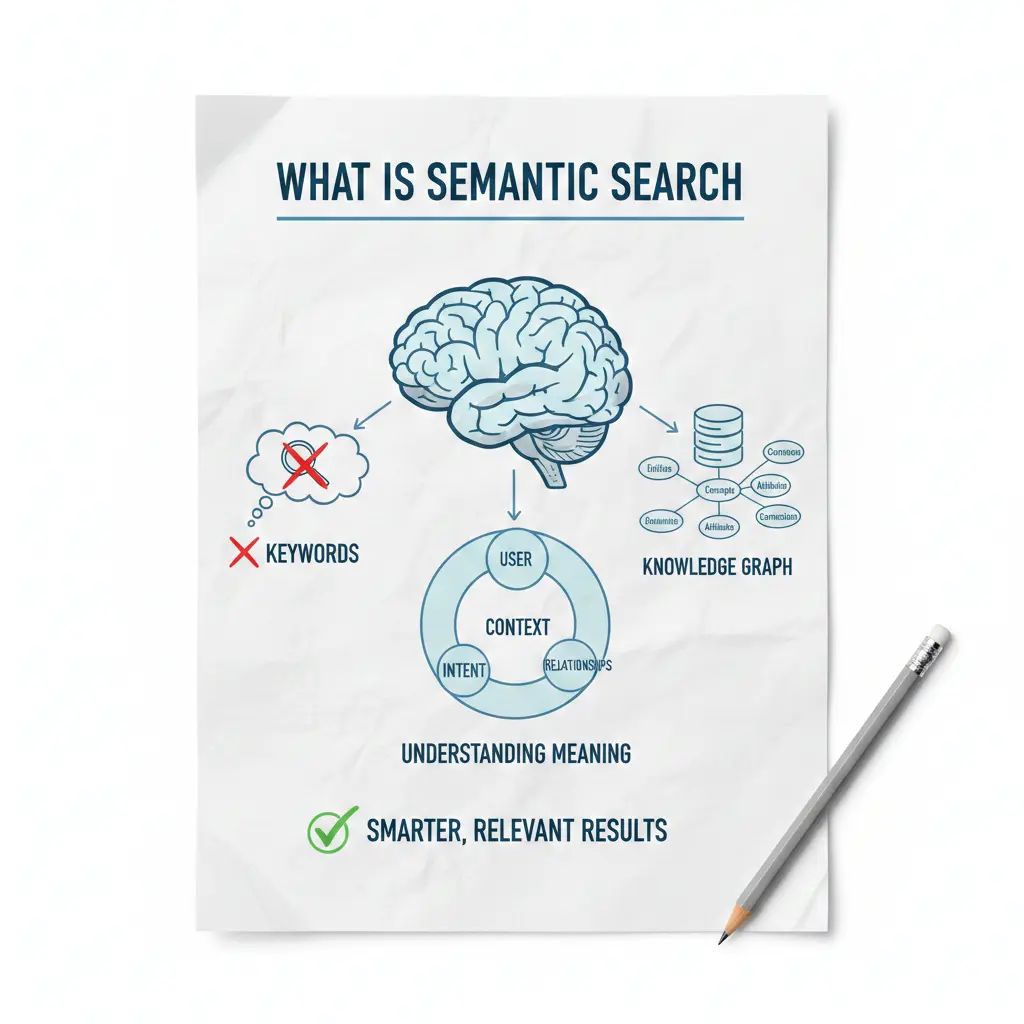
Semantic search goes beyond simple keyword matching to understand the meaning behind the search. It aims to decipher the searcher’s intent and the context of their query to deliver more relevant and accurate results. Instead of just looking for literal word matches, it considers the relationships among words, concepts, and entities. This intent-driven query understanding allows search engines to provide results that truly address the user’s needs, even if the exact keywords are not present in the content. The semantic search benefits are numerous. It improves search accuracy, enhances user experience, and enables knowledge graph exploration.
Semantic search is used in a wide range of applications, from improving search results on Google to powering E-commerce product discovery and enabling AI-driven question-answering systems. It is a core technology for Natural Language Processing (NLP) and Machine Learning (ML) applications.
The main components of semantic search include query understanding, contextual understanding, entity recognition, and the use of knowledge graphs and word embeddings. These technologies work together to extract the meaning extraction algorithms and deliver conceptual search relevance.
How does semantic search work?
Semantic search works by combining several technologies to understand the meaning and intent behind a user’s query. First, Natural Language Processing (NLP) techniques are used to analyze the query and identify the key entities, concepts, and relationships. This process, called query understanding, helps to determine what the user is really looking for.
Next, Contextual Understanding comes into play. The search engine considers the user’s location, search history, and other contextual factors to further refine the search. Entity Recognition identifies specific entities mentioned in the query, such as people, places, or organizations.
Knowledge Graphs are used to store and organize information about these entities and their relationships. This allows the search engine to understand the connections between different concepts and provide more relevant results. Word Embeddings are used to represent words and phrases as vectors in a high-dimensional space, capturing their semantic relationships. This allows the search engine to identify synonyms, related terms, and understanding related terms. Finally, the search engine uses machine learning algorithms to rank the search results based on their relevance to the user’s query.
How Semantic Search Different from Other Search?
Semantic search is different from other search methods because it focuses on understanding the meaning and intent behind a query, rather than simply matching keywords. This leads to more relevant and accurate search results.
Keyword search vs. Semantic Search
Keyword search relies on matching the exact words in a query to the words in a document. It doesn’t consider the meaning or context of the words. In contrast, semantic search uses Natural Language Processing (NLP) and Machine Learning (ML) to understand the search query intent and the relationships between words. This allows it to return results that are relevant even if they don’t contain the exact keywords.
Lexical search vs. Semantic Search
Lexical search is similar to keyword search in that it focuses on the literal matching of words. It uses techniques such as stemming and lemmatization to normalize words, but it doesn’t understand the meaning behind them. Semantic search, on the other hand, goes beyond beyond keyword matching to understand the concepts and relationships expressed in the query and the documents.
Contextual search vs. Semantic Search
Contextual search takes into account the user’s location, search history, and other contextual factors to personalize the search results. While semantic search also considers context, its primary focus is on understanding the meaning of the query itself. Contextual search results can be enhanced by incorporating semantic search techniques to improve the relevance of the results.
Vector search vs. Semantic Search
Vector search uses word embeddings to represent words and phrases as vectors in a high-dimensional space. This allows it to find similar words and phrases based on their semantic relationships. Semantic search often uses vector search as one component, but it also incorporates other techniques such as knowledge graphs and entity recognition to provide a more comprehensive understanding of the query. Vector databases like SingleStoreDB can be used to implement vector search efficiently.
What are Semantic Search Examples?
Here are some examples of semantic search in action:
- Google: When you search for “best Italian restaurants near me,” Google* uses semantic search to understand that you’re looking for restaurants that serve Italian food and are located nearby. It considers your location, reviews, and other factors to provide relevant results.
- E-commerce: When you search for “red dress with floral print” on an E-commerce website, semantic search helps the website understand that you’re looking for a dress that is red in color and has a floral pattern.
- It can then return results that match your description, even if the exact keywords aren’t present in the product titles or descriptions.
- Question Answering: When you ask a question like “Who won Jeopardy! last night?”
- to a virtual assistant, semantic search helps the assistant understand the meaning of
- the question and find the answer in a knowledge graph or other data source.
What is the Application of Semantic Search?
The applications of semantic search are vast and growing. Some applications in semantic search are given below:
Search Engines: Improving the relevance and accuracy of search results on Google and other search engines.
E-commerce: Enhancing product discovery and recommendations on E-commerce websites.
Question Answering: Powering AI-driven question-answering systems and virtual assistants.
Customer Service: Providing better customer support through chatbots and other automated systems.
Knowledge Management: Helping organizations manage and access their internal knowledge more effectively.
Data Integration: Integrating data from different sources by understanding the semantic relationships between them.
Biomedical Research: Assisting researchers in finding relevant information in scientific literature and databases.
Legal Discovery: Enabling lawyers to find relevant documents in large datasets more efficiently.
Financial Analysis: Helping analysts to identify trends and patterns in financial data.
What are the Benefits of Semantic Search?
Semantic search offers several benefits:
- Improved Search Accuracy: By understanding the meaning and intent behind a query, semantic search can deliver more relevant and accurate results than traditional keyword search.
- Enhanced User Experience: Users can find the information they need more easily and quickly, leading to a better overall search experience.
- Increased Efficiency: Semantic search can help users to be more productive by reducing the time and effort required to find information.
- Better Knowledge Discovery: By exploring the relationships between concepts and entities, semantic search can help users to discover new knowledge and insights.
- Improved Data Integration: Semantic search can facilitate the integration of data from different sources by understanding the semantic relationships between them.
- Support for Natural Language Queries: Semantic search allows users to search using natural language, rather than being limited to specific keywords.
- Context Awareness: Semantic search takes into account the user’s context, such as their location and search history, to personalize the search results.
- Handling of Ambiguity: Semantic search can handle ambiguous queries by considering the different possible meanings of the words and phrases.
What is the best semantic search model?
There is not a single “best” semantic search model, as the optimal choice depends on the specific application and data. However, several models and approaches are widely used and considered effective:
- Google BERT: Google BERT is a powerful Natural Language Processing (NLP) model that has revolutionized semantic search. It is pre-trained on a massive amount of text data and can be fine-tuned for specific tasks. BERT excels at query understanding and contextual understanding.
- Sentence Transformers: Sentence Transformers are word embedding models that are designed to generate meaningful vector representations of sentences. These models are often used for semantic similarity search and clustering.
- Open-Source Models: Several Open-Source Models are available for semantic search, such as spaCy, Gensim, and Elasticsearch. These models provide a range of NLP and machine learning capabilities that can be used to build custom semantic search solutions.
- Proprietary models: Many companies offer Proprietary models and services for semantic search, such as SingleStoreDB, Amazon Kendra, and Azure Cognitive Search. These models are often optimized for specific use cases and offer additional features such as knowledge graph integration and document indexing.
How does semantic search differ from keyword search?
Semantic search differs from keyword search by focusing on the meaning behind the search, rather than literal matches. Keyword search only looks for the presence of specific words in a document. Semantic search attempts to understand the search query intent and the relationships between concepts. Semantic search provides more relevant and accurate results, even if the exact keywords are not present.
How does semantic search differ from contextual search?
Both contextual search and semantic search aim to improve search relevance, they differ in their approach. Contextual search focuses on the user’s context, such as location and search history, to personalize the results. Semantic search focuses on understanding the meaning of the query itself. Ideally, both approaches are combined for optimal results.
How does semantic search differ from vector search?
Vector search is a technique that uses word embeddings to represent words and phrases as vectors. Allowing for similarity search based on semantic relationships. Semantic search often uses vector search as a component. It also incorporates other techniques like knowledge graphs and entity recognition for a more comprehensive understanding.
How does semantic search differ from lexical search?
Lexical search relies on the literal matching of words. And utilizing techniques such as stemming and lemmatization to normalize them. Semantic search goes beyond keyword matching to understand the underlying concepts and relationships. Lexical search does not understand the meaning of the words.
What is semantic database
A semantic database is a database that is designed to store and manage data in a way that captures the meaning and relationships between different pieces of information. And a traditional relational databases, which focus on storing data in tables with rows and columns. Semantic databases use ontology and semantics to represent the meaning of the data. This allows for more flexible and expressive queries, as well as better data integration and knowledge graph exploration. Semantic databases often use technologies such as Resource Description Framework (RDF). And Web Ontology Language (OWL) to represent the data and its relationships. SingleStoreDB can be used as a vector database for semantic search applications.
What is semantic search in eCommerce?
Semantic search in e-commerce refers to the use of semantic search technology to improve product discovery and recommendations on E-commerce websites. The meaning and intent behind a customer’s search query can lead to more relevant and accurate product results through semantic search.
For example, if a customer searches for “comfortable shoes for running,” semantic search can understand that they are looking for shoes that are both comfortable and suitable for running, and return results that match those criteria. This leads to a better shopping experience and increased sales.
How to search using text embeddings?
Searching using text embeddings involves representing text as numerical vectors and then comparing those vectors to find similar pieces of text. Here is a general outline:
- Embed Text: Use a model such as Sentence Transformers to convert text into vector embeddings.
- Index Embeddings: Store these embeddings in a vector database like SingleStoreDB.
- Search: Convert the search query into an embedding and then use a similarity metric (e.g., cosine similarity) to find the closest embeddings in the database.
- Retrieve: Return the text corresponding to the closest embeddings.
What are the use cases of semantic search?
- Semantic search has a wide range of use cases, including:
- Improving Search Engine Relevance: Delivering more accurate and relevant search results on Google and other search engines.
- Enhancing Product Discovery in E-commerce: Helping customers find the products they are looking for more easily on E-commerce websites.
- Powering Question Answering Systems: Enabling AI-driven question-answering systems to provide accurate and informative answers.
- Improving Customer Service: Providing better customer support through chatbots and other automated system.
- Knowledge Management: Helping organizations manage and access their internal knowledge more effectively.
- Data Integration: Facilitating the integration of data from different sources by understanding the semantic relationships between them.
- Biomedical Research: Assisting researchers in finding relevant information in scientific literature and databases.
- Legal Discovery: Enabling lawyers to find relevant documents in large datasets more efficiently.
- Financial Analysis: Helping analysts to identify trends and patterns in financial data.
Semantic search is a powerful technology that is transforming the way we find and access information. The meaning and intent behind a query, it delivers more relevant and accurate results, leading to a better user experience and increased efficiency. Its applications are vast and growing, and it is poised to play an increasingly important role in the future of information retrieval.

